Have you ever stopped while writing a sentence because you were unsure whether to type dwarfs vs dwarves? You are not alone. Both forms look familiar, and both appear in dictionaries, books, movies, fantasy stories, and everyday writing. The confusion becomes even stronger because many English words ending in -f change to -ves in the plural, such as wolf → wolves and leaf → leaves. Naturally, you may wonder whether dwarf follows the same pattern.
The good news is that you do not have to choose between a “correct” word and a “wrong” word in every situation. Dwarfs and dwarves are both accepted plural forms of dwarf. However, they have developed different associations and are preferred in different contexts.
In this guide, I will explain the difference between dwarfs vs dwarves, show you when to use each form, discuss common mistakes, and give you simple examples that make the rule easy to remember. Whether you are writing an academic paper, a fantasy story, a social media post, or a professional article, this guide will help you make the right choice. ✍️ Savior vs Saviour | Noisy vs Noisey | Premier vs. Premiere
Quick Answer: Dwarfs vs Dwarves
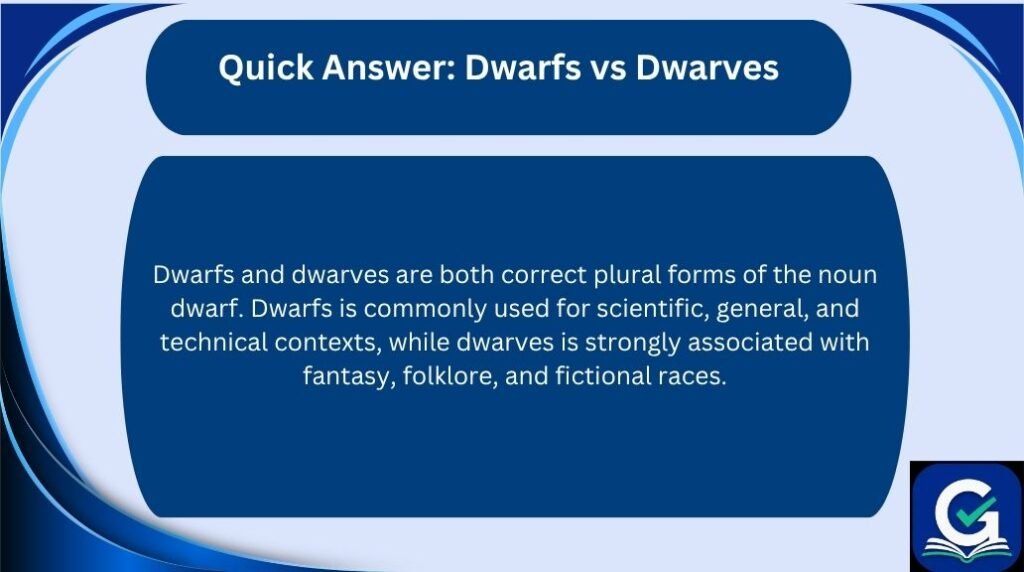
Dwarfs and dwarves are both correct plural forms of the noun dwarf. Dwarfs is commonly used for scientific, general, and technical contexts, while dwarves is strongly associated with fantasy, folklore, and fictional races.
For example:
- Astronomers study white dwarfs.
- The fantasy novel features a kingdom ruled by dwarves.
So, neither plural is automatically wrong. The best choice depends largely on context, style, and meaning.
Understanding the Basics: Dwarfs vs Dwarves
The easiest way to understand this spelling difference is to start with the singular form.
The singular noun is:
dwarf
When you are talking about more than one, you can use:
dwarfs
dwarves
Both forms are recognized in modern English.
The important difference is not simply grammar. Usage and context influence which plural sounds more natural to readers.
Basic Comparison Table
| Form | Type | Meaning | Example | Correct/Incorrect |
|---|---|---|---|---|
| dwarf | Singular noun | One dwarf | The dwarf entered the cave. | Correct |
| dwarfs | Plural noun | More than one dwarf | Several dwarfs appeared in the story. | Correct |
| dwarves | Plural noun | More than one dwarf | The dwarves protected the kingdom. | Correct |
| dwarfs | Verb | Makes something seem smaller | The tower dwarfs the nearby buildings. | Correct |
| dwarves | Verb | Incorrect verb form in standard usage | The tower dwarves the nearby buildings. | Incorrect |
This table reveals an important point: dwarfs can be both a plural noun and a verb, while dwarves is normally used as a plural noun.
For example:
The astronomers discovered several white dwarfs.
Here, dwarfs is a plural noun.
But:
The skyscraper dwarfs the surrounding buildings.
Here, dwarfs is a verb.
That distinction is useful because writers sometimes assume that dwarves can replace dwarfs in every grammatical situation. It cannot.
Correct Meanings and Uses
What Does “Dwarfs” Mean?
Dwarfs is the plural form of dwarf and is widely used in general English.
It can refer to multiple:
- Plants or animals that are unusually small
- Astronomical objects
- Legendary beings
- People, when the terminology is appropriate and respectful
- Other things described using the noun dwarf
Examples include:
- The garden contains several dwarfs of different plant varieties.
- Scientists studied several white dwarfs.
- The story included three dwarfs.
- The researchers compared different types of dwarfs.
The form is also commonly used as a verb.
For example:
The new stadium dwarfs the old one.
In this sentence, dwarfs means that the stadium makes the old one appear small by comparison.
Another example:
The company’s latest project dwarfs its previous projects.
Again, dwarfs is a verb.
What Does “Dwarves” Mean?
Dwarves is also a plural form of dwarf. It is especially familiar in fantasy and folklore.
Readers commonly encounter dwarves when reading about fictional races, magical kingdoms, mythical creatures, or fantasy adventures.
Examples include:
- The dwarves lived beneath the mountain.
- The hero traveled with a group of dwarves.
- The dwarves guarded the underground kingdom.
- The wizard asked the dwarves for help.
Because fantasy literature has popularized this spelling, many readers immediately associate dwarves with fictional or legendary beings.
That does not mean dwarves is exclusively a fantasy word. It remains a recognized plural of dwarf. Context simply makes it particularly natural in fantasy writing.
Why Are There Two Plural Forms?
English does not always use one perfectly consistent system for words ending in -f.
Some nouns change -f to -ves:
- leaf → leaves
- wolf → wolves
- knife → knives
- wife → wives
Other nouns simply add -s:
- roof → roofs
- belief → beliefs
- chief → chiefs
- proof → proofs
The word dwarf has developed both forms:
dwarf → dwarfs
and:
dwarf → dwarves
This is one reason the spelling can feel confusing. Writers may expect every noun ending in -f to follow the wolf → wolves pattern.
English does not work that neatly.
The history of the word also matters. Dwarf is an old English word with Germanic roots, and both plural patterns have existed in English usage. Over time, dwarves became especially familiar in fantasy and folklore, while dwarfs remained common in broader and scientific contexts.
When Should You Use “Dwarfs”?
Use dwarfs when the context is scientific, technical, general, or when the standard terminology of a field favors that form.
Astronomy
One of the clearest examples is astronomy.
Astronomers commonly use phrases such as:
- white dwarfs
- red dwarfs
- brown dwarfs
For example:
Scientists observed several white dwarfs through the telescope.
Here, dwarfs is the conventional plural in astronomical terminology.
Another example:
Brown dwarfs are objects that are larger than planets but do not have enough mass to sustain ordinary hydrogen fusion like stars.
In scientific writing, following established terminology is more important than choosing the form that sounds most familiar in fantasy.
Plants and Animals
The word dwarf is also used to describe plants and animals that are smaller than typical members of their type.
Examples:
The nursery sells several varieties of dwarf fruit trees.
When referring to multiple plants:
The nursery sells several types of dwarfs.
You may also encounter phrases in which dwarf functions as an adjective:
dwarf citrus trees
dwarf apple varieties
In such cases, the adjective does not become dwarves.
General Writing
Dwarfs can also be appropriate when the word is being used in a general or traditional sense.
For example:
The museum displayed paintings of mythological dwarfs.
This sentence is grammatically acceptable.
However, if the writing specifically presents a fictional fantasy race, dwarves may feel more natural to many readers.
When Should You Use “Dwarves”?
Use dwarves when you are writing about a fictional or legendary group, especially in fantasy literature.
Fantasy Stories
Fantasy is the most recognizable environment for dwarves.
For example:
The dwarves forged powerful weapons beneath the mountain.
The word immediately signals a fantasy setting.
Another example:
The prince formed an alliance with the dwarves before the final battle.
Again, the context clearly involves a fictional race.
Folklore
The spelling dwarves can also work naturally when discussing legendary creatures.
For example:
Traditional stories often portray dwarves as skilled miners and craftsmen.
Here, the word refers to legendary beings rather than scientific objects.
Creative Writing
If you are creating your own fantasy world, you can choose dwarves to create a familiar fantasy atmosphere.
For example:
The dwarves gathered beneath the ancient fortress.
This sounds natural because modern readers have become accustomed to seeing dwarves in fantasy contexts.
Dwarfs vs Dwarves in Fantasy Writing
Fantasy writing is probably where the difference between these forms becomes most noticeable.
Consider these two sentences:
The dwarfs gathered around the fire.
The dwarves gathered around the fire.
Both can be understood, and both are based on accepted plural forms. However, the second sentence may feel more natural to many modern readers because dwarves has a strong association with fantasy characters.
Now consider a different sentence:
Astronomers observed several dwarves.
This sounds unusual if the subject is stars or other astronomical objects.
A better choice is:
Astronomers observed several dwarfs.
The context determines the natural form.
A Simple Fantasy Example
Imagine that you are writing this:
The dwarves lived in a vast underground city.
The word dwarves helps readers understand that these are fictional beings.
If you write:
The dwarfs lived in a vast underground city.
The sentence is still understandable, but some readers may find dwarves more stylistically appropriate.
This is not a strict grammatical rule. It is a usage preference shaped by literary tradition.
Dwarfs vs Dwarves in Scientific Writing
Scientific writing requires a different approach.
In astronomy, terms such as white dwarf, red dwarf, and brown dwarf are established technical expressions.
Therefore, when pluralizing them, writers normally use dwarfs.
Examples:
The telescope detected several white dwarfs.
Researchers studied the temperatures of brown dwarfs.
Red dwarfs are common types of stars.
Using dwarves in these sentences may distract readers because it conflicts with the familiar scientific terminology.
This provides a useful memory trick:
Science → dwarfs
Fantasy → dwarves
This is not an absolute rule, but it works well as a practical writing guide.
Dwarfs as a Verb
One of the most important grammar points in dwarfs vs dwarves is that dwarfs can also function as a verb.
The verb dwarf means to make something seem smaller or less important by comparison.
Examples:
The new skyscraper dwarfs the older buildings.
Her latest achievement dwarfs everything she accomplished before.
The new budget dwarfs last year’s spending.
In each sentence, dwarfs is a verb.
Do not change the verb to dwarves.
Incorrect:
The new skyscraper dwarves the older buildings.
Correct:
The new skyscraper dwarfs the older buildings.
This distinction is especially important because a writer may see dwarves as an accepted plural and assume it can replace dwarfs everywhere.
It cannot.
Grammar Rules: Why Both Forms Are Correct
The most important grammar rule is simple:
Dwarfs and dwarves are both accepted plural nouns for dwarf.
Major dictionaries recognize both forms. Merriam-Webster lists dwarfs as the plural and dwarves as an alternative plural. Oxford also records both forms.
Therefore, it would be inaccurate to say that dwarves is always correct and dwarfs is always wrong.
Likewise, it would be inaccurate to claim that dwarfs is the only acceptable plural.
The difference is mainly one of usage and context.
The Practical Rule
Use:
- dwarf for one
- dwarfs for multiple subjects in general or scientific contexts
- dwarves for multiple fantasy or folklore characters
- dwarfs as the third-person singular form of the verb dwarf
Examples:
One dwarf entered the cave.
Three dwarfs appeared in the historical illustration.
Three dwarves guarded the fantasy kingdom.
The mountain dwarfs the nearby hills.
This gives you a reliable framework without forcing English into an overly rigid rule.
Test Tip: How to Choose the Right Form
When you are unsure, ask yourself one question:
What am I talking about?
If you are talking about astronomy, plants, animals, or general technical usage, dwarfs is usually the better choice.
If you are talking about a fantasy race or legendary characters, dwarves is often the more natural choice.
If the word is being used as a verb, choose dwarfs.
Quick Test
Try these:
1. The telescope detected five white _____.
Answer: dwarfs
2. The _____ defended the magical kingdom.
Answer: dwarves
3. The new tower _____ the old buildings.
Answer: dwarfs
If you can identify the context, choosing the correct form becomes much easier.
Case Study: Dwarfs vs Dwarves in Real-Life Writing
Imagine that an employee is writing an email to a science team.
They write:
Hi team,
I reviewed the latest data on white dwarves and added the results to the report.
The sentence is understandable, but if the document is using standard astronomical terminology, white dwarfs would be the more conventional choice.
A revised sentence would be:
Hi team,
I reviewed the latest data on white dwarfs and added the results to the report.
Now imagine a different situation.
A novelist sends an editor this sentence:
The dwarfs marched toward the enchanted castle.
The editor may suggest:
The dwarves marched toward the enchanted castle.
Why?
Not because dwarfs is grammatically wrong, but because dwarves fits the established fantasy style more naturally.
This example demonstrates an important principle:
Correct grammar does not always mean that every possible form is equally appropriate for every context.
Good writing considers grammar, meaning, audience, and established usage together.
Common Mistakes With Dwarfs vs Dwarves
The confusion around these words usually comes from several predictable mistakes.
Mistake 1: Thinking “Dwarves” Is the Only Correct Form
Many people learn the word through fantasy books and movies.
As a result, they may believe:
dwarf → dwarves
is the only possible plural.
That is not true.
Dwarfs is also an accepted plural.
Mistake 2: Thinking “Dwarfs” Is Always Wrong
The opposite mistake is equally common.
A writer may assume that the -f → -ves pattern must always apply.
But English has exceptions and alternative plural forms.
Scientific terminology provides a clear example:
white dwarfs
Mistake 3: Using “Dwarves” as a Verb
This is a genuine grammar mistake.
Incorrect:
The new building dwarves the old building.
Correct:
The new building dwarfs the old building.
Here, dwarfs is a verb.
Mistake 4: Using “Dwarf” for Multiple People or Things
Incorrect:
Five dwarf lived in the forest.
Correct:
Five dwarfs lived in the forest.
Or, in a fantasy context:
Five dwarves lived in the forest.
The singular and plural forms must agree with the number being discussed.
Mistake 5: Letting Autocorrect Decide
Autocorrect can sometimes encourage mistakes because it may suggest the form you have used previously.
If you write fantasy content frequently, your device may make dwarves feel more familiar.
If you write science articles, you may naturally choose dwarfs.
Always check the context instead of blindly accepting an automatic suggestion.
Why Do These Mistakes Happen?
Fast Typing
When people type quickly, they often choose the first familiar spelling that comes to mind.
Because dwarves is visually distinctive, it may be selected automatically.
Autocorrect
Autocorrect and predictive text can reinforce familiar spellings without understanding the context of the sentence.
Lack of Knowledge
Some writers simply do not know that both forms are accepted.
Once you understand that both plural forms exist, the confusion becomes much easier to manage.
Fantasy Influence
Popular fantasy literature has made dwarves extremely familiar.
That strong association can cause writers to use the form even when writing about astronomy or technical subjects.
Similar Grammar Confusions
The dwarfs vs dwarves issue is part of a much larger pattern in English where similar-looking forms cause confusion.
| Confusion | Correct Usage | Common Mistake |
|---|---|---|
| it’s vs its | It’s cold. / The dog lost its toy. | Using it’s for possession |
| your vs you’re | Your book is here. / You’re late. | Mixing possession and contraction |
| their vs they’re | Their house is large. / They’re ready. | Treating them as interchangeable |
| affect vs effect | The news affected me. / The effect was strong. | Swapping the two |
| then vs than | First this, then that. / Taller than me. | Using then for comparison |
| there vs their | There it is. / Their car is new. | Mixing location and possession |
| dwarfs vs dwarves | Both can be plural nouns | Assuming only one is correct |
The lesson is clear: English often requires you to consider context, not just spelling.
Usage in Different Contexts
Everyday Conversation
In casual conversation, both forms may be understood easily.
For example:
Did you see the dwarves in that fantasy movie?
Or:
I read about white dwarfs in a science magazine.
Most listeners will understand the intended meaning from context.
Professional Writing
Professional writing requires greater precision.
If you are writing a scientific report, use established technical terminology:
white dwarfs
If you are writing about a fantasy novel, dwarves may be more stylistically appropriate.
Professional writers should prioritize consistency.
Creative Writing
Creative writers have more flexibility.
If your story contains a fictional race, dwarves will usually feel familiar to readers.
For example:
The dwarves gathered in the royal hall.
However, an author can choose dwarfs if that spelling is part of a deliberate stylistic choice or fictional world-building system.
Social Media and Texting
Informal writing is flexible.
A social media post might say:
These fantasy dwarves are my favorite characters! 🧙♂️
A science-focused post might say:
White dwarfs are fascinating objects in astronomy. 🌌
In short messages, context usually makes the intended meaning obvious.
Why It Matters
At first glance, dwarfs vs dwarves may seem like a tiny spelling issue. However, choosing the appropriate form can improve the accuracy and professionalism of your writing.
Clarity in Communication
The right word helps readers understand your subject immediately.
When you write white dwarfs, readers familiar with astronomy know that you mean a specific class of stellar objects.
When you write dwarves in a fantasy story, readers can quickly recognize the fictional context.
Professionalism
Small language choices can affect how polished your writing appears.
A scientific article that repeatedly uses unusual terminology may seem less precise, even if the reader understands the meaning.
Accuracy in Digital Communication
Online writing moves quickly. Blog posts, emails, social media updates, and AI-generated content can spread small language mistakes rapidly.
Checking a word before publishing takes only a few seconds.
A Useful Reminder
Good writing is not only about being understood; it is also about choosing words that fit the context.
That principle applies to dwarfs vs dwarves and countless other English word choices.
Special Exception: Fantasy and Literary Usage
One interesting edge case is the strong connection between dwarves and fantasy literature.
The spelling existed before modern fantasy became popular, but influential fantasy writing helped make dwarves strongly associated with fictional dwarf characters.
This means that readers may perceive the two forms differently even when both are grammatically acceptable.
For example:
The white dwarfs were studied by astronomers.
feels scientific.
Meanwhile:
The dwarves forged weapons beneath the mountain.
feels fantastical.
The spelling itself helps establish the atmosphere.
What About Famous Fantasy Characters?
When discussing a specific fictional universe, always follow that work’s established terminology.
If a fantasy franchise consistently uses a particular spelling, changing it can make your writing look inconsistent.
This is especially important for proper names, fictional races, and official terminology.
A Note About Respectful Language
The word dwarf can refer to a person of short stature, but terminology surrounding people with dwarfism requires care.
Modern usage guides often recommend person-first or community-preferred terminology, such as person with dwarfism, little person, or person of short stature, depending on the individual and context.
Therefore, when writing about real people, avoid treating terminology as merely a grammar exercise. Respectful language matters.
For example:
The organization advocates for people with dwarfism.
is more considerate in many contexts than casually using dwarfs to label people.
When referring to fictional creatures, folklore, astronomy, plants, or animals, the terminology works differently.
Dwarfs vs Dwarves: A Simple Memory Trick
If you want a quick way to remember the difference, use this:
Dwarfs = science and general usage 🔬
Think:
- white dwarfs
- red dwarfs
- brown dwarfs
- dwarf plants
- general references
Dwarves = fantasy and folklore 🧙
Think:
- fantasy dwarves
- underground kingdoms
- magical dwarves
- fictional races
- legendary characters
Dwarfs = verb
Think:
The skyscraper dwarfs the houses.
This three-part trick will solve most usage questions.
Quick Recap Checklist
| Question | If Yes → Use |
|---|---|
| Are you talking about one? | dwarf |
| Are you discussing astronomy? | dwarfs |
| Are you describing scientific objects? | dwarfs |
| Are you writing about a fantasy race? | dwarves |
| Are you discussing folklore? | dwarves often feels natural |
| Is the word being used as a verb? | dwarfs |
| Are you following a specific fictional universe? | Follow its established spelling |
| Are you talking about real people with dwarfism? | Use respectful, preferred terminology |
Practice Example 1
Scientists discovered several new white _____.
Answer: dwarfs
Why? The sentence is about astronomy.
Practice Example 2
The _____ marched through the enchanted forest.
Answer: dwarves
Why? The sentence clearly describes a fantasy setting.
Practice Example 3
The new stadium _____ the small local field.
Answer: dwarfs
Why? Here, dwarfs is a verb meaning “makes something seem small by comparison.”
FAQs
1. Is “dwarfs” or “dwarves” correct?
Both dwarfs and dwarves are correct plural forms of dwarf. The choice depends on context and style. Dwarfs is common in scientific and general usage, while dwarves is especially common in fantasy and folklore.
2. What is the plural of dwarf?
The plural can be dwarfs or dwarves. Both forms are recognized in major English dictionaries.
3. Should I use “dwarfs” in astronomy?
Yes. Dwarfs is the standard and widely established form in astronomical terms such as white dwarfs, red dwarfs, and brown dwarfs.
4. Why is “dwarves” common in fantasy?
Dwarves has become strongly associated with fictional and legendary beings through fantasy literature and popular culture. As a result, many readers expect this spelling when reading about fantasy races.
5. Is “dwarves” a verb?
No. In standard modern usage, dwarves functions as a plural noun. The third-person singular form of the verb dwarf is dwarfs.
For example:
The mountain dwarfs the nearby hills.
6. Is “dwarfs” wrong in fantasy writing?
No. Dwarfs is still a recognized plural of dwarf. However, dwarves may sound more natural to many readers when referring to a fictional fantasy race.
Conclusion
The difference between dwarfs vs dwarves is easier to understand once you know that both forms are legitimate plural nouns. The singular form is dwarf, while the plural can be dwarfs or dwarves.
For practical writing, remember the context. Dwarfs is especially common in scientific, astronomical, technical, and general usage. You will often see phrases such as white dwarfs and brown dwarfs. Dwarves, on the other hand, is strongly associated with fantasy, folklore, and fictional races, so it is a natural choice when describing magical or legendary characters.
There is also one important grammar distinction: dwarfs can function as a verb, while dwarves should not replace it. For example, “The skyscraper dwarfs the old buildings” is correct.
The easiest rule is simple: science usually favors dwarfs, fantasy often favors dwarves, and the verb is always dwarfs. When in doubt, look at the context rather than assuming one spelling is universally correct.
Once you understand that difference, this confusing pair becomes much easier to handle. Choose the form that fits the meaning, and your writing will stay both clear and accurate.

I’m Jordan Hayes, a proofreading and editing writer at Gramfino, focused on clear and accurate English.
I enjoy finding common writing mistakes and sharing simple ways to make sentences stronger and easier to read.


[…] and everyday usage, and give you practical examples so you can choose the best form confidently. Dwarfs vs Dwarves | Savior vs Saviour | Noisy vs […]