Have you ever typed a sentence, looked at the word cringy vs cringey, and suddenly wondered which spelling looks right? You are not alone. Both forms appear frequently in texts, social media posts, blogs, conversations, and even edited publications.
The confusion exists because English often develops multiple spellings for informal words, especially when a word grows from a newer slang expression.
In this case, cringy and cringey have the same basic meaning and are pronounced the same way. The good news is that you do not have to memorize a complicated grammar rule.
Both spellings are recognized in modern English dictionaries. Merriam-Webster lists cringey as its main entry and identifies cringy as a variant, while Cambridge also lists cringey and notes cringy as another form.
So, if you have been wondering whether one is completely wrong, the answer may surprise you: both are correct. The real question is which spelling is more appropriate for your audience and writing situation. Worshiped vs Worshipped | Combating vs Combatting | En Route vs In Route
Quick Answer: Cringy vs Cringey
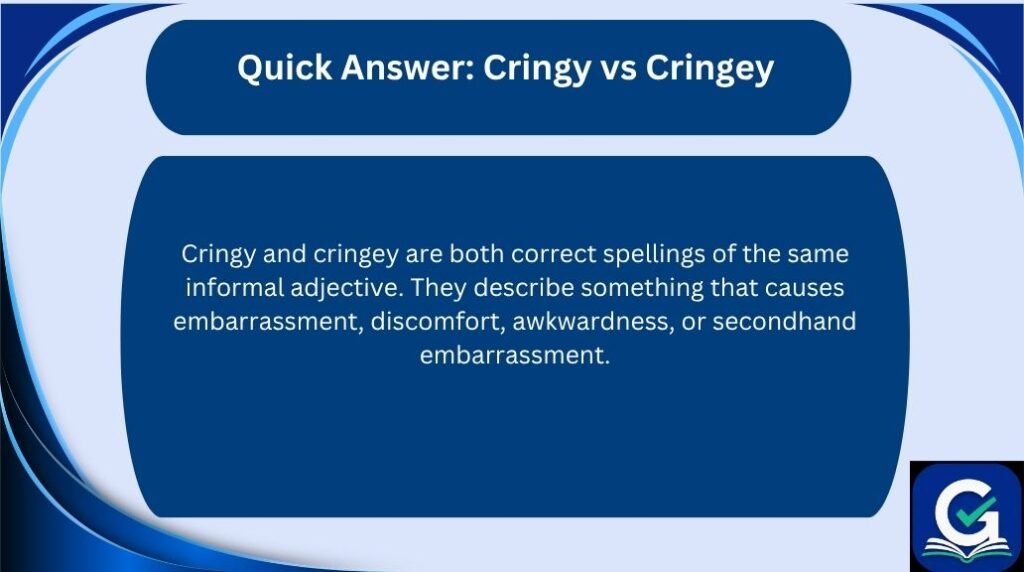
Cringy and cringey are both correct spellings of the same informal adjective. They describe something that causes embarrassment, discomfort, awkwardness, or secondhand embarrassment.
If you want the safest spelling for general or professional writing, cringey is a strong choice because major dictionaries such as Merriam-Webster use it as the primary entry and list cringy as a variant.
Example:
- “That romantic speech was incredibly cringey.”
- “That romantic speech was incredibly cringy.”
Both sentences communicate the same idea.
Understanding the Basics
The easiest way to understand cringy vs cringey is to recognize that they are spelling variants rather than two words with different meanings.
Both words are adjectives derived from the verb cringe. The verb cringe refers to reacting with embarrassment, discomfort, or awkwardness. The adjective describes something that produces that reaction or, in some contexts, someone who tends to cringe.
Merriam-Webster defines cringey as informal and explains that it can mean “tending to cause one to cringe,” essentially meaning cringeworthy. It also lists cringy as a variant.
Comparison Table
| Form | Type | Meaning | Example | Correct/Incorrect |
|---|---|---|---|---|
| cringey | Informal adjective | Causing embarrassment or discomfort | “That video was cringey.” | ✅ Correct |
| cringy | Informal adjective / variant | Causing embarrassment or discomfort | “That video was cringy.” | ✅ Correct |
| cringe | Verb/noun | To feel embarrassment or discomfort | “I cringe whenever I watch it.” | ✅ Correct |
| cringeworthy | Adjective | Extremely embarrassing or awkward | “That was a cringeworthy moment.” | ✅ Correct |
| cringie | Nonstandard spelling | Intended meaning of embarrassing | “That was cringie.” | ❌ Avoid |
| cringeyy | Misspelling | Intended meaning of embarrassing | “That was cringeyy.” | ❌ Incorrect |
The key point is simple: cringy is not a misspelling of cringey. It is a recognized variant.
What Does “Cringey” Mean?
Cringey is an informal adjective used for something that makes people feel embarrassed, uncomfortable, awkward, or uneasy.
Cambridge Dictionary defines cringey as “very embarrassing” and explicitly identifies cringy as another form.
For example:
“That old video of me singing is so cringey.”
Here is the sentence breakdown:
- That old video = subject
- of me singing = phrase describing the video
- is = linking verb
- so cringey = adjective phrase describing the video
The speaker is saying that watching the video creates a strong feeling of embarrassment.
More Examples
- “His attempt at telling a joke was cringey.”
- “That commercial feels a little cringey.”
- “I deleted the post because it sounded cringey.”
- “The romantic scene became surprisingly cringey.”
- “Her old social media posts are sometimes cringey.”
In each example, cringey describes something that produces an uncomfortable or embarrassing reaction.
What Does “Cringy” Mean?
Cringy has essentially the same meaning as cringey.
It is also an informal adjective used to describe something embarrassing, awkward, uncomfortable, or difficult to watch.
For example:
“That pickup line was really cringy.”
The meaning is the same as:
“That pickup line was really cringey.”
Cambridge Dictionary explicitly gives cringy as a form associated with cringey.
Merriam-Webster likewise lists cringy as a variant of cringey.
Examples
- “That joke was cringy.”
- “The entire conversation became cringy.”
- “His dance moves were funny but slightly cringy.”
- “I found the advertisement a little cringy.”
- “The ending was unnecessarily cringy.”
Again, there is no meaningful difference in definition.
Why Are There Two Spellings?
The answer lies partly in how English forms adjectives.
The word cringe already exists. When speakers turn it into an adjective, they may spell the ending in different ways.
One form is:
cringe + y → cringey
Another common spelling simplifies the middle letters:
coring + y → cringy
English has many examples of spelling variation, particularly with informal and newer vocabulary.
Think about words such as:
- cozy / cosy
- gray / grey
- canceled / cancelled
- traveled / travelled
Some spelling differences reflect regional conventions. Others develop because speakers naturally experiment with how newer words should be written.
In the case of cringy vs cringey, the difference does not create a difference in meaning.
Is “Cringey” More Correct Than “Cringy”?
Not exactly.
It is more accurate to say that cringey is the primary dictionary form in some major dictionaries, while cringy is recognized as a variant.
Merriam-Webster’s current entry is headed cringey and states that the variants include cringe-y and, less commonly, cringy.
Cambridge similarly presents cringey as the main entry and identifies cringy as another form.
Therefore, calling cringy completely wrong would be inaccurate.
A better rule is:
Use “cringey” when you want the dictionary headword and “cringy” when you prefer the shorter recognized variant.
For most everyday writing, either works.
Is “Cringy” a Real Word?
Yes. Cringy is a recognized English word and spelling variant.
This is important because many people assume that every word ending in -y must follow a fixed spelling pattern. Language does not always work that way.
Merriam-Webster specifically identifies cringy as a variant of cringey.
Cambridge also gives cringy as an alternative form.
So if you write:
“That was incredibly cringy.”
you have not automatically made a spelling mistake.
Is “Cringey” Better for American English?
For a US English audience, cringey is a very safe choice.
It appears as the main entry in Merriam-Webster, an important American dictionary authority. Merriam-Webster identifies the word as informal and records its first known use in 1986.
That does not make cringy incorrect in American English. It simply means that cringey is an especially straightforward choice when you want to follow the dictionary’s main entry.
For example:
Recommended:
“The presentation became awkward and cringey.”
Also acceptable:
“The presentation became awkward and cringy.”
If consistency matters in an article, choose one spelling and use it throughout.
Test Tip: How Can You Remember the Difference?
Here is an easy test.
Ask yourself:
Am I describing something embarrassing or awkward?
If yes, either cringey or cringy can work.
Try replacing the word with “embarrassing.”
For example:
“That speech was cringey.”
Replace it:
“That speech was embarrassing.”
The meaning still works.
Now try:
“That speech was cringy.”
Again:
“That speech was embarrassing.”
The meaning remains the same.
This test confirms that both spellings function as adjectives with essentially the same meaning.
Cringy vs Cringey in a Real-Life Conversation
Imagine two friends are watching an old video from high school.
Friend 1: “Why did we think those hairstyles looked good?”
Friend 2: “I know! This video is so cringey.”
Another person might say:
Friend 2: “I know! This video is so cringy.”
Neither sentence changes the meaning.
This is an excellent example of why cringy vs cringey can cause unnecessary anxiety. People sometimes think one spelling must be grammatically wrong simply because the two forms look different.
In reality, the dictionaries recognize both.
A Workplace Case Study
Imagine an employee is preparing an internal presentation about an outdated advertising campaign.
They write:
“Some of the campaign’s slogans now seem cringy.”
A colleague edits the sentence to:
“Some of the campaign’s slogans now seem cringey.”
Is the original sentence grammatically wrong?
No.
Both forms can function correctly as informal adjectives.
However, a professional editor may prefer cringey because it is the primary form listed by Merriam-Webster.
There is another consideration: formality.
Even though cringey is accepted, it is still informal. If the document is a formal business report, a more professional alternative might be:
“Some of the campaign’s slogans now seem outdated and embarrassing.”
That sentence communicates the idea without relying on informal slang.
The lesson
The question is not always:
“Which spelling is grammatically correct?”
Sometimes the better question is:
“Which word fits the tone of my writing?”
Grammar Rules Behind the Word
One reason this topic causes confusion is that people often expect every adjective to have one official spelling.
But dictionaries describe how English is actually used. They do not always create a single mandatory spelling for every informal expression.
Merriam-Webster lists cringey as an adjective and gives cringy as a variant. It also labels the word informal.
Cambridge Dictionary does something similar by listing cringey and identifying cringy as another form.
Therefore, the grammar rule is straightforward:
Both “cringey” and “cringy” can be used as informal adjectives meaning embarrassing, awkward, or likely to make someone cringe.
What about “cringe-y”?
Merriam-Webster also records cringe-y as a variant.
However, this hyphenated form is less common in everyday writing.
For normal use, cringey or cringy will usually be the better choice.
Common Mistakes With These Spellings
Although both words are valid, writers can still make mistakes when using them.
1. Assuming “cringy” is always wrong
This is probably the most common misunderstanding.
Because cringey looks more closely connected to cringe, some writers assume that cringy must be a typo.
It is not.
Both dictionaries mentioned above recognize cringy as a variant.
2. Treating the word as formal
Both forms are informal.
You might comfortably say:
“That TikTok was cringey.”
But in a highly formal academic paper, you may prefer:
“The video created a strong sense of embarrassment.”
The problem is not spelling. It is register.
3. Switching spellings randomly
Suppose an article says:
“The movie was cringey.”
“The characters were cringy.”
“The ending was cringey.”
“The dialogue was cringy.”
This is not grammatically wrong, but the inconsistent spelling can make the writing look less polished.
Pick one form and stay consistent.
Why Do People Make This Mistake?
Several everyday factors contribute to confusion.
Fast Typing
When people type quickly, they often write words according to sound rather than spelling.
Because cringy and cringey sound alike, either spelling may appear naturally.
Autocorrect
Autocorrect can also contribute to confusion.
A phone or browser may accept one form but flag another depending on its dictionary.
That does not necessarily mean the flagged version is incorrect.
Lack of Familiarity
The word cringey is relatively informal and became much more visible through modern internet culture.
Someone who rarely encounters the word may naturally wonder whether cringy is the correct spelling.
Sound-Based Spelling
Both forms are pronounced essentially the same way.
Cambridge gives the pronunciation /ˈkrɪn.dʒi/ for cringey.
When two spellings have the same pronunciation, writers can easily hesitate between them.
Similar Grammar and Spelling Confusions
The cringy vs cringey debate is part of a much larger pattern in English.
| Confusion | Correct Forms | Main Difference |
|---|---|---|
| its vs it’s | Both correct | Possessive vs “it is” |
| your vs you’re | Both correct | Possessive vs “you are” |
| their vs they’re | Both correct | Possessive vs “they are” |
| affect vs effect | Both correct | Different grammatical roles and meanings |
| advice vs advise | Both correct | Noun vs verb |
| then vs than | Both correct | Time/order vs comparison |
| everyday vs every day | Both correct | Adjective vs time expression |
| cringy vs cringey | Both correct | Variant spellings of the same informal adjective |
The important lesson is that spelling questions cannot always be solved by asking, “Which word is correct?”
Sometimes both forms are correct but serve different purposes. In other cases, as with cringy and cringey, both forms have essentially the same meaning.
Usage in Everyday Conversation
In casual conversation, either form is perfectly understandable.
You might say:
“That was so cringey.”
Or:
“That was so cringy.”
Both sound natural.
Because the word is informal, it fits particularly well in conversations about:
- awkward situations
- embarrassing memories
- movies and TV shows
- social media posts
- dating experiences
- jokes
- public speeches
- old photographs
- uncomfortable conversations
For example:
“Watching my old school videos is painfully cringey.”
Or:
“Watching my old school videos is painfully cringy.”
Both communicate the same idea.
Usage in Professional Writing
Professional writing requires a little more caution.
The spelling itself is not the biggest issue. Register is.
If you are writing a casual workplace message, cringey can be perfectly reasonable:
“That slogan sounds a little cringey.”
But in a formal report, consider a more precise alternative:
“That slogan may appear outdated or embarrassing to modern audiences.”
This is especially useful in:
- academic writing
- legal writing
- business reports
- official correspondence
- technical documentation
- formal presentations
The word cringey is not grammatically defective. It is simply informal.
Usage in Creative Writing
Creative writing gives you much more flexibility.
A novelist might write:
“He looked at the old photograph and immediately felt cringey.”
A more natural version might be:
“He looked at the old photograph and immediately cringed.”
This demonstrates an important point.
Sometimes cringey is useful because you want to describe the quality of something:
“It was a cringey photograph.”
But when describing a person’s reaction, the verb may be more natural:
“She cringed at the photograph.”
Compare
Adjective:
“The speech was cringey.”
Verb:
“I cringed during the speech.”
These are related but grammatically different constructions.
Usage on Social Media and in Texting
Social media is probably where you will see both spellings most often.
People frequently use cringey and cringy in:
- comments
- captions
- memes
- text messages
- online reviews
- forum discussions
- casual posts
Examples include:
“This is so cringey 😂”
“Why is this video so cringy?”
“That caption was painfully cringey.”
“The secondhand embarrassment is real. So cringy!”
The informal nature of social media makes either form acceptable in most casual contexts.
Why Spelling Choice Still Matters
If both forms are correct, why should you care?
Because clarity and consistency still matter.
Clarity
Your reader should understand your meaning immediately.
Fortunately, both spellings are familiar enough that this is rarely a problem.
Professionalism
In polished writing, consistency matters.
If you choose cringey, use cringey consistently rather than alternating randomly between cringey and cringy.
Digital Communication
Online writing moves quickly, but readers still notice spelling patterns.
A consistent style can make your website, article, blog, or social media content look more carefully edited.
A Useful Principle
Correct spelling gets you understood; consistent spelling makes your writing look polished.
Is “Cringey” Formal English?
No. Cringey is informal English.
Merriam-Webster labels the word “informal.”
That means it is suitable for many ordinary conversations and casual forms of writing but may not be the best choice for highly formal communication.
Instead of:
“The results were kind of cringey.”
a formal report could say:
“The results were somewhat embarrassing.”
Or:
“The presentation created an uncomfortable impression.”
Choosing vocabulary based on audience is an important part of effective writing.
Special Exception: “Cringe” as a Noun or Verb
There is an important distinction between cringe and cringey/cringy.
Cringe as a Verb
“I cringe whenever I hear that recording.”
Here, cringe describes an action or reaction.
Cringe as a Noun
“The entire interview was pure cringe.”
Here, cringe functions as a noun in informal English.
Cringey as an Adjective
“The interview was extremely cringey.”
Here, cringey describes the interview.
Cringy as an Adjective
“The interview was extremely cringy.”
Again, the meaning is essentially identical.
Knowing the grammatical role of the word can help you choose the right form of the sentence.
Can You Say “More Cringey” or “More Cringy”?
Yes.
Both adjectives can be used in comparative constructions.
For example:
“The second episode was more cringey than the first.”
Or:
“The second episode was more cringy than the first.”
You can also use most:
“That was the most cringey moment of the entire movie.”
And:
“That was the most cringy moment of the entire movie.”
However, in everyday speech, people may also use forms such as cringier and cringiest.
For example:
“That was even cringier.”
The exact comparative style may vary with speaker preference, but the basic adjective remains the same.
Cringy vs Cringey: Which One Should You Use?
If you want a simple recommendation, use cringey.
Why?
Because:
- Merriam-Webster uses cringey as the main entry.
- Cambridge uses cringey as the main entry.
- Both dictionaries recognize cringy as a variant.
- Cringey clearly connects visually to cringe.
- It is a safe choice when writing for a broad audience.
But remember:
Cringy is not wrong.
If you naturally prefer cringy, you can use it in appropriate informal contexts.
Quick Recap Checklist
Use this checklist whenever you are unsure about cringy vs cringey.
| Question | If Yes → Use |
|---|---|
| Do you mean embarrassing or awkward? | Cringey / cringy |
| Are you writing casually? | Either |
| Do you want the main dictionary form? | Cringey |
| Are you writing for a US audience? | Cringey is a safe choice |
| Are you using an informal adjective? | Either |
| Are you writing a highly formal document? | Consider embarrassing or awkward instead |
| Are you trying to stay consistent? | Choose one spelling and stick with it |
Practice Example 1
Incorrect assumption:
“Cringy is always misspelled.”
Better understanding:
“Cringy is a recognized variant of cringey.”
Practice Example 2
“That speech was extremely cringey.”
✅ Correct
Practice Example 3
“That speech was extremely cringy.”
✅ Also correct
FAQs
1. Is “cringy” or “cringey” correct?
Both are correct. Cringey is the main dictionary form in Merriam-Webster and Cambridge, while cringy is recognized as a variant.
2. Is “cringy” a misspelling?
No. Cringy is not automatically a misspelling. Major dictionaries recognize it as a variant of cringey.
3. What does “cringey” mean?
Cringey means very embarrassing, awkward, uncomfortable, or likely to make someone cringe. It is an informal adjective.
4. Which spelling is better for professional writing?
If you must use the word, cringey is a safe choice because it is the primary dictionary entry in Merriam-Webster. However, because the word is informal, a more formal alternative such as embarrassing, awkward, or uncomfortable may be better in professional documents.
5. Do “cringy” and “cringey” sound the same?
Yes. They are normally pronounced the same way. Cambridge gives cringey the pronunciation /ˈkrɪn.dʒi/.
6. Can I use “cringy” in American English?
Yes. Cringy is an accepted variant in American English. Merriam-Webster lists it as a variant of cringey.
Conclusion
When it comes to cringy vs cringey, there is no need to worry that you are choosing between a correct word and an incorrect one. Both spellings are recognized English forms with essentially the same meaning.
They describe something embarrassing, awkward, uncomfortable, or likely to make someone cringe. Merriam-Webster lists cringey as the primary entry and cringy as a variant, while Cambridge also recognizes both forms.
If you want the safest general choice, especially for polished US English content, cringey is an excellent option. If you prefer the shorter cringy, you can use it confidently in informal writing.
The biggest rule to remember is simple: both are correct, but consistency matters. Choose the spelling that fits your audience, maintain that spelling throughout your writing, and remember that formal contexts may call for a more precise word such as embarrassing or awkward.
When in doubt, remember: cringey is the standard-looking choice, cringy is the accepted variant, and neither one needs an apology. 😄

I’m Clara Bennett, a vocabulary and language specialist at Gramfino, where I write about word meanings and proper usage.
I love helping readers choose the right words and build stronger English vocabulary with confidence.
[…] caption, understanding this distinction can help you communicate more accurately and confidently. Cringy vs Cringey | Worshiped vs Worshipped | Combating vs […]
[…] In this guide, I’ll explain the difference between cozy vs cosy, show you how to use both forms correctly, and give you simple examples so you never have to second-guess this spelling again. 🇺🇸🇬🇧 Peak vs Peek | Color vs Colour | Cringy vs Cringey […]