If you have ever stopped while writing a sentence and wondered whether to say “I swam” or “I have swum,” you are not alone. The difference between swam vs swum is a common grammar question because both words come from the same verb: swim. They describe the same basic action, but they do not work in the same grammatical situations.
The key is understanding verb forms and knowing when English requires a simple past verb versus a past participle. Once you learn this small but important distinction, choosing between swam and swum becomes much easier.
In this guide, I will explain the difference with simple rules, examples, tables, practical situations, common mistakes, and easy memory tricks. If you are a student, professional writer, English learner, or someone who simply wants to improve everyday communication, this guide will help you use swam vs swum correctly and confidently. Imminent vs Eminent | Censored vs Sensored | Sheath vs Sheathe
Quick Answer: Swam vs Swum
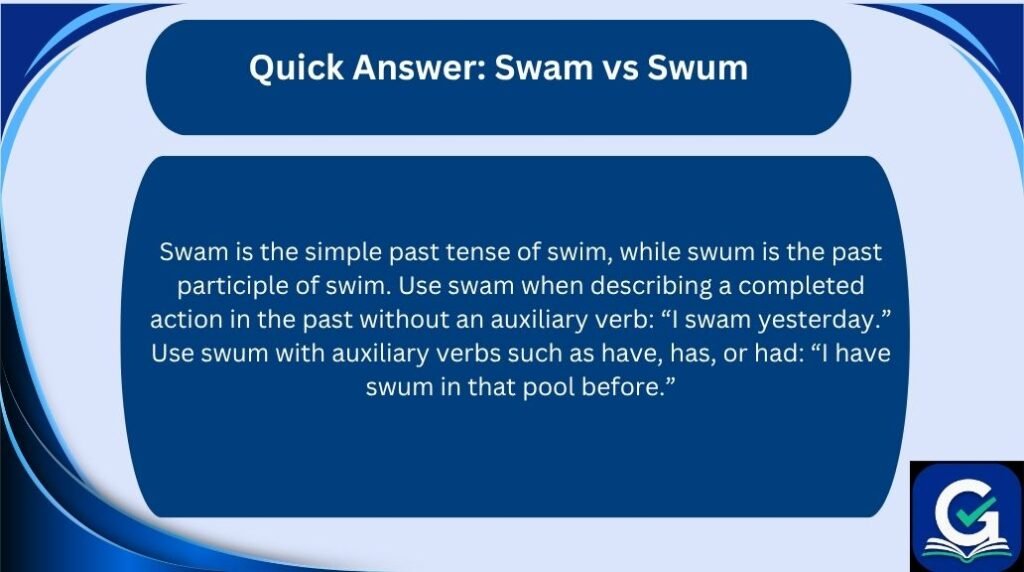
Swam is the simple past tense of swim, while swum is the past participle of swim. Use swam when describing a completed action in the past without an auxiliary verb: “I swam yesterday.” Use swum with auxiliary verbs such as have, has, or had: “I have swum in that pool before.”
The easiest rule is:
- I swam → simple past
- I have swum → present perfect
- I had swum → past perfect
- I will have swum → future perfect
So, swam and swum are both correct words, but they have different grammatical jobs.
Understanding the Basics of Swam vs Swum
The verb swim is an irregular verb. Unlike regular verbs such as walk → walked, it changes its form rather than simply adding -ed.
The three principal forms are:
| Form | Type | Meaning | Example | Correct/Incorrect |
|---|---|---|---|---|
| swim | Base form | To move through water | I swim every morning. | ✅ Correct |
| swam | Simple past | Swam at a specific time in the past | I swam yesterday. | ✅ Correct |
| swum | Past participle | Used with helping verbs | I have swum here before. | ✅ Correct |
| swimming | Present participle | Ongoing action or gerund | She is swimming now. | ✅ Correct |
Cambridge Dictionary identifies swam as the past simple form of swim and swum as the past participle.
The basic pattern
Think of the verb like this:
Swim → Swam → Swum
For example:
- Present: I swim every Saturday.
- Past: I swam last Saturday.
- Perfect: I have swum every Saturday this month.
The important difference is not the meaning of the action. The difference is how the verb functions in the sentence.
What Does Swam Mean?
Swam is the simple past form of swim. It tells us that the swimming happened at a completed time in the past.
Examples of swam
- I swam yesterday.
- She swam across the lake last summer.
- We swam for two hours.
- They swam at the community pool on Saturday.
- He swam five laps before breakfast.
In each example, the action happened in the past.
Sentence breakdown
Consider:
I swam three miles yesterday.
Here:
- I = subject
- swam = simple past verb
- three miles = distance
- yesterday = past-time marker
Because the sentence identifies a completed past event, swam is the appropriate form.
When should you use swam?
Use swam when:
- The action happened in the past.
- You are using the simple past tense.
- You are not using have, has, or had as a helping verb.
For example:
Maria swam in the ocean last weekend.
The phrase last weekend points to a completed past time, so swam works naturally.
What Does Swum Mean?
Swum is the past participle of swim. It normally needs a helping verb such as have, has, or had.
Examples include:
- I have swum in that lake.
- She has swum across the river.
- We had swum for an hour before the storm arrived.
- They have never swum in the ocean.
- He had swum five laps before the coach arrived.
Cambridge Dictionary specifically identifies swum as the past participle of swim.
Why can’t you usually use swum by itself?
A common mistake is writing:
I swum yesterday. ❌
Standard English requires:
I swam yesterday. ✅
Or:
I have swum before. ✅
The reason is simple: swum is a past participle, not the simple past form.
A past participle usually works together with an auxiliary or helping verb.
Common structures with swum
Have + swum
I have swum in the Atlantic Ocean.
Has + swum
She has swum competitively for years.
Had + swum
He had swum two miles before he became tired.
Could have + swum
We could have swum farther if the water had been warmer.
The Main Difference Between Swam and Swum
The easiest way to understand swam vs swum is to focus on the tense.
Swam = simple past
Use swam for a completed past action.
I swam yesterday.
Swum = past participle
Use swum after a suitable helping verb.
I have swum today.
Compare these sentences:
I swam in the pool yesterday.
I have swum in the pool many times.
The first sentence focuses on a completed event in the past. The second connects past experience to the present.
Swam vs Swum in Different Verb Tenses
Understanding the tense makes this distinction much easier.
Simple Present
Use swim.
I swim every morning.
She swims at the local pool.
Simple Past
Use swam.
I swam yesterday.
She swam last weekend.
Present Perfect
Use have/has + swum.
I have swum in that pool before.
She has swum across the lake.
Past Perfect
Use had + swum.
I had swum for an hour before lunch.
They had swum across the river before the boat arrived.
Future Perfect
Use will have + swum.
By noon, I will have swum three miles.
This pattern shows why simply memorizing the words is not enough. You need to understand the tense structure around them.
Correct Meanings and Uses
Using Swam for a Finished Past Event
Use swam when the action occurred at a definite or understood point in the past.
Examples:
I swam at the gym yesterday.
Sarah swam in the lake last July.
We swam after school.
The action is complete, and the sentence uses simple past tense.
Using Swum for Past Experience
The present perfect often uses swum to describe experiences without focusing on one specific completed time.
I have swum in the Pacific Ocean.
This means the experience has happened at some point before now.
Compare:
I swam in the Pacific Ocean in 2024.
This identifies a specific past time.
But:
I have swum in the Pacific Ocean.
This talks about life experience without naming a specific time.
Using Swum With Past Perfect
Use had swum when one past action happened before another past action.
We had swum for thirty minutes before it started raining.
There are two past events:
- We swam for thirty minutes.
- It started raining.
The swimming happened first, so had swum is appropriate.
Using Swum With Modal Perfect Structures
You may also see swum after structures such as:
- could have
- should have
- would have
- might have
- must have
Examples:
She could have swum farther.
He might have swum across the lake.
They should have swum with a coach.
In these structures, have + past participle is required, so swum is correct.
Test Tip: How to Choose Between Swam and Swum
Here is a quick test.
Step 1: Look for a helping verb
If you see:
- have
- has
- had
- could have
- would have
- should have
- might have
you will generally need swum.
Example:
I have ___ before.
Answer: swum
Step 2: If there is no helping verb, ask whether the action happened in the past
If yes, use swam.
I ___ yesterday.
Answer: swam
Easy memory trick
Remember:
SWAM stands alone. SWUM needs help.
This is not an absolute statement about every possible construction, but it is an excellent practical shortcut for everyday English.
Case Study: A Real-Life Conversation
Imagine two coworkers discussing a weekend trip.
Alex: How was your vacation?
Jordan: It was great. I swam in the ocean almost every day.
Alex: Nice! Have you ever swum in a lake?
Jordan: Yes, I have swum in several lakes.
Notice how the two forms work differently.
Jordan says:
I swam in the ocean almost every day.
This describes completed activities during a past vacation.
Alex asks:
Have you ever swum in a lake?
The word have requires the past participle swum.
Jordan replies:
I have swum in several lakes.
Again, have + swum forms the present perfect.
Workplace example
Imagine an employee writing a report:
During the team retreat, several employees swam in the hotel pool.
That is correct because the report describes a completed event.
But:
Several employees have swum in the pool during previous retreats.
That is also correct because have + swum describes experience over time.
Grammar Rules Explained
The confusion between swam vs swum exists because English has many irregular verbs with different past and participle forms.
For example:
- go → went → gone
- eat → ate → eaten
- write → wrote → written
- sing → sang → sung
- swim → swam → swum
The simple past and past participle are separate grammatical forms.
Cambridge Dictionary lists the forms of swim as swimming, swam, swum, identifying swam as the past tense and swum as the past participle.
Why “I swum yesterday” is incorrect
The sentence:
I swum yesterday. ❌
uses a past participle where the simple past is required.
The correct sentence is:
I swam yesterday. ✅
Why “I have swam” is incorrect
The sentence:
I have swam before. ❌
uses the simple past form after have.
The correct version is:
I have swum before. ✅
The pattern is:
have/has/had + past participle
Therefore:
have + swum
not:
have + swam
Swam vs Swum: More Examples
| Incorrect | Correct | Why? |
|---|---|---|
| I swum yesterday. | I swam yesterday. | Simple past requires swam. |
| I have swam before. | I have swum before. | Have requires the past participle. |
| She had swam already. | She had swum already. | Had requires the past participle. |
| They swam every day last week. | They swam every day last week. | Simple past is correct. |
| We have swum there before. | We have swum there before. | Present perfect is correct. |
| He swum across the pool. | He swam across the pool. | No auxiliary verb is present. |
Common Mistakes With Swam and Swum
Why do people confuse these two forms?
There are several common reasons.
1. Fast typing
When people type quickly, they often choose the form that sounds familiar without thinking about the sentence structure.
For example:
I have swam there before.
The writer may know that swam is a past form but forget that have requires the past participle.
2. Autocorrect
Autocorrect and grammar-checking software can sometimes miss contextual mistakes, particularly when both words are valid English words.
Since swam and swum are both legitimate words, a basic spell checker may not always flag the wrong one.
3. Lack of grammar knowledge
English learners may memorize:
swim → swam → swum
without learning when each form should be used.
Memorizing the forms is useful, but understanding their grammatical roles is more powerful.
4. Pronunciation confusion
The words also sound different:
- swam /swæm/
- swum /swʌm/
However, in fast speech, learners may not always notice the difference clearly.
Similar Grammar Confusions
The swam vs swum problem is part of a larger group of English grammar mistakes involving words that sound or look similar.
| Confusion | Correct Difference | Example |
|---|---|---|
| it’s vs its | It’s = it is; its = possessive | It’s cold. / The dog wagged its tail. |
| your vs you’re | Your = possession; you’re = you are | Your book is here. / You’re ready. |
| their vs they’re | Their = possession; they’re = they are | Their car is new. / They’re outside. |
| there vs their | There = place; their = possession | Put it there. / Their house is nearby. |
| then vs than | Then = time; than = comparison | We ate then. / She is taller than me. |
| lay vs lie | Different verb structures | Lay the book down. / Lie down. |
| affect vs effect | Usually verb vs noun | It affected me. / The effect was strong. |
| swam vs swum | Simple past vs past participle | I swam. / I have swum. |
The solution is the same in many cases: learn the grammatical role instead of relying only on how a word sounds.
Usage in Different Contexts
Everyday Conversation
In casual conversation, both forms appear frequently.
Examples:
I swam this morning.
Have you ever swum in the ocean?
We swam at the beach yesterday.
I’ve never swum in a river.
These sentences sound natural because each form matches the tense.
Professional Writing
Correct grammar becomes particularly important in professional communication.
Consider:
Our team swam in the hotel pool after the conference.
This is appropriate when describing a specific past event.
But:
Our team has swum together during several company retreats.
Here, has swum describes repeated experience.
Using the correct form makes reports, emails, presentations, and other professional documents more polished.
Creative Writing
Writers can use both forms depending on the narrative structure.
She swam toward the shore as the sun disappeared.
This simple past sentence moves the story forward.
A reflective passage might say:
She had swum those waters many times before.
The past perfect establishes an earlier experience within a past narrative.
Social Media and Texting
Informal communication often contains grammatical shortcuts, but standard forms are still useful.
Instead of:
I have swam here before lol
write:
I have swum here before! 😄
Or:
I swam here yesterday! 🏊
The context determines the correct form, even in casual writing.
Why Swam vs Swum Matters
You might wonder whether this tiny grammatical distinction really matters.
It does.
1. Clarity in Communication
Correct verb forms make your meaning easier to understand.
Compare:
I swam there before.
and:
I have swum there before.
Both can communicate past experience, but the second specifically uses the present perfect structure and connects the experience to the present.
2. Professionalism
Grammar errors can affect how polished your writing appears.
In an email, application, report, or academic assignment, writing:
I have swam there before.
can make the sentence look careless.
Writing:
I have swum there before.
shows control of standard English grammar.
3. Accuracy in Digital Communication
People communicate constantly through emails, messages, social posts, forms, and online content.
Because short messages often provide little context, accurate grammar can help prevent misunderstandings.
4. Better English Confidence
Once you understand why swam and swum are different, you can apply the same principle to other irregular verbs.
A useful reminder is:
“Grammar works best when you understand the pattern, not just the word.”
Special Exception: Is “Swum” Ever Used Without Have, Has, or Had?
There is an important nuance here.
For everyday learning, it is helpful to remember:
Swum usually appears with a helping verb.
However, English grammar can be more flexible in certain constructions.
For example:
The distance swum by the athletes was impressive.
Here, swum is part of a reduced participial construction modifying distance.
Another example is:
She was the first person to have swum across the channel.
The word swum is still functioning as a past participle.
You may also encounter passive constructions such as:
The final lap was swum in record time.
This is grammatically possible because swim can be used transitively in certain contexts, especially when the object is a distance, race, or portion of a competition.
These examples do not change the basic rule. They simply show that real English contains more structures than the basic have + swum pattern.
A Simple Way to Remember the Difference
Use this three-step memory method.
Remember the three forms
Swim → Swam → Swum
Associate each form with a question
Swim: What happens regularly?
I swim every morning.
Swam: What happened in the past?
I swam yesterday.
Swum: What has happened before now?
I have swum before.
Remember the helping verb
When you see:
have + ___
think:
swum
When you see:
yesterday + ___
think:
swam
For example:
I swam yesterday.
I have swum before.
This simple contrast solves many common mistakes.
Swam vs Swum Practice Examples
Try choosing the correct word before looking at the answers.
Example 1
I ___ in the pool yesterday.
Answer: swam
I swam in the pool yesterday.
The sentence uses simple past tense.
Example 2
I have ___ in that pool before.
Answer: swum
I have swum in that pool before.
The word have requires the past participle.
Example 3
She ___ across the lake last summer.
Answer: swam
She swam across the lake last summer.
The sentence describes a completed past event.
Example 4
She has ___ across the lake three times.
Answer: swum
She has swum across the lake three times.
The structure is has + past participle.
Example 5
They had ___ for an hour before lunch.
Answer: swum
They had swum for an hour before lunch.
The structure is had + past participle.
Quick Recap Checklist
Use this checklist whenever you are unsure.
| Question | If Yes → Use |
|---|---|
| Did the action happen at a specific time in the past? | swam |
| Is the sentence simple past? | swam |
| Does the sentence contain “have”? | swum |
| Does the sentence contain “has”? | swum |
| Does the sentence contain “had”? | swum |
| Does it use “could have,” “would have,” or “should have”? | swum |
| Are you describing past experience without a specific time? | Usually have/has + swum |
Three quick practice questions
- Yesterday, I ___ five laps.
- I have never ___ in the ocean.
- She had ___ for thirty minutes before the coach arrived.
Answers
- swam
- swum
- swum
FAQs
1. Is “swam” or “swum” correct?
Both are correct, but they have different grammatical functions. Swam is the simple past form of swim, while swum is the past participle.
Examples:
I swam yesterday.
I have swum before.
2. Is “I swam” correct?
Yes. I swam is grammatically correct when you are using the simple past tense.
Example:
I swam in the lake yesterday.
Cambridge Dictionary identifies swam as the past simple form of swim.
3. Is “I have swum” correct?
Yes. I have swum is correct because swum is the past participle used with have.
Example:
I have swum in the ocean several times.
4. Is “I have swam” correct?
No, not in standard English. The correct form is:
I have swum.
The structure have + past participle requires swum, not swam.
5. Is “I swum yesterday” correct?
No. The correct sentence is:
I swam yesterday.
Because yesterday indicates a completed past event and there is no helping verb, the simple past form swam is required.
6. What is the easiest way to remember swam vs swum?
Remember:
Swim = present
Swam = simple past
Swum = past participle
A useful shortcut is:
I swam. I have swum.
If you can remember those two sentences, you can usually choose the correct form.
Conclusion
The difference between swam vs swum is simple once you understand the role each word plays. Swam is the simple past form of swim, so you use it for completed actions in the past: “I swam yesterday.” Swum is the past participle, so it usually appears with helping verbs such as have, has, or had: “I have swum before.”
Cambridge Dictionary confirms this distinction by listing swam as the past simple form and swum as the past participle of swim.
The best memory trick is straightforward: swam can stand as the past-tense verb, while swum usually needs a helping verb. Once this pattern becomes familiar, you will be able to use both forms naturally in conversations, emails, schoolwork, professional writing, and everyday communication.
When in doubt, remember the sequence: swim → swam → swum. Master the pattern, and this common grammar confusion will quickly become a thing of the past.

I’m Mason Reed, a grammar researcher at Gramfino, where I explore grammar rules and common English mistakes.
I turn my research into clear explanations and practical examples that readers can easily follow.
[…] emails, essays, articles, workplace communication, social media posts, and everyday conversations. Swam vs Swum | Imminent vs Eminent | Censored vs […]