Have you ever written a sentence and suddenly stopped because you could not decide between imminent vs eminent? These two words are easy to mix up because they look almost identical and sound very similar.
However, they have completely different meanings and are used in different situations. If you say that a storm is “eminent” when you mean it is coming soon, or describe a respected professor as “imminent,” your sentence will not communicate the meaning you intended. I know this distinction can feel confusing at first, especially when you are writing quickly, but the basic rule is surprisingly simple.
Imminent means something is about to happen very soon, while eminent means someone or something is distinguished, prominent, or highly respected.
Once you connect each word with its main meaning, choosing the correct one becomes much easier. Censored vs Sensored | Sheath vs Sheathe | Complaint vs Complain
Quick Answer: Imminent vs Eminent
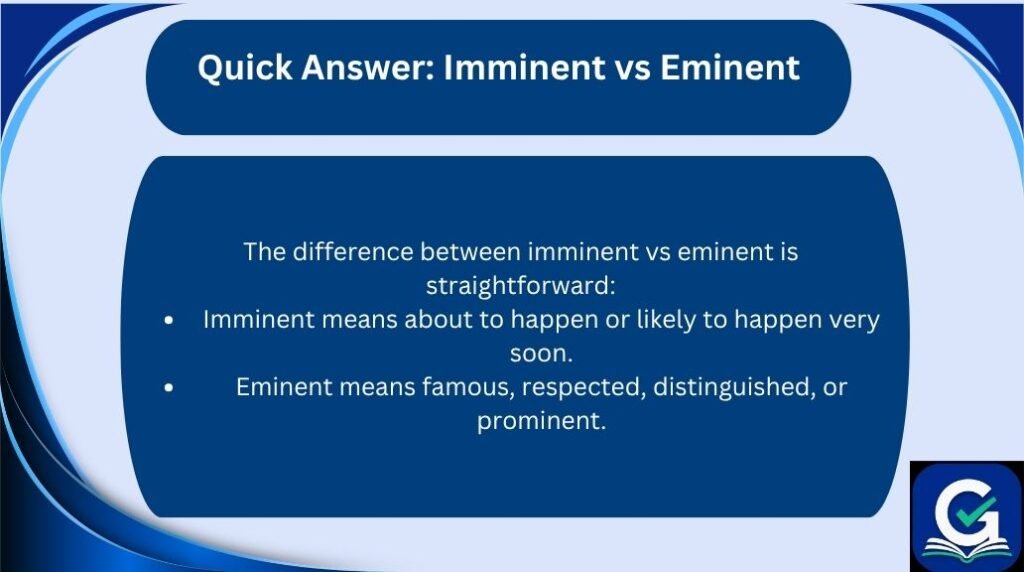
The difference between imminent vs eminent is straightforward:
- Imminent means about to happen or likely to happen very soon.
- Eminent means famous, respected, distinguished, or prominent.
For example:
A severe storm is imminent.
The storm is expected to happen soon.
She is an eminent scientist.
She is highly respected or distinguished in her field.
Easy Memory Trick
Think:
Imminent = Immediate
Eminent = Exceptional
If something is coming soon, use imminent. If someone stands out because of reputation, achievement, or importance, use eminent.
Understanding the Basic Difference
The best way to understand imminent vs eminent is to focus on the type of idea each word expresses.
Imminent is primarily connected with time. It tells us that something is approaching and expected to happen soon.
Eminent is primarily connected with status or distinction. It tells us that a person or thing stands out because of importance, reputation, achievement, or position.
Consider these two sentences:
The company’s closure is imminent.
The closure is expected soon.
The company’s eminent founder spoke at the event.
The founder is distinguished or highly respected.
The words may look similar, but they answer different questions.
- Imminent: When will it happen?
- Eminent: Why is this person or thing notable?
Comparison Table
| Form | Type | Meaning | Example | Correct/Incorrect |
|---|---|---|---|---|
| imminent | Adjective | About to happen soon | The storm is imminent. | ✅ Correct |
| eminent | Adjective | Distinguished or respected | She is an eminent professor. | ✅ Correct |
| imminent | Adjective | Describes an approaching event | An imminent deadline is approaching. | ✅ Correct |
| eminent | Adjective | Describes something happening soon | The meeting is eminent. | ❌ Incorrect |
| imminent | Adjective | Describes a distinguished person | He is an imminent scientist. | ❌ Incorrect |
| eminent | Adjective | Describes a notable person | He is an eminent scientist. | ✅ Correct |
The simplest rule is:
Imminent describes what is coming. Eminent describes what stands out.
What Does Imminent Mean?
Imminent is an adjective meaning that something is about to happen or is expected very soon.
It is commonly used with events, situations, changes, dangers, arrivals, departures, and decisions.
Common expressions include:
- imminent danger
- imminent arrival
- imminent departure
- imminent storm
- imminent change
- imminent decision
- imminent deadline
- imminent threat
- imminent collapse
- imminent announcement
For example:
The arrival of the guests is imminent.
This means the guests are expected to arrive very soon.
Another example:
The company warned workers that layoffs were imminent.
This means the layoffs were expected to happen soon.
The important point is that imminent describes the timing of something.
Examples of Imminent in Sentences
Example 1: Weather
The meteorologist said that severe weather was imminent.
Here, imminent means the severe weather was expected very soon.
Example 2: A Deadline
Our deadline is imminent, so we need to finish the project today.
The deadline is close in time.
Example 3: An Arrival
The train’s arrival is imminent.
The train is expected to arrive soon.
Example 4: A Change
The company announced that a major policy change was imminent.
The change is expected to happen soon.
Example 5: Danger
The hikers were evacuated because the danger was imminent.
The danger was close and likely to occur soon.
Notice that imminent does not mean “important.” It means close in time.
What Does Eminent Mean?
Eminent is an adjective that means distinguished, prominent, famous, respected, or notable.
It is often used to describe people who have achieved a high level of recognition in their profession or field.
Common combinations include:
- eminent scientist
- eminent scholar
- eminent professor
- eminent physician
- eminent historian
- eminent author
- eminent lawyer
- eminent artist
- eminent leader
- eminent researcher
For example:
The university invited an eminent historian to speak.
The historian is respected and distinguished.
Another example:
She became an eminent physician after decades of research and service.
The word eminent describes her professional reputation.
Examples of Eminent in Sentences
Example 1: A Scientist
An eminent scientist delivered the keynote speech.
The scientist is highly respected in the field.
Example 2: A Professor
The university honored an eminent professor.
The professor is distinguished because of achievement or reputation.
Example 3: An Author
The conference attracted several eminent authors.
The authors are prominent and respected.
Example 4: A Historian
An eminent historian wrote the introduction to the book.
The historian is recognized as an authority in the field.
Example 5: A Physician
The patient was referred to an eminent physician.
The physician is highly respected or notable.
In each example, eminent describes status, reputation, or distinction rather than timing.
Imminent Does Not Mean Important
One common reason people make mistakes with imminent vs eminent is that imminent often appears in serious situations.
For example:
The country faces imminent danger.
Because the danger is serious, someone might mistakenly assume that imminent means “serious” or “important.”
It does not.
The sentence means the danger is likely to happen soon.
Compare:
The danger is imminent.
This means the danger is approaching.
The danger is significant.
This means the danger is important or serious.
The danger is eminent.
This is incorrect in standard usage.
The meaning of imminent is about timing, not importance.
Eminent Does Not Mean Upcoming
The opposite mistake is using eminent for an event that is approaching.
For example:
❌ The meeting is eminent.
If you mean the meeting is about to happen, this sentence is incorrect.
The correct version is:
✅ The meeting is imminent.
However, you can use eminent to describe a person participating in that meeting:
An eminent professor will speak at the meeting.
Here, the two words can appear in the same context:
- imminent meeting = meeting happening soon
- eminent professor = distinguished professor
This is an excellent example of why understanding meaning is more useful than simply memorizing spelling.
A Simple Memory Trick
If you frequently confuse these words, use this easy trick.
Imminent = Immediate
Both words begin with im.
Think:
Imminent → Immediate → Soon
Examples:
- imminent storm
- imminent arrival
- imminent deadline
- imminent decision
Eminent = Exceptional
Think:
Eminent → Exceptional → Distinguished
Examples:
- eminent scientist
- eminent professor
- eminent scholar
- eminent author
This is not a formal grammar rule, but it is a practical memory device.
Test Tip: Ask Yourself One Question
When you are unsure about imminent vs eminent, ask:
Am I talking about something happening soon, or someone/something that is distinguished?
If the answer is happening soon, use:
imminent
If the answer is distinguished or prominent, use:
eminent
Quick Test
The baby’s arrival is _____.
The answer is imminent because the arrival is expected soon.
The doctor is an _____ specialist.
The answer is eminent because the doctor is highly respected.
This test works in most everyday situations.
Real-Life Case Study: A Workplace Email
Imagine that a manager is preparing an email for employees.
Incorrect Sentence
An eminent announcement about the company’s restructuring will be made tomorrow.
The manager probably means that the announcement is coming soon. Therefore, eminent is the wrong choice.
Correct Sentence
An imminent announcement about the company’s restructuring will be made tomorrow.
Now the meaning is clear: the announcement is about to happen.
But consider this sentence:
An eminent business leader will address employees during the announcement.
This sentence is correct.
Why?
Because eminent describes the business leader as distinguished or prominent.
The Lesson
The same workplace situation can require both words:
The announcement is imminent.
An eminent leader will speak.
One word describes timing. The other describes status.
Grammar Rules for Correct Usage
Both imminent and eminent are adjectives.
They can appear before nouns or after linking verbs.
Imminent Before a Noun
An imminent storm could affect travel.
Here, imminent modifies storm.
Imminent After a Linking Verb
The storm is imminent.
Here, imminent describes the condition of the storm.
Eminent Before a Noun
An eminent researcher joined the project.
Here, eminent modifies researcher.
Eminent After a Linking Verb
The researcher is eminent in her field.
Here, eminent describes the researcher’s professional status.
Standard dictionaries such as Merriam-Webster distinguish the words based on these different meanings. Imminent refers to something ready to happen or approaching soon, while eminent refers to something or someone prominent, distinguished, or notable.
Why the Words Are So Easy to Confuse
The confusion between imminent vs eminent is understandable.
They Look Similar
Compare:
imminent
eminent
Only one letter separates them.
They Sound Similar
Their pronunciation is also very close.
That makes them particularly easy to confuse during conversation.
Their Histories Are Related
The similarity also has a historical explanation. Both words developed from related Latin roots, although their modern meanings became distinct.
Merriam-Webster’s usage discussion explains the differences among imminent, eminent, and the related word immanent.
Fast Typing
When people type quickly, they often choose the familiar-looking word without stopping to check its meaning.
Autocorrect
Autocorrect may not catch this mistake because both words are correctly spelled.
For example:
The storm is eminent.
There is no spelling error. The problem is word choice.
Lack of Knowledge
Some writers simply have not learned the distinction.
That is easy to fix once you remember the central rule.
Common Mistakes With Imminent and Eminent
Here are some common incorrect sentences and their corrections.
| Incorrect | Correct | Explanation |
|---|---|---|
| The storm is eminent. | The storm is imminent. | The storm is coming soon. |
| She is an imminent scientist. | She is an eminent scientist. | She is distinguished. |
| The deadline is eminent. | The deadline is imminent. | The deadline is approaching. |
| He is an imminent scholar. | He is an eminent scholar. | He is highly respected. |
| Their arrival is eminent. | Their arrival is imminent. | Their arrival is expected soon. |
| An imminent professor gave the lecture. | An eminent professor gave the lecture. | The professor is distinguished. |
The best correction strategy is to ask what the adjective is actually describing.
Similar Grammar Confusions
English has many pairs of words that look or sound similar but have different meanings.
| Word Pair | Meaning |
|---|---|
| its / it’s | its = belonging to it; it’s = it is |
| your / you’re | your = belonging to you; you’re = you are |
| their / they’re | their = belonging to them; they’re = they are |
| affect / effect | affect is usually a verb; effect is usually a noun |
| principal / principle | principal = main/person; principle = rule or belief |
| compliment / complement | compliment = praise; complement = something that completes |
| stationary / stationery | stationary = not moving; stationery = writing materials |
| imminent / eminent | imminent = happening soon; eminent = distinguished |
Learning these pairs improves both accuracy and confidence.
Imminent vs Eminent in Everyday Conversation
In everyday conversation, imminent usually appears when people discuss something that is coming soon.
Examples:
The bus is imminent.
The storm looks imminent.
The baby’s arrival is imminent.
The announcement is imminent.
The word eminent is more formal and often appears when talking about respected professionals.
Examples:
She is an eminent scientist.
He is an eminent professor.
An eminent author attended the ceremony.
In casual conversation, people may choose simpler alternatives such as:
- famous
- respected
- well-known
- distinguished
- coming soon
- approaching
Professional and Business Writing
Precise word choice is especially important in professional communication.
Consider:
The company expects an imminent change in its leadership structure.
This means the change is expected soon.
Now compare:
The company hired an eminent leadership consultant.
This means the consultant is distinguished or highly respected.
Using the wrong word can make an otherwise professional document look careless.
This distinction matters in:
- business emails
- reports
- presentations
- proposals
- press releases
- academic writing
- legal documents
- professional websites
Clear writing builds trust because readers can immediately understand what you mean.
Academic Writing
The word eminent is particularly useful in academic contexts.
You may encounter phrases such as:
eminent scholar
eminent researcher
eminent historian
eminent professor
For example:
The conference brought together eminent researchers from several universities.
The researchers are described as eminent because of their accomplishments and reputation.
On the other hand:
The researchers warned that an imminent shortage could affect the industry.
Here, imminent refers to an upcoming event.
Academic writers should pay close attention to this distinction because formal writing depends heavily on precise vocabulary.
Creative Writing
Both words can be effective in creative writing.
Using Imminent for Suspense
Thunder rolled across the valley as the villagers realized that disaster was imminent.
The word creates a sense of urgency because something bad is about to happen.
Using Eminent for Character Description
The eminent professor entered the crowded auditorium to enthusiastic applause.
Here, eminent establishes the person’s importance and reputation.
Therefore:
imminent can create anticipation.
eminent can establish prestige.
Social Media and Text Messages
Digital communication often happens quickly, so mistakes between similar words are common.
You might see:
The concert is imminent! 🎶
This means the concert is happening soon.
Or:
An eminent musician is performing tonight! 🎤
This means the musician is highly respected or famous.
In casual posts, using simpler wording is also perfectly acceptable:
The concert is coming soon!
A famous musician is performing tonight!
However, if you choose imminent or eminent, make sure you are using the correct one.
Why Correct Word Choice Matters
Clarity
The correct word tells readers exactly what you mean.
Compare:
An eminent deadline
and:
An imminent deadline
The second sentence clearly tells readers that the deadline is approaching.
Professionalism
Correct vocabulary makes your writing appear polished and reliable.
A grammar mistake involving a single word may seem small, but repeated word-choice errors can affect how readers judge the overall quality of your writing.
Digital Communication
Online readers often scan content quickly. Clear vocabulary helps them understand your message without having to stop and interpret it.
This is especially important for:
- websites
- blogs
- emails
- social media
- online education
- business communication
- AI-generated and AI-assisted content
The right word makes your meaning easier to understand at a glance.
A Third Word to Know: Immanent
There is another word that looks very similar to both imminent and eminent:
immanent
Although it is less common in everyday English, it is useful to understand the distinction.
Immanent generally means existing within something or inherent in it. It often appears in philosophical, theological, or academic writing.
For example:
The philosopher believed that certain qualities were immanent in human nature.
This does not mean the qualities are about to happen.
So you can remember all three:
| Word | Main Meaning | Example |
|---|---|---|
| imminent | About to happen | Danger is imminent. |
| eminent | Distinguished or prominent | She is an eminent scholar. |
| immanent | Existing within; inherent | The quality is immanent in the system. |
Merriam-Webster identifies these words as related but distinct terms that are commonly confused.
Special Exception: Eminent Domain
One important fixed phrase is eminent domain.
The correct expression is:
eminent domain
Not:
❌ imminent domain
In US legal terminology, eminent domain refers to the government’s authority to take private property for public use under applicable law, generally with compensation.
For example:
The city used eminent domain to acquire the land for the public project.
This is a standard legal expression, so it is worth remembering exactly as written.
The important point is that eminent does not only describe famous people. It also appears in established expressions such as eminent domain.
Quick Recap Checklist
Use this checklist whenever you are uncertain about imminent vs eminent.
| Question | If Yes → Use |
|---|---|
| Is something about to happen? | imminent |
| Is an event expected very soon? | imminent |
| Is a deadline approaching? | imminent |
| Is danger coming soon? | imminent |
| Is a person highly respected? | eminent |
| Is someone distinguished in their profession? | eminent |
| Is someone prominent or notable? | eminent |
| Are you using the legal phrase “_____ domain”? | eminent |
Practice Examples
Try choosing the correct word before checking the answers.
Example 1
The arrival of the guests is ______.
Answer:
imminent
The guests are expected soon.
Example 2
The university invited an ______ professor.
Answer:
eminent
The professor is distinguished or highly respected.
Example 3
The company warned employees that layoffs were ______.
Answer:
imminent
The layoffs were expected to happen soon.
Example 4
The conference featured several ______ scientists.
Answer:
eminent
The scientists were prominent or highly respected.
Example 5
The city discussed the use of ______ domain.
Answer:
eminent
The established legal phrase is eminent domain.
Imminent vs Eminent: The Fastest Way to Decide
When you are writing and need an immediate answer, use this three-step method.
Step 1: Find the noun
Look at the word being described.
Is it:
- a storm?
- a deadline?
- an arrival?
- a decision?
- a person?
- a scientist?
- a professor?
Step 2: Identify the meaning
Ask:
Is it happening soon?
If yes, use imminent.
Ask:
Is the person or thing distinguished or prominent?
If yes, use eminent.
Step 3: Read the sentence again
For example:
The scientist is imminent.
Does that mean the scientist is about to happen? That makes no sense.
So you probably mean:
The scientist is eminent.
Now the meaning is clear.
Similarly:
The storm is eminent.
If you mean the storm is approaching, change it to:
The storm is imminent.
This simple process can prevent most mistakes.
Frequently Asked Questions
1. What is the difference between imminent and eminent?
Imminent means something is about to happen soon. Eminent means someone or something is distinguished, prominent, famous, or highly respected.
Example:
The storm is imminent.
She is an eminent scientist.
2. Is it “imminent danger” or “eminent danger”?
The correct phrase is imminent danger when you mean danger is approaching or likely to happen soon.
Example:
The hikers were warned about imminent danger.
Eminent danger would not express this meaning.
3. Is it an eminent person or an imminent person?
Use eminent person when you mean the person is distinguished, respected, or prominent.
For example:
He is an eminent physician.
Imminent describes something that is about to happen, so it normally does not describe a person’s reputation.
4. How can I remember the difference between imminent and eminent?
Use the memory trick:
Imminent = Immediate
Something imminent is coming soon.
And:
Eminent = Exceptional
Someone eminent is distinguished or outstanding.
5. Can imminent describe a positive event?
Yes. Although imminent is frequently associated with danger or negative situations, it can describe any event expected to happen soon.
Examples include:
The baby’s arrival is imminent.
Her promotion is imminent.
The product launch is imminent.
The key idea is timing, not whether the event is positive or negative.
6. What does eminent domain mean?
Eminent domain is a legal term referring to the government’s authority to take private property for public use, subject to applicable legal requirements.
The correct phrase is always eminent domain, not imminent domain.
Conclusion
Understanding imminent vs eminent is much easier when you focus on meaning instead of spelling. Imminent describes something that is about to happen or expected very soon. Eminent describes someone or something that is distinguished, prominent, notable, or highly respected.
A storm can be imminent because it is approaching. A scientist can be eminent because of outstanding achievements and professional reputation. A deadline can be imminent, while a professor can be eminent. The two words may look nearly identical, but they answer completely different questions.
The easiest memory trick is simple: imminent = immediate, while eminent = exceptional. If you remember that one distinction, you can avoid most mistakes.
So, whenever you hesitate, stop and ask yourself: Is it coming soon, or does it stand out? If it is coming soon, choose imminent. If it stands out because of distinction or reputation, choose eminent.
Remember: imminent is about what is coming; eminent is about what stands out. ✨

I’m Jordan Hayes, a proofreading and editing writer at Gramfino, focused on clear and accurate English.
I enjoy finding common writing mistakes and sharing simple ways to make sentences stronger and easier to read.
[…] everyday communication, this guide will help you use swam vs swum correctly and confidently. Imminent vs Eminent | Censored vs Sensored | Sheath vs […]
[…] articles, workplace communication, social media posts, and everyday conversations. Swam vs Swum | Imminent vs Eminent | Censored vs […]