Have you ever typed a word, looked at it on the screen, and suddenly wondered, “Wait, is that actually spelled right?” 🤔 Hoarder vs horder is one of those confusing word pairs that can make even careful writers hesitate.
The two spellings look almost identical, and because English contains many words with silent letters and unexpected spelling patterns, it is easy to assume that both forms might be acceptable.
However, there is a clear answer. Hoarder is the standard and correct spelling when you mean a person who collects, stores, or accumulates things, especially someone who keeps excessive amounts of possessions. Horder is generally a misspelling of hoarder when used with that meaning.
The confusion comes from the pronunciation. Hoarder is pronounced roughly like “HOR-der,” so the silent-looking a can be easy to forget when writing.
In this guide, we will explore hoarder vs horder, explain why the correct spelling contains hoard, show practical examples, examine common mistakes, and give you simple ways to remember the difference. Premise vs Premises | Standardized vs Standardised | Memento vs Momento
Quick Answer: Hoarder vs Horder
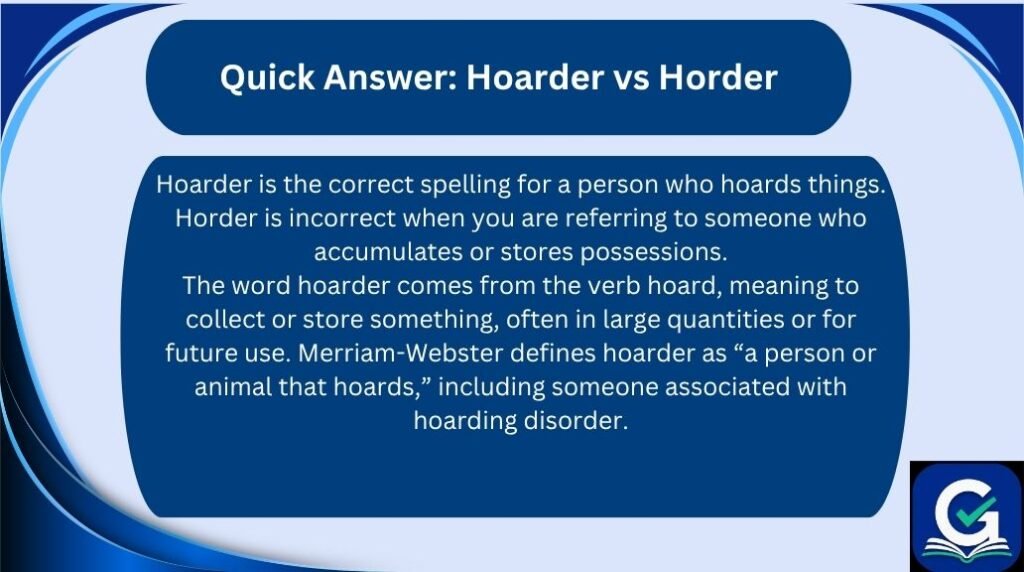
Hoarder is the correct spelling for a person who hoards things. Horder is incorrect when you are referring to someone who accumulates or stores possessions.
The word hoarder comes from the verb hoard, meaning to collect or store something, often in large quantities or for future use. Merriam-Webster defines hoarder as “a person or animal that hoards,” including someone associated with hoarding disorder.
Correct: She is a hoarder who keeps old magazines.
Incorrect: She is a horder who keeps old magazines.
The easiest rule is:
Hoard + er = hoarder.
The spelling follows the base word hoard, so the a must remain.
Understanding the Basics
The central difference between hoarder vs horder is simple: one is a standard English word for a person who hoards, while the other is normally just a spelling error.
The Basic Difference
Hoarder is a noun formed from the verb hoard plus the agentive suffix -er.
- hoard → hoarder
- teach → teacher
- work → worker
- collect → collector
A hoarder is therefore someone who hoards.
The verb hoard means to accumulate, collect, or store things, often because you want to keep them for future use or do not want to give them up. Merriam-Webster describes hoard as a verb meaning to collect and often hide away a supply of something.
By contrast, horder does not serve as the standard spelling for this meaning.
Comparison Table
| Form | Type | Meaning | Example | Correct/Incorrect |
|---|---|---|---|---|
| hoarder | Noun | A person who hoards | My uncle is a serious hoarder of books. | ✅ Correct |
| horder | Noun | Usually an incorrect spelling of hoarder | He is a horder of old boxes. | ❌ Incorrect |
| hoard | Verb/Noun | To accumulate or a stored collection | She likes to hoard supplies. | ✅ Correct |
| hoarding | Noun/Verb form | The act of accumulating or storing | Hoarding supplies can create shortages. | ✅ Correct |
| hoarded | Past-tense verb | Accumulated or stored | They hoarded food before the storm. | ✅ Correct |
So, when you are deciding between hoarder vs horder, choose hoarder.
What Does “Hoarder” Mean?
Hoarder as a Person
The most common meaning of hoarder is a person who collects or keeps a large amount of something.
For example:
My neighbor is a hoarder of old newspapers.
Here is the sentence breakdown:
- My neighbor = subject
- is = linking verb
- a hoarder = noun phrase describing the person
- of old newspapers = explains what the person hoards
The word can be used casually or in more serious contexts.
Another example:
He became a hoarder of vintage video games.
The sentence says that he accumulated a large collection of video games.
Hoarder in the Context of Hoarding Disorder
The word can also refer specifically to a person affected by hoarding disorder. Merriam-Webster includes this specialized meaning in its definition of hoarder.
However, writers should be thoughtful when using the term in sensitive situations. Simply owning many possessions does not automatically mean someone has a mental health disorder.
For example:
She collects vintage postcards.
That does not necessarily make her a hoarder in the clinical sense.
But:
The article discusses people affected by hoarding disorder.
This clearly refers to the psychological condition.
Hoarder Can Be Used More Broadly
You can also use hoarder humorously or figuratively.
For example:
I’m a hoarder of screenshots on my phone.
The speaker probably does not mean they have a disorder. They are joking about keeping far too many screenshots.
Other examples include:
- a hoarder of recipes
- a hoarder of books
- a hoarder of coupons
- a hoarder of concert tickets
- a hoarder of digital files
- a hoarder of childhood toys
The exact meaning depends on context.
What Does “Horder” Mean?
This is where the hoarder vs horder confusion becomes important.
When you intend to describe someone who accumulates things, horder is not the standard spelling. The correct word is hoarder.
For example:
❌ He is a horder who never throws anything away.
Correct it to:
✅ He is a hoarder who never throws anything away.
The mistake usually happens because the pronunciation does not make the spelling obvious. When people say hoarder, the word can sound very similar to what someone might instinctively spell as horder.
English has many spelling patterns in which letters are not strongly represented in everyday pronunciation. That is why relying entirely on sound can lead to errors.
Why “Horder” Looks Reasonable
At first glance, horder seems plausible because:
- hoarder sounds similar to horder.
- English often removes letters when words change form.
- People may not immediately connect hoarder with the base word hoard.
- Fast typing encourages phonetic spelling.
- Spell-checkers and autocorrect can sometimes fail to catch context-specific mistakes.
But the correct construction is:
hoard + er = hoarder
The a belongs to the root word and remains in the derived noun.
The Root Word Makes the Difference
One of the easiest ways to understand hoarder vs horder is to look at the word’s root.
The base word is:
hoard
From hoard, we get:
- hoard
- hoards
- hoarded
- hoarding
- hoarder
Notice that the a remains in every form.
Examples
Verb:
She likes to hoard old books.
Past tense:
He hoarded supplies during the winter.
Present participle:
They are hoarding food.
Noun:
He is a hoarder.
The spelling stays connected to the original word.
Merriam-Webster lists hoard as both a noun and a verb and identifies hoarder as a related noun.
This gives you a powerful spelling clue:
If you mean someone who hoards, spell the person hoarder.
Correct Meanings and Uses
“Hoard” as a Verb
As a verb, hoard means to collect and store something, often in large quantities.
Example:
People began to hoard bottled water before the storm.
Breakdown:
- People = subject
- began = main verb
- to hoard = infinitive
- bottled water = object
Another example:
She hoards every receipt she receives.
Here, hoards means she keeps or accumulates the receipts rather than getting rid of them.
“Hoard” as a Noun
The word hoard can also be a noun.
Example:
The archaeologists discovered a hoard of ancient coins.
In this sentence, hoard refers to a stored collection or supply.
Merriam-Webster defines the noun hoard as a supply or fund stored up and often hidden away.
“Hoarder” as a Noun
When you add -er to hoard, you get hoarder.
Example:
My brother is a hoarder of old comic books.
The noun identifies the person performing the action.
Compare:
- hoard = accumulate
- hoarder = person who accumulates
This relationship is similar to:
- run → runner
- teach → teacher
- write → writer
- paint → painter
- hoard → hoarder
A Simple Spelling Test Tip
Here is an easy Test Tip you can use whenever you are unsure.
Test Tip: Find the Base Word
Ask yourself:
“What does this person do?”
If the answer is:
They hoard things.
Then the person is a:
hoarder
This technique works because the spelling of the noun directly reflects the spelling of the verb.
Another Memory Trick
Think:
A hoarder has a hoard.
Both words contain hoar.
You can remember:
HOARD → HOARDER
Not:
HORD → HORDER
If you can remember hoard, you can remember hoarder. 🧠
Hoarder vs Horder in Real-Life Writing
Imagine you are writing an email to your coworkers.
You want to say:
Our storage room is becoming difficult to manage because several employees keep accumulating old equipment.
You might write:
We need to organize the storage room before it turns into a hoarder’s paradise.
The spelling is hoarder’s, with the possessive apostrophe.
It would be incorrect to write:
❌ horder’s paradise
The correct word remains hoarder.
Another Workplace Example
Suppose a manager writes:
John is a hoarder of outdated documents.
The word hoarder correctly describes someone who keeps excessive amounts of something.
A better professional alternative might be:
John tends to retain large numbers of outdated documents.
This version is more neutral and less judgmental.
That distinction matters in professional communication.
Case Study: A Workplace Email
Consider this fictional workplace situation.
An office is moving to a new building. During the move, employees discover boxes of old documents, broken keyboards, unused cables, and outdated equipment.
A team member sends this email:
Subject: Storage Room Cleanup
We have discovered several boxes of equipment that have not been used in years. Some of us may be accidental hoarders! Please review the items assigned to your department and let us know what should be kept, recycled, or discarded.
The word hoarders is correctly spelled.
Why?
Because it comes from the verb hoard:
hoard → hoarder → hoarders
If the writer typed horders, the spelling would be incorrect.
Why Context Matters
In a workplace email, hoarder may sound humorous among coworkers. However, in formal documentation, a neutral expression may be better.
Instead of:
The employee is a hoarder.
Consider:
The employee retains a large quantity of unused materials.
The second sentence describes the behavior without assigning a potentially sensitive label.
Grammar Rules: Why “Hoarder” Is Correct
The grammar itself is straightforward.
Hoarder is a noun formed from the verb hoard.
The suffix -er commonly creates a noun referring to someone or something that performs an action.
Examples:
- teach → teacher
- drive → driver
- farm → farmer
- sing → singer
- run → runner
- hoard → hoarder
The spelling of the base word is retained.
Merriam-Webster recognizes hoarder as a noun and defines it as a person or animal that hoards.
Likewise, Merriam-Webster defines hoard as a verb meaning to collect and often hide away a supply of something.
Therefore:
hoard + er = hoarder
There is no standard spelling rule that changes hoard into hord when forming hoarder.
Why People Spell It “Horder”
The spelling horder is understandable as a mistake, even though it is not the standard form for this meaning.
Several factors can cause the error.
1. Pronunciation
Hoarder is pronounced in a way that can make the internal a easy to overlook.
When people write words based on sound, they may produce:
horder
instead of:
hoarder
2. Fast Typing
When people type quickly, they often skip letters.
For example:
I think he’s a horder.
The writer may know the correct word but simply omit the a.
3. Autocorrect
Autocorrect is helpful, but it is not perfect. If the incorrect spelling is typed in a context where the software does not identify the error, it may remain unchanged.
4. Lack of Familiarity
Someone who has heard the word frequently but rarely seen it written may not know that it comes from hoard.
5. Phonetic Spelling
Some people naturally spell unfamiliar words according to how they sound.
That strategy works with some words but fails with many English words.
Common Mistakes Similar to “Hoarder vs Horder”
English contains countless pairs that cause similar problems.
| Confusion | Correct Form | Meaning |
|---|---|---|
| its / it’s | its / it’s | Possessive vs. “it is” |
| your / you’re | your / you’re | Possessive vs. “you are” |
| their / they’re | their / they’re | Possessive vs. “they are” |
| there / their | there / their | Place vs. possession |
| accept / except | accept / except | Receive vs. excluding |
| affect / effect | affect / effect | Influence vs. result |
| loose / lose | loose / lose | Not tight vs. misplace |
| then / than | then / than | Time/order vs. comparison |
| hoarder / horder | hoarder | Person who hoards vs. misspelling |
These errors happen for different reasons, but the underlying problem is often the same: the words look or sound similar.
Fast Typing
Digital communication has made typing speed more important than ever.
People write messages quickly and may not reread them. A missing letter can easily slip through.
Autocorrect
Autocorrect can correct obvious mistakes, but it cannot always determine what the writer intended.
Lack of Knowledge
If someone has never seen a word in print, they may rely entirely on pronunciation.
That is especially likely with uncommon vocabulary.
Hoarder vs Horder in Different Contexts
The correct spelling does not change depending on where you use the word.
However, the tone and meaning can change depending on context.
Everyday Conversation
In casual conversation, hoarder can be used playfully.
I’m such a hoarder of snacks.
This means the speaker tends to keep or accumulate snacks.
Another example:
My dad is a tool hoarder.
The speaker may simply be joking about a large collection of tools.
Professional Writing
Professional writing requires more care.
Instead of:
He’s a hoarder of files.
You might write:
He retains a large number of files.
Or:
He has accumulated a substantial archive of documents.
The word hoarder is grammatically correct, but it may not always be the most diplomatic choice.
Creative Writing
Authors can use hoarder to create a character with a particular personality.
For example:
The old librarian was a hoarder of forgotten stories, collecting every dusty manuscript she could find.
Here, hoarder has a figurative and literary flavor.
Social Media and Texting
In social media posts, informal uses are common.
I’m officially a plant hoarder. 🌱
Or:
Confession: I’m a book hoarder. 📚
These are perfectly understandable casual uses.
However:
❌ I’m a book horder.
is still a spelling mistake if the intended word is hoarder.
Hoarder vs Collector: Are They the Same?
Not necessarily.
This distinction is useful because people sometimes use hoarder and collector interchangeably.
A collector usually gathers things intentionally and organizes them around an interest.
For example:
She is a collector of rare stamps.
A hoarder may accumulate items without the same level of organization or control.
For example:
He keeps every broken appliance because he thinks he might need it someday.
The two concepts can overlap, but they are not automatically identical.
Someone can have a large collection without being a hoarder.
Compare:
Collector:
She carefully displays her antique dolls.
Hoarder:
He keeps piles of objects because he cannot bring himself to discard them.
Context is important.
Hoarder vs Hoarding
Another common point of confusion is the difference between the person and the behavior.
Hoarder
A hoarder is the person.
He is a hoarder.
Hoarding
Hoarding refers to the action or behavior.
Hoarding can create serious storage problems.
Merriam-Webster identifies hoarding as the present participle of hoard and defines the verb in terms of storing or accumulating things.
Hoard
Hoard can be the action or the collection itself.
She hoards old letters.
or:
She has a hoard of old letters.
Understanding this word family makes the spelling much easier.
Why Correct Spelling Matters
At first, hoarder vs horder might seem like a tiny spelling issue. After all, most readers can probably understand what horder means from context.
But accurate spelling still matters.
1. Clarity in Communication
Correct spelling helps readers understand your intended meaning immediately.
When readers encounter an unfamiliar or misspelled word, they may pause and wonder whether it is a different term.
2. Professionalism
Spelling mistakes can affect how your writing is perceived.
A resume, business email, article, report, or academic paper should use standard spelling whenever possible.
3. Searchability
Correct spelling matters in digital communication, too.
Search engines, databases, dictionaries, and content platforms depend heavily on recognizable word forms.
Using the standard spelling hoarder makes your writing easier to understand and discover.
4. Writing Accuracy
Small errors can weaken otherwise excellent writing.
As a simple principle:
Clear words create clear communication.
That is particularly important when you are writing for customers, employers, students, readers, or a professional audience.
A Short Quote to Remember
“When in doubt, return to the root word.”
For this word pair, the root word is hoard.
Once you remember hoard, the spelling of hoarder becomes much easier.
Special Exception: Can “Horder” Ever Appear?
There is an important distinction between a standard English word and a proper name or specialized use.
Although horder is not the standard spelling for someone who hoards, a form like Horder could theoretically appear as a surname, username, business name, character name, or other proper noun.
That does not make it the standard English noun.
For example, if Horder were someone’s surname, you would preserve the person’s chosen spelling.
But if you are writing:
A person who accumulates too many possessions is a hoarder.
the standard spelling is hoarder, not horder.
This distinction is useful because proper names do not always follow ordinary dictionary spelling conventions.
Quick Recap Checklist
Use this checklist whenever you hesitate over hoarder vs horder.
| Question | If Yes → Use |
|---|---|
| Are you describing someone who hoards things? | hoarder |
| Does the word come from the verb “hoard”? | hoarder |
| Are you describing someone who accumulates excessive possessions? | hoarder |
| Are you using a standard English noun? | hoarder |
| Are you writing “horder” because it sounds that way? | ❌ Change it to hoarder |
| Is “Horder” a specific person’s name or proper noun? | Preserve the proper-name spelling if applicable |
Practice Example 1
❌ My friend is a horder of old magazines.
✅ My friend is a hoarder of old magazines.
Practice Example 2
❌ The office has become a horder’s dream.
✅ The office has become a hoarder’s dream.
Practice Example 3
❌ He hords everything he might need later.
✅ He hoards everything he might need later.
Notice that the correct spelling remains connected to hoard.
Easy Ways to Remember “Hoarder”
If you regularly confuse these words, try one of these memory techniques.
Method 1: Remember the Root
HOARD → HOARDER
This is the most reliable method.
Method 2: Think “A Hoarder Has a Hoard”
The two words share the same spelling:
hoard
hoarder
Method 3: Think of the Word Family
Remember the entire group:
- hoard
- hoards
- hoarded
- hoarding
- hoarder
- hoarders
Seeing the words together makes the spelling pattern easier to recognize.
Method 4: Don’t Spell It Only by Sound
English spelling is not always phonetic.
If you hear hoarder, do not immediately write the word based on its pronunciation. Instead, connect it to the familiar word hoard.
Examples You Can Use Correctly
Here are additional examples showing how hoarder works naturally in sentences:
- My sister is a book hoarder.
- He became a hoarder of old computer parts.
- The documentary followed a person struggling with hoarding behavior.
- I’m a digital hoarder who saves every photo.
- The garage belongs to a serious hoarder of tools.
- She jokingly called herself a shoe hoarder.
- The character was a mysterious hoarder of forgotten objects.
- He was known as a hoarder of historical documents.
- Don’t become a hoarder of files you no longer need.
- The family discovered that the house belonged to a longtime hoarder.
In each sentence, hoarder contains the a from the base word hoard.
What About “Horder” in Search Queries?
You may encounter horder online because people frequently make spelling mistakes.
Search engines can sometimes infer what a person intended to search for and display results for hoarder.
That does not mean the spelling horder has become the standard form.
When writing content, titles, articles, emails, assignments, or professional documents, use:
hoarder
rather than:
horder
This is especially important for editors, students, bloggers, copywriters, and anyone producing searchable content.
FAQs
1. Is “hoarder” or “horder” correct?
Hoarder is the correct standard English spelling for a person who hoards or accumulates things. Horder is normally a misspelling when used with this meaning.
2. Why is “hoarder” spelled with an A?
Because it comes from the base word hoard. Adding the suffix -er produces hoarder.
The spelling is:
hoard + er = hoarder
3. Is “horder” a real English word?
Horder is not the standard spelling for someone who hoards. It may appear as a proper name or other specialized form, but when you mean a person who hoards things, use hoarder.
4. What is the difference between a hoarder and a collector?
A collector generally gathers items intentionally because of an interest and may organize or display them. A hoarder may accumulate possessions excessively and have difficulty discarding them. The terms can overlap, but they are not identical.
5. Is “hoarder” a noun or an adjective?
Hoarder is primarily a noun. It names a person or animal that hoards. For example, “He is a hoarder.” The related adjective is usually expressed with forms such as hoarding or other descriptive phrases depending on the sentence.
6. How can I remember the spelling of hoarder?
Remember the base word hoard. Then add -er:
HOARD + ER = HOARDER
A simple memory phrase is: “A hoarder has a hoard.”
Final Comparison: Hoarder vs Horder
Let’s put the entire issue into one final comparison.
| Word | Standard English? | Meaning | Example |
|---|---|---|---|
| hoard | ✅ Yes | To accumulate/store or a stored collection | She likes to hoard books. |
| hoarder | ✅ Yes | A person or animal that hoards | He is a hoarder of old tools. |
| hoarding | ✅ Yes | The act of accumulating or storing | Hoarding unnecessary items can create clutter. |
| hoarded | ✅ Yes | Past tense of hoard | They hoarded supplies. |
| horder | ❌ Usually no | Normally a misspelling of hoarder | Use hoarder instead. |
The key is not complicated. Once you recognize hoard as the root, the spelling of hoarder becomes logical.
Conclusion
When comparing hoarder vs horder, the answer is clear: hoarder is the standard and correct spelling when you mean a person who hoards or accumulates things. Horder is normally a misspelling of that word.
The easiest way to remember the difference is to start with the root word hoard. Merriam-Webster defines hoard as a verb meaning to collect or store something, while hoarder refers to a person or animal that hoards.
So remember this simple formula:
HOARD + ER = HOARDER ✅
Whether you are writing an email, article, school assignment, social media post, or professional report, choose hoarder when referring to someone who hoards. If you see horder used with that meaning, treat it as a spelling error unless it is specifically a proper name.
When spelling feels uncertain, go back to the root: hoard → hoarder. 📝

I’m Mason Reed, a grammar researcher at Gramfino, where I explore grammar rules and common English mistakes.
I turn my research into clear explanations and practical examples that readers can easily follow.


[…] in US English. By the end, you’ll know how to choose the correct form with confidence. 🇺🇸 Hoarder vs Horder | Premise vs Premises | Standardized vs […]
[…] In this guide, we’ll explain the difference between informal vs unformal, show you which form is correct, and provide clear examples to help you use the right word confidently. Optimize vs Optimise | Practices vs Practises | Hoarder vs Horder […]