Have you ever typed a sentence and suddenly wondered whether “imbalance vs inbalance” is the correct spelling? You are not alone. These two forms look almost identical, so it is easy to assume that both might be acceptable. However, standard English makes the choice much simpler: imbalance is the correct and commonly accepted word, while inbalance is generally considered a misspelling when you mean a lack of balance.
The word imbalance is used in everyday conversation, professional writing, academic work, business communication, and many other contexts. Understanding imbalance vs inbalance can help you avoid an unnecessary spelling mistake and make your writing more accurate. If you have ever hesitated before using this word, do not worry.
In this guide, we will explain the difference, show you the correct usage, explore common mistakes, and give you simple examples that make the rule easy to remember. ✍️ Roster vs Roaster | Appendixes vs Appendices | Favor vs Favour
Quick Answer: Imbalance vs Inbalance
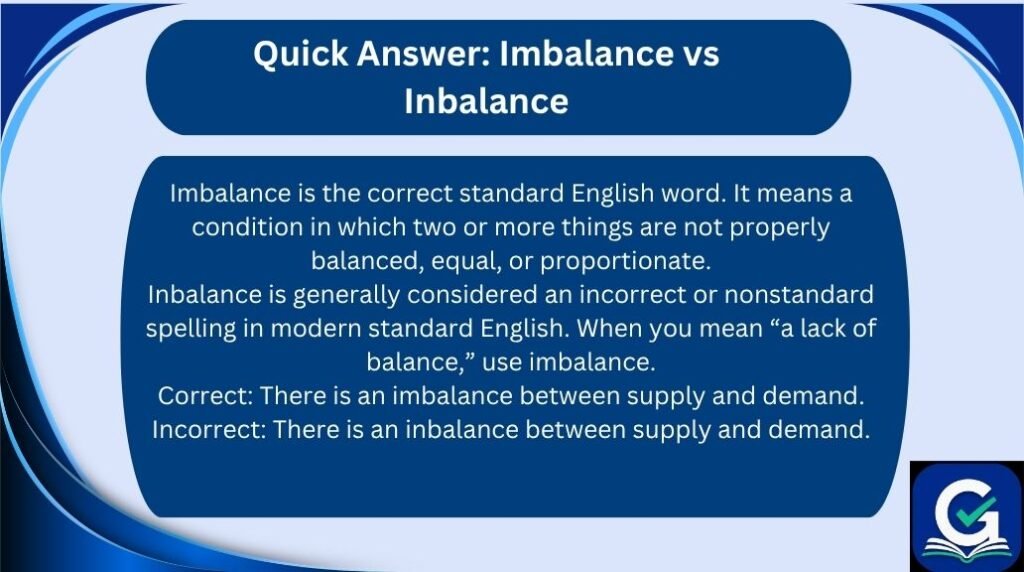
Imbalance is the correct standard English word. It means a condition in which two or more things are not properly balanced, equal, or proportionate.
Inbalance is generally considered an incorrect or nonstandard spelling in modern standard English. When you mean “a lack of balance,” use imbalance.
Correct: There is an imbalance between supply and demand.
Incorrect: There is an inbalance between supply and demand.
Merriam-Webster defines imbalance as a “lack of balance” or a state of being out of equilibrium or proportion. Cambridge likewise defines it as a situation in which things that should be equal or normally equal are not.
Understanding the Basics of Imbalance vs Inbalance
The easiest way to understand imbalance vs inbalance is to remember that imbalance is the established noun used in standard English.
The word balance means a state of stability, equality, or proper proportion. Adding the prefix im- produces imbalance, meaning a lack of balance.
Comparison Table
| Form | Type | Meaning | Example | Correct/Incorrect |
|---|---|---|---|---|
| imbalance | Noun | A lack of balance or equality | There is an imbalance in the budget. | ✅ Correct |
| inbalance | Noun | Intended to mean a lack of balance | There is an inbalance in the budget. | ❌ Nonstandard/Incorrect |
| imbalanced | Adjective | Not balanced | The system is imbalanced. | ✅ Correct |
| unbalanced | Adjective | Not balanced or properly proportioned | The account is unbalanced. | ✅ Correct |
| unbalance | Verb/Noun | To cause something to lose balance; also a noun meaning lack of balance | The sudden movement may unbalance the machine. | ✅ Correct |
The important point is that inbalance is not the standard noun spelling. If you are writing an essay, business report, academic paper, professional email, or website content, choose imbalance.
Merriam-Webster lists imbalance as a noun and gives examples involving structural, chemical, trade, and power imbalances.
What Does Imbalance Mean?
Imbalance is a noun that describes a condition where things are not balanced, equal, or properly proportioned.
It can refer to physical objects, finances, relationships, social conditions, systems, workloads, health-related situations, and many other areas.
For example:
There is an imbalance between work and family life.
This means the two areas are not receiving an appropriate or equal amount of attention.
Another example is:
The company is dealing with a serious imbalance between expenses and revenue.
Here, expenses and revenue are not in a healthy or expected relationship.
Simple Definition
You can remember imbalance this way:
Imbalance = lack of balance.
Cambridge Dictionary describes it as a situation where two things that should be equal, or are normally equal, are not.
How to Use Imbalance Correctly
The noun imbalance can appear in many grammatical structures.
1. Imbalance Between Two Things
One of the most common patterns is:
imbalance between A and B
For example:
There is an imbalance between supply and demand.
The sentence says that supply and demand are not properly matched.
Another example:
The report identifies an imbalance between spending and savings.
Here, the word between connects the two things being compared.
2. Imbalance in Something
You can also use:
imbalance in + noun
For example:
The company discovered an imbalance in its financial records.
The imbalance exists within the financial records.
Another example:
The engineer noticed an imbalance in the machine.
The machine is not operating with the expected balance.
3. An Imbalance of Something
Another possible construction is:
an imbalance of + noun
For example:
The policy created an imbalance of power.
This means power was distributed unevenly.
The phrase power imbalance is also very common.
The negotiation revealed a significant power imbalance.
Merriam-Webster specifically gives examples involving structural imbalance, trade imbalance, and power imbalance.
Why Is Imbalance Correct but Inbalance Incorrect?
This is the central question behind imbalance vs inbalance.
English prefixes do not always behave exactly as learners expect. Although in- is a common English prefix, the established word formed from balance is imbalance, not inbalance.
The spelling imbalance reflects the form of the negative prefix im-, which commonly appears before certain consonant sounds. Similar examples include:
- impossible
- imperfect
- immature
- impatient
- imbalance
The spelling is therefore not simply a matter of attaching in- to balance.
Think of It as a Vocabulary Pattern
Instead of trying to build the word from scratch, remember the established form:
im + balance = imbalance
That makes the spelling easier to recall.
You do not need to invent the word every time you write it. Treat imbalance as a fixed vocabulary item.
Is Inbalance Ever Correct?
In ordinary modern standard English, inbalance should not be used as the spelling of the noun meaning “lack of balance.”
If you see inbalance online, it may be:
- A spelling mistake
- A typing error
- A learner’s version of the word
- An informal or nonstandard usage
- A transcription error
That does not make it the preferred spelling for professional English.
For polished writing, use imbalance.
What About Unbalance?
There is an important distinction here.
Unbalance is a legitimate English word. Merriam-Webster lists it as both a verb and a noun. As a verb, it means “to put out of balance.”
For example:
The heavy load could unbalance the truck.
Here, unbalance is a verb.
But if you want the noun meaning “a lack of balance,” imbalance is the natural standard choice:
The truck has an imbalance in its load.
This distinction is useful because people sometimes assume that if unbalance exists, inbalance should exist too. English does not work that mechanically.
Imbalance vs Imbalanced
Another common source of confusion is the difference between the noun imbalance and the adjective imbalanced.
Imbalance = Noun
Use imbalance when you are naming the condition.
The company has an imbalance in its workforce.
The word imbalance identifies the condition.
Imbalanced = Adjective
Use imbalanced when you are describing something.
The workforce is imbalanced.
Here, imbalanced describes the workforce.
Merriam-Webster lists imbalanced as the adjective form associated with imbalance.
Compare These Sentences
There is an imbalance in the system.
The system is imbalanced.
Both sentences are grammatically possible, but they use different parts of speech.
Common Meanings of Imbalance
The word imbalance is flexible and can be used in many contexts.
Physical Imbalance
A person, object, or system may lack physical stability.
The athlete experienced an imbalance while landing.
Financial Imbalance
Businesses and economies can have unequal financial conditions.
The company needs to correct the imbalance between revenue and expenses.
Economic Imbalance
The term is frequently used when discussing differences between regions, countries, industries, or markets.
The report examines the economic imbalance between rural and urban areas.
Cambridge provides an example involving economic imbalance between countries.
Work-Life Imbalance
This is a common everyday expression.
Working seven days a week can create a serious work-life imbalance.
Power Imbalance
The phrase describes unequal control or influence.
The negotiation involved a significant power imbalance.
Structural Imbalance
The term can describe an unequal arrangement within a physical or organizational structure.
Engineers discovered a structural imbalance in the design.
Merriam-Webster includes “structural imbalance” among its examples.
Test Tip: How to Remember the Correct Spelling
Here is a simple test you can use whenever you are unsure.
The “Lack of Balance” Test
Ask yourself:
Am I trying to say “a lack of balance”?
If the answer is yes, write:
imbalance
Never automatically write inbalance just because it seems logical.
Memory Trick 🧠
Think:
IMBALANCE has IM + BALANCE.
You can visually connect the word to its base:
IM + BALANCE → IMBALANCE
The word contains the complete word balance, making it easier to remember.
Case Study: A Workplace Email
Imagine a manager is reviewing a company’s monthly financial report.
An employee writes:
“We noticed an inbalance between our marketing expenses and sales revenue.”
The employee’s meaning is understandable, but the spelling is incorrect for standard professional English.
A polished version would be:
“We noticed an imbalance between our marketing expenses and sales revenue.”
Why the Correction Matters
The corrected sentence:
- Uses the standard spelling.
- Sounds professional.
- Clearly communicates the financial issue.
- Avoids distracting the reader with a spelling error.
In business writing, small errors can affect how carefully your work is perceived.
Grammar Rules for Imbalance vs Inbalance
The grammar rule is straightforward:
Use “Imbalance”
Use imbalance as a noun when you mean:
- lack of balance
- lack of equality
- lack of proportion
- unequal distribution
- lack of equilibrium
Examples:
The study found an imbalance in the population.
There is an imbalance between imports and exports.
The team has an imbalance of experience.
Do Not Use “Inbalance” as the Standard Noun
If your sentence needs the noun meaning “lack of balance,” do not choose inbalance.
Instead, use:
imbalance
This is supported by standard dictionary usage. Merriam-Webster has a dedicated entry for imbalance, defining it as a lack of balance or a condition of being out of equilibrium or proportion.
Cambridge Dictionary likewise recognizes imbalance as the standard noun for a situation where things that should be equal are not.
Imbalance vs Inbalance in Everyday Conversation
In casual conversation, people may not notice a spelling mistake because the words sound similar.
For example, someone might say:
“There is an imbalance in the schedule.”
This is completely natural.
However, if you are writing the sentence, spelling becomes important.
You might use imbalance when discussing:
- time
- money
- work
- relationships
- responsibilities
- exercise
- resources
- priorities
For example:
“I need to fix the imbalance between work and personal time.”
The word works naturally in everyday English.
Imbalance in Professional Writing
Professional writing requires greater precision.
You may encounter imbalance in:
- Business reports
- Financial documents
- Research papers
- News articles
- Workplace emails
- Presentations
- Technical documentation
- Academic essays
Examples:
The audit revealed an imbalance in the company’s accounts.
The report highlights an imbalance between demand and supply.
Management is working to address the staffing imbalance.
Using imbalance rather than inbalance ensures that your writing follows standard English conventions.
Imbalance in Creative Writing
Creative writers can use imbalance metaphorically.
For example:
The silence created an uncomfortable imbalance in the room.
Or:
She felt an imbalance between what she wanted and what she had.
In creative writing, the word can describe emotional, social, physical, or symbolic situations.
The spelling does not change simply because the writing is creative.
Imbalance in Social Media and Texting
Social media and texting are more relaxed, so spelling mistakes are common.
Someone might type:
“There’s an inbalance here 😂”
Readers may still understand the intended meaning.
However, if you are posting professional content, writing a LinkedIn update, creating website content, or publishing an article, use the standard spelling:
“There’s an imbalance here.”
Informal communication may tolerate mistakes, but standard spelling remains imbalance.
Common Mistakes with Imbalance
Why do people write inbalance?
There are several reasons.
1. Fast Typing
When people type quickly, they may spell words based on how they sound.
Because imbalance begins with a sound that can resemble other in- words, the wrong spelling can slip through.
2. Autocorrect
Autocorrect can sometimes make assumptions that are not appropriate for the intended sentence.
Writers may also accept a suggested spelling without checking it.
3. Lack of Vocabulary Knowledge
Someone who has never encountered the word imbalance in written English may logically assume that inbalance is correct.
English has many prefixes, and not every word can be constructed simply by applying a general rule.
4. Pronunciation
The beginning of imbalance may not make the spelling immediately obvious to every learner.
This is why reading is important. Seeing the correct spelling repeatedly helps build vocabulary memory.
Similar Grammar and Spelling Confusions
The imbalance vs inbalance problem belongs to a larger group of common English confusions.
| Confusion | Correct Form | Meaning |
|---|---|---|
| it’s / its | Both can be correct | “It’s” = it is; “its” = possessive |
| your / you’re | Both can be correct | “Your” = possessive; “you’re” = you are |
| their / there / they’re | All can be correct | Different meanings and grammatical functions |
| affect / effect | Both can be correct | Usually verb vs noun, with exceptions |
| definitely / definately | definitely | Correct spelling |
| separate / seperate | separate | Correct spelling |
| receive / recieve | receive | Correct spelling |
| imbalance / inbalance | imbalance | Standard noun spelling |
The larger lesson is simple: English spelling often requires learning established word forms rather than relying entirely on intuition.
Why Imbalance Matters in Clear Communication
A single spelling error rarely destroys the meaning of a sentence. However, repeated errors can make writing appear less polished.
Clarity
Correct spelling helps readers process information without interruption.
Professionalism
In a business report or formal email, standard spelling shows attention to detail.
Accuracy
When discussing technical, financial, academic, or professional subjects, precise vocabulary matters.
Digital Communication
Online writing spreads quickly. A spelling error in a webpage, social post, or published article may be seen by hundreds or thousands of readers.
That is why choosing imbalance is more than a spelling preference. It is part of writing clearly and professionally.
Good writing makes the right word easy for the reader to understand.
Special Exception: What About Unbalance?
There is a useful edge case worth remembering.
Unbalance is a real English word, but it is not simply another spelling of imbalance.
Merriam-Webster lists unbalance as a verb meaning “to put out of balance,” and also recognizes a noun use meaning lack of balance.
For example:
The uneven weight may unbalance the shelf.
Here, unbalance means to cause the shelf to lose its balance.
Compare:
The shelf has an imbalance.
Here, imbalance is the noun describing the condition.
So remember:
imbalance = the condition
unbalance = to cause something to lose balance
There may be specialized or unusual uses of words in particular historical or technical sources, but that does not change the standard choice for ordinary modern writing: use imbalance when you mean “a lack of balance.”
Imbalance vs Inbalance: Sentence Examples
Seeing the words in complete sentences can make the distinction easier to remember.
Correct Examples
- There is an imbalance between supply and demand.
- The report identified an imbalance in the budget.
- An imbalance of power can affect negotiations.
- The company wants to correct the staffing imbalance.
- The machine developed an imbalance after the repair.
- The study examined the economic imbalance between regions.
- She noticed an imbalance between work and family responsibilities.
- The new policy may reduce the imbalance between the two groups.
Incorrect Examples
- ❌ There is an inbalance between supply and demand.
- ❌ The report identified an inbalance in the budget.
- ❌ The company wants to correct the staffing inbalance.
- ❌ The study examined the economic inbalance between regions.
Replace inbalance with imbalance in each sentence.
How to Improve Your Spelling
If you frequently confuse imbalance vs inbalance, use these strategies.
Read More
Seeing the correct word in books, articles, reports, and reputable websites strengthens visual memory.
Use a Dictionary
When you are unsure, check a reliable dictionary instead of trusting what looks familiar.
Merriam-Webster and Cambridge Dictionary both list imbalance as the standard word.
Create a Personal Word List
Keep a short list of words that you frequently misspell.
For example:
- imbalance
- definitely
- separate
- necessary
- receive
Reviewing these words regularly can reduce repeated mistakes.
Proofread Before Publishing
A quick proofreading pass can catch errors that spell-check software misses.
Quick Recap Checklist
Use this checklist whenever you are unsure about imbalance vs inbalance.
| Question | If Yes → Use |
|---|---|
| Do you mean a lack of balance? | imbalance |
| Are you writing a professional document? | imbalance |
| Are you describing unequal proportions? | imbalance |
| Are you referring to a noun meaning lack of equilibrium? | imbalance |
| Are you trying to write the standard English spelling? | imbalance |
| Do you mean “to put something out of balance”? | unbalance |
Practice Examples
1. The company discovered an ______ between expenses and revenue.
Answer: imbalance
2. The heavy load could ______ the vehicle.
Answer: unbalance
3. The report discusses the economic ______ between the two regions.
Answer: imbalance
A useful memory formula is:
Lack of balance = imbalance.
FAQs
1. Is “imbalance” or “inbalance” correct?
Imbalance is the correct standard English spelling when you mean a lack of balance, equality, proportion, or equilibrium. Inbalance is not the standard spelling for this noun.
2. Why is imbalance spelled with “im” instead of “in”?
The established English word is imbalance. The spelling reflects the form of the prefix used before the base word balance. English prefixes do not always combine with words in a way that can be predicted simply from their meanings.
3. Is “inbalance” a real English word?
You may encounter inbalance in informal writing or online text, but it is not the standard spelling you should use when writing standard modern English. For formal and professional writing, use imbalance.
4. What does imbalance mean?
Imbalance means a lack of balance, equality, proportion, or equilibrium. For example, “There is an imbalance between supply and demand” means supply and demand are not properly matched.
5. Is “unbalance” the same as “imbalance”?
Not exactly. Imbalance is commonly used as a noun for a lack of balance. Unbalance can function as a verb meaning “to put out of balance,” and Merriam-Webster also recognizes it as a noun.
6. What is the adjective form of imbalance?
The adjective is imbalanced. For example:
The system is imbalanced.
You can also use unbalanced in many contexts, depending on the intended meaning. Merriam-Webster lists imbalanced and unbalanced as established adjectives.
Conclusion
When it comes to imbalance vs inbalance, the choice is simple: use imbalance. It is the standard English noun meaning a lack of balance, equality, proportion, or equilibrium. Major dictionaries, including Merriam-Webster and Cambridge Dictionary, recognize imbalance as the established form.
Inbalance may appear because of fast typing, pronunciation, autocorrect, or confusion about English prefixes, but it is not the form you should choose in polished standard English.
Also remember that unbalance is a separate legitimate word, particularly as a verb meaning “to put out of balance.” That distinction can prevent another common mistake.
So, whenever you mean “a lack of balance,” remember the simple rule:
No balance = imbalance.
Master that one pattern, and you will never have to second-guess imbalance vs inbalance again. ✅

I’m Ethan Carter, a grammar writer at Gramfino, where I explain English grammar in a simple and practical way.
I enjoy helping readers understand sentence structure, grammar rules, and common writing mistakes.
[…] uses, and a few easy memory tricks. By the end, you will know exactly when to use each word. ✂️ Imbalance vs Inbalance | Roster vs Roaster | Appendixes vs […]