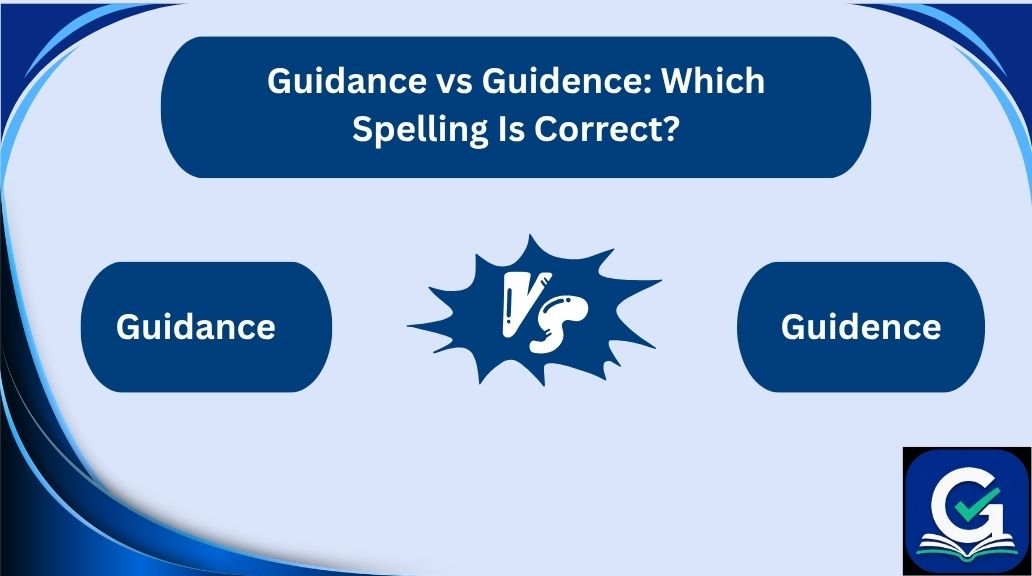
Guidance vs guidence is a common spelling confusion that can make even confident English writers pause and wonder which form is correct. Have you ever typed one of these words and suddenly questioned whether you chose the right spelling? You are not alone.
The two forms look very similar, but there is an important difference: guidance is the correct standard spelling, while guidence is a misspelling.
The word guidance is a noun that means help, advice, direction, or support given to someone. It is commonly used when talking about education, careers, workplaces, personal decisions, and professional advice.
In this guide, I will explain the difference between guidance vs guidence, show you practical examples, discuss common spelling mistakes, and share an easy memory trick that can help you remember the correct form. By the end, you will know exactly which spelling to use every time. 😊 Tomorrow vs Tommorow
Quick Answer: Guidance vs Guidence
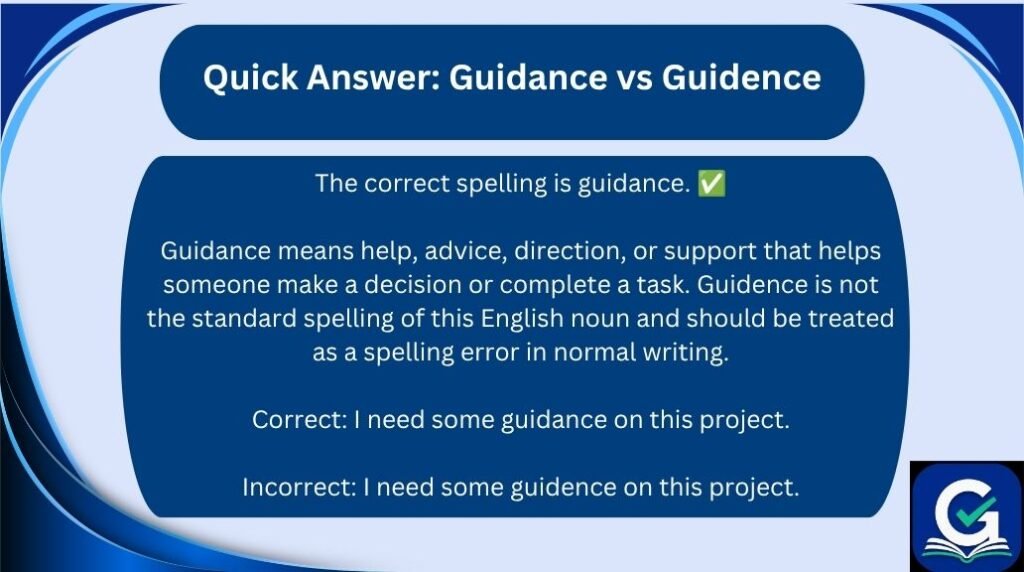
The correct spelling is guidance. ✅
Guidance means help, advice, direction, or support that helps someone make a decision or complete a task. Guidence is not the standard spelling of this English noun and should be treated as a spelling error in normal writing.
Correct: I need some guidance on this project.
Incorrect: I need some guidence on this project.
A simple way to remember it is:
guide + ance = guidance
The word comes from guide, so keep the “i” after the gu: guidance.
Understanding the Basics of Guidance vs Guidence
The confusion between these two forms comes mainly from their similar appearance.
At first glance, guidance and guidence differ by only one letter:
- guidance → correct
- guidence → incorrect
The correct word contains “guid” followed by “-ance.”
Comparison Table
| Form | Type | Meaning | Example | Correct/Incorrect |
|---|---|---|---|---|
| guidance | Noun | Help, advice, or direction | I asked my teacher for guidance. | ✅ Correct |
| guidence | Misspelling | No standard dictionary meaning as the intended noun | I asked for guidence. | ❌ Incorrect |
The important point is that guidance is a noun. It describes the help or direction a person receives.
For example:
The manager gave me valuable guidance.
Here, guidance is the thing the manager provided.
You can also use it with common expressions such as:
- career guidance
- professional guidance
- financial guidance
- legal guidance
- academic guidance
- practical guidance
- expert guidance
- parental guidance
- technical guidance
Cambridge Dictionary lists guidance as a noun and gives examples involving instructors, teachers, supervisors, parents, and practical advice.
What Does Guidance Mean?
Guidance means help, advice, or direction that enables someone to understand what to do or how to handle a situation.
It can come from a person, organization, teacher, manager, parent, expert, counselor, manual, or another source.
For example:
I need guidance before making this decision.
The speaker is asking for help or advice before deciding what to do.
Another example is:
The instructor provided guidance on how to operate the equipment.
In this sentence, the instructor gave directions or helpful information.
Guidance as Help or Advice
The most common meaning of guidance is advice or assistance.
Examples include:
- I appreciate your guidance.
- She asked her parents for guidance.
- The teacher offered guidance to the students.
- We need professional guidance before making a decision.
- His guidance helped me solve the problem.
In each sentence, guidance refers to helpful direction.
Guidance in Education
Education is one of the most common contexts for this word.
Students may receive:
- academic guidance
- career guidance
- college guidance
- study guidance
- professional guidance
For example:
My counselor gave me career guidance before I applied to college.
Here, guidance means advice that helps the student make a career-related decision.
Cambridge specifically includes career guidance among its examples and explains that the word can refer to help and advice related to work, education, and personal matters.
Guidance in the Workplace
The word is also extremely common in professional communication.
For example:
Please provide guidance on the next steps.
This sentence is polite and professional. The writer is asking someone to explain what should happen next.
Other examples include:
The manager provided guidance to the new employee.
Employees can request guidance from their supervisors.
We need additional guidance before proceeding.
The company issued guidance for handling customer complaints.
Notice that guidance does not necessarily mean a strict command. It can simply mean useful advice or direction.
Why Is Guidance the Correct Spelling?
The easiest way to understand the spelling is to look at the relationship between guide and guidance.
The base word is:
guide
From it, we get:
guidance
The spelling keeps the letters guid from the base word.
That gives us:
guide → guidance
Not:
guide → guidence ❌
The incorrect spelling guidence often appears because writers hear the word and assume the vowel should be e rather than a.
However, English spelling is not always predictable from pronunciation. This is why visual memory and word formation can be useful.
The Spelling Pattern
Think of the word in two parts:
guid + ance
That gives:
guidance
The a in -ance is important.
Compare:
- guidance ✅
- guidence ❌
A Helpful Memory Trick
Use this sentence:
A guide gives guidance.
Both words begin with guid-.
So remember:
GUIDE → GUIDANCE
If you can spell guide, you can use that spelling as a visual reminder for guidance.
Correct Meanings and Uses of Guidance
Although guidance has a central meaning, it appears in several contexts.
1. Advice From a Person
Someone may provide guidance when another person needs help making a decision.
My father gave me guidance when I was choosing a career.
Breakdown:
- My father = person providing help
- gave = action
- me = recipient
- guidance = advice or direction
2. Direction for Completing a Task
Guidance can also describe instructions or useful direction.
The manual provides guidance on installing the software.
Here, the manual helps the reader understand what to do.
3. Professional Advice
Experts often provide guidance.
The accountant offered guidance on managing the company’s finances.
The accountant is using professional knowledge to help someone make better financial decisions.
4. Personal Support
Guidance does not have to be technical.
She needed guidance after starting her new job.
The sentence suggests that she needed advice, support, or direction.
5. Official Recommendations
Organizations can issue guidance.
The agency published new guidance for employers.
In this context, guidance means information or recommendations intended to help people understand how to act.
Cambridge’s Business English examples include expressions such as give guidance, offer guidance, and provide guidance, showing how naturally the word functions in professional writing.
Guidance in Common Expressions
Learning common phrases is one of the easiest ways to become comfortable with the spelling.
“Ask for guidance”
I asked my supervisor for guidance.
Meaning: I asked my supervisor for advice or direction.
“Provide guidance”
The teacher provided guidance during the assignment.
Meaning: The teacher gave helpful direction.
“Offer guidance”
Our team can offer guidance to new employees.
Meaning: The team can give advice or support.
“Seek guidance”
You should seek guidance from an experienced professional.
Meaning: You should look for advice or direction.
“Under the guidance of”
Under the guidance of her coach, she improved quickly.
Meaning: She improved while receiving direction and support from her coach.
“With guidance”
With proper guidance, beginners can learn the skill quickly.
Meaning: Beginners can succeed when they receive appropriate help.
These phrases are useful because they make the correct spelling easier to remember through repetition.
Test Tip: How to Check the Spelling
If you are unsure about guidance vs guidence, try this quick test:
Step 1: Find the base word
Ask yourself:
What word is this related to?
The answer is guide.
Step 2: Keep “guid”
Start with:
guid
Step 3: Add “ance”
Now add:
ance
You get:
guidance ✅
This is a better memory strategy than trying to guess the vowel from pronunciation.
Quick Test
Which sentence is correct?
A. The counselor gave me guidence.
B. The counselor gave me guidance.
Correct answer:
B. The counselor gave me guidance. ✅
Guidance vs Guidence in a Real-Life Case Study
Imagine that you are starting a new job.
Your manager sends you an email saying:
Please review the attached document. If you need further guidance, feel free to contact me.
The word guidance is correct because the manager is offering help or direction.
Now imagine an employee replies:
Thank you for the guidence. I really appreciate it.
The meaning is understandable, but the spelling is wrong.
The professional version should be:
Thank you for the guidance. I really appreciate it.
Why This Matters
A single spelling mistake usually does not prevent someone from understanding the message. However, professional writing benefits from accuracy.
A correctly spelled word can make an email appear:
- more polished
- more credible
- more professional
- easier to read
This is especially important when writing to clients, employers, teachers, customers, or business partners.
Grammar Rules: Is Guidance a Noun?
Yes. Guidance is a noun.
More specifically, dictionaries commonly classify it as an uncountable noun. Cambridge lists guidance as a noun marked [U], meaning it is generally used as an uncountable noun.
This means we normally say:
I need some guidance.
rather than:
I need a guidance. ❌
We also commonly say:
She gave me helpful guidance.
rather than:
She gave me a guidance. ❌
Why “Guidence” Is Incorrect
Guidence is not the standard spelling of the noun meaning advice or direction.
The standard form is:
guidance
This distinction is supported by established dictionary usage. Cambridge defines guidance as help and advice about how to do something or deal with problems.
So when you are writing standard American English, choose guidance.
Is “Guidance” Related to the Verb “Guide”?
Yes.
The connection is useful because it gives you a spelling clue.
Verb
The teacher will guide the students.
Noun
The teacher will provide guidance.
The words share the same guid- spelling.
More examples:
My mentor guided me through the process.
My mentor provided guidance throughout the process.
The instructions guide users through the setup.
The instructions provide guidance during setup.
Recognizing this relationship can help you avoid guidence.
Common Mistakes With Guidance
Why do people write guidence when the correct form is guidance?
There are several possible reasons.
Fast Typing
When people type quickly, they often write words according to how they sound.
Because the pronunciation does not clearly highlight the spelling difference, it is easy to type:
guidence
instead of:
guidance
Autocorrect
Autocorrect can sometimes fail to identify a spelling error, especially if the incorrectly typed form resembles a word pattern that the software recognizes.
For this reason, writers should not rely entirely on automatic correction.
Lack of Familiarity
People who have rarely seen the word in writing may not know which spelling is standard.
This is particularly common with English words whose pronunciation does not directly reveal their spelling.
Confusion With Other Words
English contains many words with -ence and -ance endings.
For example:
- difference
- reference
- importance
- performance
- assistance
Because both endings are common, writers may choose the wrong one.
Similar Spelling Confusions
The guidance vs guidence problem belongs to a larger group of common English mistakes.
| Common Confusion | Correct Form | Incorrect Form | Main Issue |
|---|---|---|---|
| your / you’re | your, you’re | — | Possession vs “you are” |
| its / it’s | its, it’s | — | Possession vs “it is” |
| advice / advise | advice, advise | — | Noun vs verb |
| affect / effect | affect, effect | — | Different grammatical functions |
| definitely | definitely | definately | Vowel order |
| separate | separate | seperate | Missing “a” |
| receive | receive | recieve | “i before e” confusion |
| guidance | guidance | guidence | -ance vs -ence |
These errors are different, but they have something in common: the incorrect version often looks or sounds plausible.
That is why proofreading matters.
Guidance in Everyday Conversation
You may not notice the word guidance in casual speech because people often use simpler alternatives such as:
- advice
- help
- direction
- support
However, guidance is still perfectly natural in everyday English.
For example:
Can you give me some guidance?
I need your guidance on this.
Thanks for the guidance.
I appreciate your guidance.
The word often sounds slightly more formal than help or advice, but it is not overly formal.
Guidance vs Advice
These words overlap, but there can be a slight difference in emphasis.
Advice often refers to a recommendation about what someone should do.
Guidance can suggest broader support, direction, or help through a process.
For example:
My friend gave me advice about which phone to buy.
But:
My mentor gave me guidance throughout my career.
The second sentence suggests ongoing support rather than one isolated recommendation.
Guidance in Professional Writing
In workplace writing, guidance is extremely useful.
Consider these examples:
Please provide guidance on how we should proceed.
We appreciate your guidance on this matter.
The document provides guidance for new employees.
Employees should follow the guidance provided by management.
I am writing to request guidance regarding the project timeline.
These sentences sound professional without being unnecessarily complicated.
Why Professionals Use the Word
Guidance is useful because it is neutral.
It does not always imply that the person giving guidance has complete authority. Instead, it can simply indicate that someone is helping another person understand a situation.
That makes it appropriate for:
- business emails
- reports
- policies
- training materials
- academic writing
- workplace conversations
- customer support
Guidance in Creative Writing
Creative writers can also use guidance to describe emotional, moral, or symbolic direction.
For example:
She looked to her grandmother for guidance.
The old map became his only guidance through the forest.
Without guidance, the young hero struggled to choose the right path.
Here, the word can carry a deeper emotional meaning.
It may represent:
- wisdom
- mentorship
- direction
- protection
- moral support
- experience
Creative writing allows the word to be used both literally and figuratively.
Guidance in Social Media and Texting
On social media, people may use shorter expressions such as:
Need some advice!
or:
Can someone help me?
Still, guidance is completely acceptable.
For example:
Looking for some guidance from people who have done this before.
Or:
I could really use some guidance right now.
The important point is that informal writing does not change the standard spelling.
Even if you are texting quickly, the correct form remains:
guidance
not:
guidence
Why Spelling Guidance Correctly Matters
You might wonder whether one missing or misplaced vowel really matters.
In casual communication, a spelling error may not cause serious problems. Your reader will probably understand what you mean.
However, accurate spelling still matters for several reasons.
1. Clarity
Correct spelling makes your message easier to process.
When readers encounter unfamiliar spellings, they may pause to determine what word you intended.
2. Professionalism
A spelling error in a job application, business proposal, report, or formal email can make your writing look less polished.
3. Credibility
Accurate writing can help demonstrate attention to detail.
This is particularly important when your work involves:
- education
- business
- journalism
- marketing
- customer service
- law
- technical writing
4. Digital Communication
Today, people write constantly through emails, websites, messaging apps, social media, and online documents.
Correct spelling helps your message remain clear across all these platforms.
A useful principle is:
Clear writing builds confidence in the reader.
Special Exception: Can “Guidence” Ever Appear?
In standard English, guidance is the correct spelling for the noun meaning help, advice, or direction.
You may occasionally encounter guidence online because people make spelling mistakes. Seeing the misspelling on a website, social post, or informal message does not make it an accepted standard spelling.
There could also be unusual cases involving names, usernames, fictional terms, or intentionally altered spellings. If Guidence were used as a specific name or invented term, its spelling would depend on that particular context.
But for ordinary English writing, the rule is straightforward:
Use guidance.
How to Remember Guidance Forever
Here are three simple memory tricks.
Trick 1: Guide + ance
Think:
guide + ance = guidance
This is the most useful method.
Trick 2: A Guide Gives Guidance
Repeat this phrase:
A guide gives guidance.
Both words begin with guid-.
Trick 3: Watch the “A”
If you are tempted to write guidence, stop and look at the ending.
The correct ending is:
-ance
So:
guid + ance = guidance
This small visual reminder can prevent the mistake.
Quick Recap Checklist
Use this checklist whenever you are unsure.
| Question | If Yes → Use |
|---|---|
| Do you mean help or advice? | guidance |
| Do you mean direction or support? | guidance |
| Are you asking someone what to do? | guidance |
| Are you writing about career or academic advice? | guidance |
| Are you writing a professional email? | guidance |
| Are you tempted to write “guidence”? | Stop and use guidance |
Practice Example 1
Choose the correct spelling:
The teacher gave us useful ______ before the exam.
Answer:
guidance ✅
Practice Example 2
I appreciate your ______ during this difficult time.
Answer:
guidance ✅
Practice Example 3
The website offers ______ for new users.
Answer:
guidance ✅
Guidance vs Guidence: Practice Sentences
Here are several examples you can use to reinforce the correct spelling:
- I asked my teacher for guidance.
- The manager provided guidance to the new employee.
- We need professional guidance before making a decision.
- Her parents offered valuable guidance.
- The handbook provides guidance for employees.
- Thank you for your guidance and support.
- The counselor gave me career guidance.
- The instructor offered practical guidance.
- We are seeking legal guidance on the issue.
- Under his guidance, the team improved quickly.
Every sentence uses the same correct spelling.
FAQs About Guidance vs Guidence
1. Is it guidance or guidence?
Guidance is the correct spelling. Guidence is a misspelling when you mean help, advice, or direction.
2. What does guidance mean?
Guidance means help, advice, direction, or support that helps someone decide what to do or handle a situation. Cambridge Dictionary defines it as help and advice about how to do something or deal with problems.
3. Why do people spell guidance as guidence?
The error usually happens because guidance and guidence look and sound similar. Fast typing, unfamiliarity with the word, and confusion between -ance and -ence endings can contribute to the mistake.
4. Is guidance a noun?
Yes. Guidance is a noun and is generally treated as uncountable in standard usage. You normally say some guidance or a lot of guidance, rather than a guidance. Cambridge lists it as a noun with no plural in its standard dictionary entry.
5. What is an easy way to remember the spelling of guidance?
Remember:
A guide gives guidance.
The word guidance keeps the guid- spelling from guide and uses the ending -ance.
6. Can I use guidance in professional writing?
Absolutely. Guidance is common in professional, academic, workplace, and official writing. Phrases such as provide guidance, seek guidance, offer guidance, and request guidance are natural and widely used.
Conclusion
When comparing guidance vs guidence, the answer is clear: guidance is the correct standard spelling. ✅ It is a noun meaning help, advice, direction, or support, and it is commonly used in education, business, personal communication, and professional writing.
The spelling becomes much easier to remember when you connect it to the word guide: guide → guidance. The incorrect form guidence usually results from pronunciation, fast typing, or confusion between the endings -ance and -ence. If you ever hesitate, remember the simple phrase “A guide gives guidance.” That one memory trick can help you avoid the mistake every time.
Accurate spelling may seem like a small detail, but it improves clarity, professionalism, and confidence in your writing. So the next time you need advice or direction, ask for guidance—never guidence. When in doubt, remember: a guide gives guidance. ✨

I’m Clara Bennett, a vocabulary and language specialist at Gramfino, where I write about word meanings and proper usage.
I love helping readers choose the right words and build stronger English vocabulary with confidence.
[…] In this guide, I will explain the difference between the two forms, show you how to remember the correct spelling, discuss common mistakes, and provide practical examples so you can use tomorrow confidently every time. 😊 Guidance vs Guidence […]