Have you ever typed a sentence quickly and suddenly wondered whether tomorrow has one “m” or two? You are not alone. The spelling “tommorow” is a very common mistake, especially when people type quickly, rely on memory, or hear the word more often than they see it written. If you are confused about tomorrow vs tommorow, the good news is that the rule is simple once you learn the correct pattern.
Tomorrow is the standard and correct spelling in English, while tommorow is a misspelling. The word refers to the day after today and can also describe a future time. It is commonly used in conversations, emails, school assignments, business writing, text messages, and social media.
In this guide, I will explain the difference between the two forms, show you how to remember the correct spelling, discuss common mistakes, and provide practical examples so you can use tomorrow confidently every time. 😊 Guidance vs Guidence
Quick Answer: Tomorrow vs Tommorow
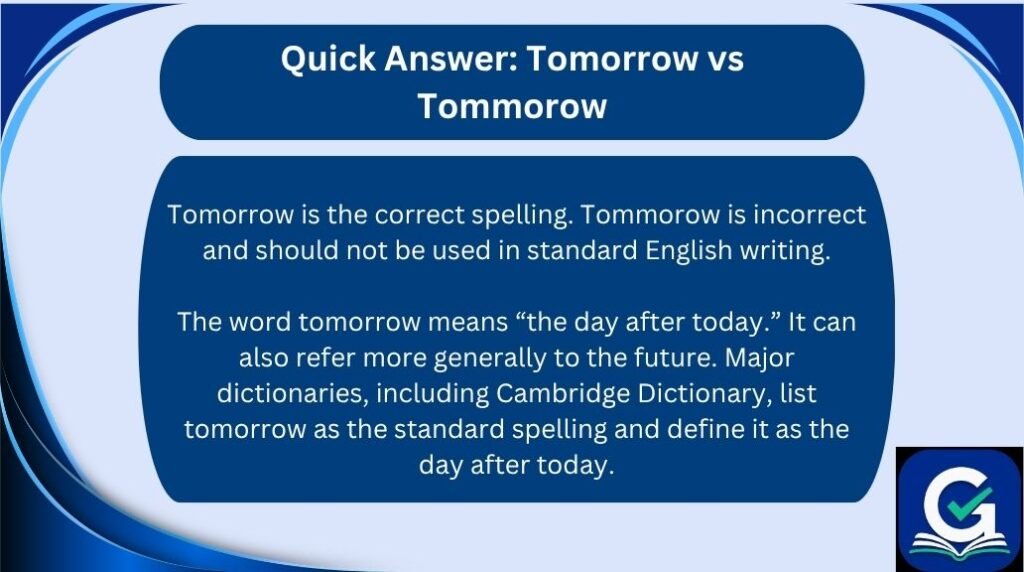
Tomorrow is the correct spelling. Tommorow is incorrect and should not be used in standard English writing.
The word tomorrow means “the day after today.” It can also refer more generally to the future. Major dictionaries, including Cambridge Dictionary, list tomorrow as the standard spelling and define it as the day after today.
Correct: I will call you tomorrow.
Incorrect: I will call you tommorow.
A simple way to remember it is:
tomorrow = one “m,” two “r”s
So, when choosing between tomorrow vs tommorow, always choose tomorrow.
Understanding the Basics of Tomorrow vs Tommorow
The confusion comes from the way the word sounds and the arrangement of its letters. When spoken quickly, tomorrow can sound as if it contains more repeated consonants than it actually does.
However, standard English spelling uses:
T-O-M-O-R-R-O-W
There is only one “m” after “to,” followed by two “r”s.
Comparison Table
| Form | Type | Meaning | Example | Correct/Incorrect |
|---|---|---|---|---|
| tomorrow | Adverb / noun | The day after today; the future | I will finish it tomorrow. | ✅ Correct |
| tommorow | Misspelled word | No standard English meaning | I will finish it tommorow. | ❌ Incorrect |
The key difference is the spelling.
Tomorrow: T-O-M-O-R-R-O-W
Tommorow: T-O-M-M-O-R-O-W
The second form incorrectly adds an extra m and removes one of the required rs.
What Does “Tomorrow” Mean?
According to Cambridge Dictionary, tomorrow can function as both an adverb and a noun. As an adverb, it means “on the day after today.” As a noun, it can mean the day after today or a more general future time.
For example:
- I am leaving tomorrow.
- We have a meeting tomorrow.
- Tomorrow is another day.
- We need to think about the future and build a better tomorrow.
The meaning is clear, but the spelling must remain tomorrow.
Why Is “Tomorrow” Correct?
The correct spelling contains one m and two rs:
to + morrow = tomorrow
The important visual pattern is:
tom + orrow
Not:
tomm + orow
Although English spelling can sometimes be unpredictable, tomorrow has a fixed standard spelling. Adding another “m” does not create an alternative spelling.
Cambridge Dictionary lists tomorrow as the dictionary form and gives examples such as “I don’t have time now. I’ll do it tomorrow.”
That means tommorow is not a separate word with a different meaning. It is simply a spelling error.
Correct Letter Pattern
Break the word into letters:
T – O – M – O – R – R – O – W
There are:
- 1 T
- 1 O after T
- 1 M
- 1 O
- 2 Rs
- 1 O
- 1 W
The two rs are especially important because they are often accidentally reduced to one when people type quickly.
Correct Meanings and Uses of “Tomorrow”
1. Tomorrow as the Day After Today
The most common use of tomorrow is to identify the day immediately following today.
Examples:
- I will see you tomorrow.
- The store opens tomorrow.
- We are leaving tomorrow morning.
- My appointment is tomorrow afternoon.
- The exam begins tomorrow.
In each example, tomorrow points to the next calendar day.
For instance:
I will call you tomorrow.
Sentence breakdown:
- I = subject
- will call = future verb phrase
- you = object
- tomorrow = time expression
The word tells the reader when the calling will happen.
2. Tomorrow as a Future Time
The word can also have a broader meaning.
For example:
We are building a better tomorrow.
Here, tomorrow does not necessarily mean the literal next day. Instead, it represents the future.
Cambridge Dictionary also recognizes this broader meaning of tomorrow as a future time.
Other examples include:
- Technology will shape our tomorrow.
- Young people are the leaders of tomorrow.
- We must prepare for tomorrow.
- The choices we make today can affect tomorrow.
3. Tomorrow With Parts of the Day
You can combine tomorrow with expressions such as:
- tomorrow morning
- tomorrow afternoon
- tomorrow evening
- tomorrow night
- tomorrow at noon
Examples:
- I will send the report tomorrow morning.
- She is arriving tomorrow afternoon.
- We can discuss it tomorrow evening.
- They are leaving tomorrow night.
These combinations are natural and common in American English.
Test Tip: How Can You Check the Spelling?
If you are unsure about tomorrow vs tommorow, use this quick test:
The “One M, Two Rs” Test
Ask yourself:
Does tomorrow have one “m” and two “r”s?
Yes.
T O M O R R O W
If you write tommorow, you have accidentally used two “m”s.
A simple memory sentence is:
Tomorrow has one M but two Rs.
Repeat that a few times, and the correct spelling becomes easier to remember.
Another Memory Trick
Think of the word as:
TO + MORROW
The middle pattern is:
M-O-R-R-O-W
That makes it easier to avoid writing MM in the middle.
Tomorrow vs Tommorow in Real-Life Writing
Imagine that you are writing an email to your manager.
You want to say:
I will send the completed report tomorrow.
This sentence looks professional and correct.
Now imagine writing:
I will send the completed report tommorow.
The meaning is still understandable, but the spelling error can make the message look rushed or careless.
The same issue can occur in:
- school assignments
- job applications
- business emails
- blog posts
- resumes
- reports
- presentations
- social media posts
- customer service messages
A single spelling mistake does not necessarily prevent someone from understanding your message. However, repeated mistakes can affect how your writing is perceived.
Case Study: A Workplace Email
Consider a simple workplace situation.
Sarah needs to tell her supervisor that she will submit a project tomorrow.
Incorrect Version
Hi Mark,
I will send the final project tommorow.
Thanks,
Sarah
The message is understandable, but tommorow is misspelled.
Correct Version
Hi Mark,
I will send the final project tomorrow.
Thanks,
Sarah
The second version is clean and professional.
Why the Difference Matters
In casual texting, a person may overlook a spelling mistake. In professional communication, however, accuracy matters more.
If you are sending an important email, take a few seconds to proofread words that you frequently misspell.
A quick check can prevent simple errors from appearing in:
- client emails
- proposals
- reports
- cover letters
- presentations
- official documents
Grammar Rules: Is “Tomorrow” a Noun or an Adverb?
One reason tomorrow can be confusing is that it can perform different grammatical roles.
Tomorrow as an Adverb
When tomorrow tells us when an action will happen, it works as an adverb.
Example:
I will finish the work tomorrow.
Here, tomorrow modifies the verb phrase will finish by telling us when the action will occur.
Another example:
She is leaving tomorrow.
Again, tomorrow tells us when she is leaving.
Tomorrow as a Noun
Tomorrow can also function as a noun.
Example:
Tomorrow is a new day.
Here, tomorrow is the subject of the sentence.
Another example:
We need to prepare for tomorrow.
Here, tomorrow is the object of the preposition for.
Cambridge Dictionary explicitly identifies tomorrow as both a noun and an adverb.
Does the Grammar Change the Spelling?
No.
Whether tomorrow functions as a noun or an adverb, its spelling stays exactly the same:
tomorrow
Never:
tommorow
Why Do People Write “Tommorow”?
There are several common reasons.
1. Fast Typing
When people type quickly, their fingers may repeat a letter accidentally.
For example:
tomorrow → tommorow
The extra m is an easy typing error.
This is especially common when someone is writing quickly on a phone or computer.
2. Memory Confusion
English contains many words with doubled consonants, so writers sometimes assume that tomorrow follows a similar pattern.
They may remember that some English words contain double letters and incorrectly insert another m.
3. Pronunciation
Spoken English does not always make spelling obvious.
The pronunciation of tomorrow can vary somewhat by accent, but hearing the word does not clearly reveal every letter.
Cambridge gives US pronunciations including /təˈmɔːr.oʊ/ and /təˈmɑr.oʊ/.
4. Autocorrect and Habit
If someone repeatedly types a misspelling, they may become accustomed to seeing it. Depending on the device or application, autocorrect may also fail to catch every mistake.
5. Lack of Spelling Practice
People who mostly communicate through informal messages may encounter fewer opportunities to practice formal spelling.
The solution is simple: learn the correct visual pattern and use it consistently.
Common Spelling Confusions Similar to Tomorrow vs Tommorow
Tomorrow vs tommorow is only one example of a common English spelling problem.
Here are several others:
| Confusing Forms | Correct Form | Common Problem |
|---|---|---|
| your / you’re | Both are correct, but different | Possession vs “you are” |
| its / it’s | Both are correct, but different | Possession vs “it is” |
| their / there / they’re | All are correct, but different | Possession, place, contraction |
| definitely / definately | definitely | Incorrect vowel pattern |
| separate / seperate | separate | Wrong middle vowel |
| receive / recieve | receive | Common “ie/ei” confusion |
| tomorrow / tommorow | tomorrow | Extra “m” |
| occurred / occured | occurred | Missing repeated letters |
| beginning / begining | beginning | Missing “n” |
| successful / succesful | successful | Missing “s” |
These mistakes show why spelling should not always be based on how a word sounds.
Cambridge notes that English spelling can be irregular and that spelling mistakes are a normal challenge for learners.
Tomorrow vs Tommorow in Different Contexts
Everyday Conversation
In everyday conversation, tomorrow is extremely common.
Examples:
- See you tomorrow!
- Are you working tomorrow?
- What are you doing tomorrow?
- Let’s talk tomorrow.
- I will finish it tomorrow.
Because the word is so common, learning its correct spelling is especially useful.
Professional Writing
In professional writing, accuracy becomes even more important.
Examples:
The meeting is scheduled for tomorrow.
I will provide the updated document tomorrow morning.
Please submit your response by tomorrow.
These sentences are concise, clear, and professional.
Creative Writing
Writers may use tomorrow literally or symbolically.
Examples:
Tomorrow brought a new beginning.
She believed tomorrow would be different.
He had spent years dreaming about tomorrow.
In creative writing, tomorrow can represent hope, uncertainty, change, or the future.
Social Media and Texting
Informal communication often contains abbreviations and typos.
You might see:
- See u tomorrow!
- Tomorrow is the day! 🎉
- Can’t wait for tomorrow!
- Tomorrow, we start fresh. ✨
Even in informal writing, tomorrow remains the standard spelling.
Texting style may be relaxed, but the correct spelling does not change.
Why Correct Spelling Matters
It may seem like a tiny issue. After all, most readers understand what someone means when they write tommorow.
So why bother correcting it?
1. Clarity
Correct spelling helps readers process information smoothly.
When every word looks familiar and correctly written, the reader does not need to pause and mentally correct it.
2. Professionalism
Spelling errors can influence how readers perceive a writer.
A clean email looks more polished than one containing several avoidable mistakes.
3. Digital Communication
Today, much of our communication happens through:
- websites
- messaging apps
- social media
- online forms
- workplace platforms
That means written communication is part of everyday life.
4. Search and Content Quality
Correct spelling also matters for websites and online content. A properly spelled word makes content easier to read and more trustworthy.
A Short Quote
“Accuracy builds trust.”
That principle applies to grammar, spelling, business communication, and everyday writing.
Is “Tommorow” Ever Correct?
In standard English, tommorow is not the accepted spelling of the word meaning the day after today.
The standard spelling is:
tomorrow
There may be isolated cases where a misspelled form appears in usernames, fictional names, informal branding, or other creative contexts. For example, someone could intentionally use Tommorow as a username or a fictional name.
However, that does not make it the standard English spelling.
If you are writing a normal sentence, use tomorrow.
Is “Tomorrow” Different in British and American English?
The spelling tomorrow is standard in both American and British English.
The pronunciation may vary between accents, but the spelling remains:
tomorrow
Cambridge provides both US and UK pronunciation information while listing the same spelling.
Therefore, you do not need to choose between tomorrow and another regional spelling.
For US English writing, simply use:
tomorrow
Common Sentences Using “Tomorrow”
Here are practical examples you can use in everyday writing:
- I have a meeting tomorrow.
- We will discuss the issue tomorrow.
- She is arriving tomorrow morning.
- Can you call me tomorrow?
- The store will reopen tomorrow.
- I need to finish this assignment by tomorrow.
- Tomorrow is my first day at work.
- We are traveling tomorrow.
- He promised to send the file tomorrow.
- Let’s start tomorrow.
- The weather may improve tomorrow.
- I will see you tomorrow.
- Tomorrow could be a better day.
- We should prepare today for tomorrow.
- The children of tomorrow will face new challenges.
Notice that the spelling never changes.
Common Incorrect Examples
Here are some mistakes to avoid:
❌ I will call you tommorow.
✅ I will call you tomorrow.
❌ The meeting is tommorow.
✅ The meeting is tomorrow.
❌ See you tommorow morning.
✅ See you tomorrow morning.
❌ I will finish it tommorow.
✅ I will finish it tomorrow.
❌ Let’s talk about it tommorow.
✅ Let’s talk about it tomorrow.
The incorrect version is easy to recognize once you remember the letter pattern.
Quick Recap Checklist
Use this checklist whenever you are unsure about tomorrow vs tommorow.
| Question | If Yes → Use |
|---|---|
| Do you mean the day after today? | tomorrow |
| Are you referring to a future time? | tomorrow |
| Are you writing an email or formal document? | tomorrow |
| Are you writing a text message? | tomorrow |
| Did you accidentally type two “m”s? | Change it to tomorrow |
| Are you using “tommorow” as the normal English word? | ❌ Do not use it |
Practice Example 1
Choose the correct form:
I will finish the report ______.
Answer: tomorrow
Practice Example 2
Choose the correct form:
Are you free ______ afternoon?
Answer: tomorrow
Practice Example 3
Choose the correct form:
We can plan for a better ______.
Answer: tomorrow
A Simple Trick to Remember “Tomorrow”
If you repeatedly make this spelling mistake, try the following technique.
Write:
Tomorrow = 1 M + 2 Rs
Then visualize:
T O M O R R O W
You can also remember:
One M, double R.
This is much easier than trying to memorize every letter separately.
Visual Memory
TOMORROW
Look at the middle:
M O R R
The double letters are RR, not MM.
So:
✅ TOMORROW
❌ TOMMOROW
Once you recognize that pattern, the confusion becomes much less likely.
FAQs About Tomorrow vs Tommorow
1. Is “tomorrow” or “tommorow” correct?
Tomorrow is correct. Tommorow is a misspelling. The standard spelling contains one m and two rs.
2. Why do people spell tomorrow as “tommorow”?
People commonly make this mistake because of fast typing, memory confusion, pronunciation, or uncertainty about where the repeated letters belong. It is also possible to develop the habit of typing a misspelled version.
3. Does tomorrow have one M or two?
Tomorrow has one M. It has two rs.
The correct spelling is:
T-O-M-O-R-R-O-W
4. Is “tommorow” accepted in English?
No. Tommorow is not the standard spelling of the English word. In normal writing, use tomorrow.
5. What does tomorrow mean?
Tomorrow means the day after today. It can also refer more generally to the future. Cambridge Dictionary gives both meanings.
6. Is tomorrow spelled the same in American and British English?
Yes. The standard spelling is tomorrow in both American and British English. Pronunciation can vary by accent, but the spelling does not change.
Final Takeaway
The tomorrow vs tommorow confusion is easy to solve once you remember one simple rule: tomorrow is the correct spelling, while tommorow is incorrect. The standard word contains one M and two Rs: T-O-M-O-R-R-O-W. You use tomorrow when talking about the day after today, such as “I will see you tomorrow,” and you can also use it to refer more broadly to the future, as in “We are building a better tomorrow.”
Whether you are writing a text, email, school assignment, blog post, or professional document, choose tomorrow every time. The easiest memory trick is simple: one M, double R. Once that pattern becomes familiar, this common spelling mistake should disappear from your writing.
Remember: Tomorrow has one M, two Rs—and no extra M. ✨

I’m Amelia Parker, an English language writer at Gramfino, focused on making difficult language topics easier to understand.
I write about grammar, vocabulary, word usage, and everyday English to help readers communicate clearly.
[…] In this guide, I will explain the difference between guidance vs guidence, show you practical examples, discuss common spelling mistakes, and share an easy memory trick that can help you remember the correct form. By the end, you will know exactly which spelling to use every time. 😊 Tomorrow vs Tommorow […]
[…] you will have an easy rule to remember and practical examples that make the distinction clear. 📚 Tomorrow vs Tommorow | Guidance vs […]
[…] you how to use the correct spelling, and give you simple ways to remember it. 😊 Lent vs Lended | Tomorrow vs Tommorow | Guidance vs […]
[…] cover the grammar rules, and give you simple tricks to remember which spelling to use. 😊 Tomorrow vs Tommorow | Experience vs Experiance | Lent vs […]