Have you ever typed a sentence and suddenly wondered whether smoky or smokey is the correct spelling? You are not alone. These two words look almost identical, sound the same in many contexts, and are both found in English writing. That makes the smoky vs smokey question surprisingly confusing, especially when you are writing about food, fire, air, scents, or even a person’s eyes.
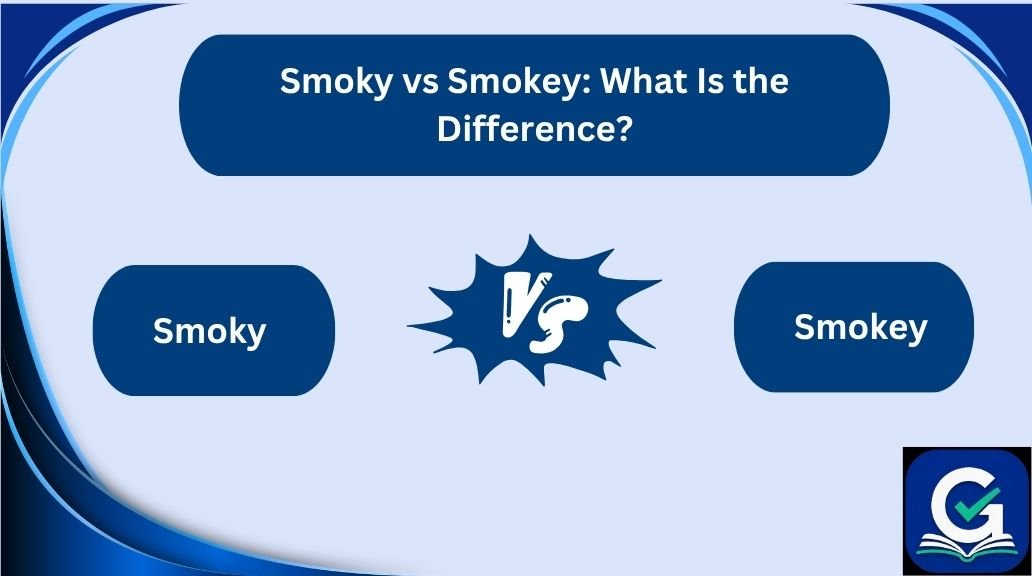
The good news is that there is a simple answer. Smoky is the standard and preferred spelling in American English when you mean “full of smoke,” “resembling smoke,” or “having a flavor or smell associated with smoke.” Smokey, on the other hand, is generally used as a proper name or in certain established names and expressions.
Understanding this difference can help you avoid spelling mistakes in school assignments, professional writing, recipes, product descriptions, emails, and online content.
In this guide, I will explain smoky vs smokey in simple terms, show you practical examples, discuss the grammar behind the distinction, and give you easy ways to remember which form to use. Doughnut vs Donut | Bad Rap vs Bad Rep | One and the Same vs One in the Same
Quick Answer: Smoky vs Smokey
Smoky is the standard spelling for the adjective meaning “full of smoke,” “producing smoke,” or “having a smoky flavor, smell, or appearance.”
Smokey is usually a proper name or part of an established name, such as Smokey Bear. In ordinary descriptive writing, use smoky, not smokey.
Example:
- The kitchen became smoky after the food burned. ✅
- The kitchen became smokey after the food burned. ❌
Understanding the Basics of Smoky vs Smokey
The main difference between smoky and smokey is not meaning alone. It is primarily a matter of standard spelling and usage.
The word smoky is formed from the noun smoke with the suffix -y. It describes something characterized by smoke or something that resembles smoke.
For example:
The restaurant has a smoky atmosphere.
Here, smoky describes the atmosphere because it has qualities associated with smoke.
Smokey is much less common as a general adjective in modern standard American English. It is most familiar as part of a proper name, especially Smokey Bear, the well-known American wildfire-prevention mascot.
Comparison Table
| Form | Type | Meaning | Example | Correct/Incorrect |
|---|---|---|---|---|
| smoky | Standard adjective | Full of, producing, or resembling smoke | The room was smoky. | ✅ Correct |
| smokey | Variant/proper-name spelling | Usually appears in names or established names | Smokey Bear teaches fire safety. | ✅ Correct in proper names |
| smokey | General adjective | Intended to mean “full of smoke” | The room was smokey. | ⚠️ Generally avoid |
| smoke | Noun/verb | The visible gas or act of producing it | Smoke filled the room. | ✅ Correct |
| smoked | Past participle/adjective | Cooked or treated with smoke | We ordered smoked salmon. | ✅ Correct |
The safest rule is simple:
Use “smoky” for ordinary descriptions. Use “Smokey” when it is part of a specific name or established expression.
What Does Smoky Mean?
Smoky is an adjective derived from the noun smoke.
It can describe something that contains a lot of smoke, produces smoke, resembles smoke, or has a taste or smell associated with smoke.
1. Smoky Air
When air contains smoke, you can describe it as smoky.
Example:
The air became smoky after the forest fire.
Sentence breakdown:
- The air = subject
- became = linking verb
- smoky = adjective describing the air
The adjective tells the reader what the air was like.
2. Smoky Room
A room may become smoky because of a fireplace, cooking, candles, or another source.
The restaurant became smoky after several grills were turned on.
Here, smoky describes the condition of the restaurant.
3. Smoky Flavor
The word can also describe food and drinks.
The barbecue sauce has a rich, smoky flavor.
In this example, smoky does not necessarily mean that the sauce contains visible smoke. Instead, it has a taste associated with smoke or smoking.
Other examples include:
- smoky barbecue
- smoky cheese
- smoky bacon
- smoky coffee
- smoky whiskey
- smoky roasted vegetables
4. Smoky Smell
Smoky can describe an odor.
I noticed a smoky smell coming from the kitchen.
The word tells us that the smell resembles or comes from smoke.
5. Smoky Appearance
The adjective can also describe something that visually resembles smoke.
The mountain looked smoky in the distance.
It can also appear in descriptions of colors, makeup, lighting, and artistic effects.
For example:
She wore smoky eye makeup.
Here, smoky describes a blended, shadowy makeup style.
What Does Smokey Mean?
Smokey is not normally the preferred spelling when you simply want to describe something as smoky.
Its most recognizable use is in proper names.
One famous example is Smokey Bear, the American wildfire-prevention mascot.
Because Smokey is part of the character’s official name, changing it to Smoky Bear would be incorrect when referring to the official mascot.
This is an important lesson:
A word can have a nonstandard-looking spelling in a proper name while the ordinary adjective uses a different spelling.
That happens in English more often than you might expect.
Example
The forest looked smoky after the fire. ✅
But:
Smokey Bear is a famous wildfire-prevention symbol. ✅
The first sentence uses smoky as an adjective. The second uses Smokey as part of a proper name.
Why Is Smoky Usually Correct?
English often forms adjectives by adding -y to nouns.
Examples include:
- cloud → cloudy
- rain → rainy
- dirt → dirty
- wind → windy
- sun → sunny
- smoke → smoky
Therefore:
smoke + y = smoky
The resulting adjective means something like “characterized by smoke” or “having qualities associated with smoke.”
This pattern makes smoky the natural spelling for ordinary descriptive writing.
Standard dictionaries, including Merriam-Webster, recognize smoky as the ordinary adjective related to smoke.
Correct Meanings and Uses of Smoky
The word smoky has several closely related uses.
Smoky Meaning “Full of Smoke”
This is one of its most direct meanings.
The cabin became smoky when the chimney stopped working properly.
The adjective indicates that smoke was present in the cabin.
Another example:
We opened the windows because the room was too smoky.
Here, smoky describes an atmosphere containing noticeable smoke.
Smoky Meaning “Producing Smoke”
Something can also be described as smoky when it gives off smoke.
The smoky fire filled the campsite with a strong smell.
Depending on context, this can describe the character or effect of a fire.
Smoky Meaning “Having a Taste of Smoke”
Food and beverages are often described as smoky.
The grilled vegetables had a delicious smoky flavor.
This usage is extremely common in food writing.
For example:
- smoky barbecue
- smoky salsa
- smoky paprika
- smoky grilled chicken
- smoky cheese
In these examples, smoky describes flavor rather than visible smoke.
Smoky Meaning “Resembling Smoke”
Something can also have a smoky appearance.
A smoky haze covered the valley.
Here, the word describes the hazy, smoke-like quality of the scene.
Smoky in Beauty and Fashion
The word is also common in beauty-related expressions.
The most familiar example is:
smoky eyes
A smoky eye is a makeup style that uses blended, darker shades around the eyes.
Therefore:
She created a beautiful smoky eye look. ✅
Not:
She created a beautiful smokey eye look. ⚠️
In ordinary descriptive writing, smoky is the preferred spelling.
Test Tip: How to Choose Smoky or Smokey
Try this simple test:
Ask yourself:
“Am I describing something related to smoke?”
If the answer is yes, use smoky.
Examples:
- smoky room
- smoky smell
- smoky flavor
- smoky atmosphere
- smoky barbecue
- smoky haze
If the word is part of a specific name, check whether that name officially uses Smokey.
For example:
Smokey Bear
Easy memory trick
Think:
Smoke → Smoky
The spelling changes naturally by adding -y.
If you are writing a normal sentence and you are not referring to a proper name, smoky is almost always the form you want.
Smoky vs Smokey in Real-Life Writing
Imagine you are writing an email to your manager about an office problem.
You might write:
The conference room became smoky because someone left food in the oven.
That is correct.
Now imagine writing a restaurant review:
The ribs had a deep, smoky flavor with a slightly sweet finish.
Again, smoky is correct.
Now imagine talking about the famous fire-safety mascot:
The children learned about fire prevention from Smokey Bear.
Here, Smokey is correct because it is part of a proper name.
This distinction becomes easy once you consider whether the word is functioning as a normal adjective or as part of an established name.
Case Study: A Workplace Email
Consider this workplace situation.
An employee notices that smoke from a kitchen area has entered an office.
A poorly written email might say:
The kitchen area is very smokey today, and the smell is spreading into the office.
A better version would be:
The kitchen area is very smoky today, and the smell is spreading into the office.
Why?
The employee is using the adjective to describe an environment containing smoke. Therefore, smoky is the standard choice.
Now consider a different sentence:
The safety presentation included information about Smokey Bear.
Here, Smokey is correct because it refers to a specific name.
This small distinction can make professional communication look more polished and accurate.
Grammar Rules for Smoky vs Smokey
The grammar itself is not complicated.
Both words can function as adjectives, but they do not have equal status in ordinary modern usage.
Smoky
Smoky is the standard adjective related to smoke.
It can describe:
- air
- rooms
- fires
- food
- flavors
- smells
- colors
- visual effects
- makeup
- atmospheres
Examples:
The room was smoky.
The chicken had a smoky flavor.
A smoky haze covered the road.
Smokey
Smokey is generally encountered in proper names and established uses rather than as the standard everyday spelling of the adjective.
The most famous example is:
Smokey Bear
Merriam-Webster and other major English dictionaries recognize smoky as the standard adjective meaning characterized by smoke or resembling smoke.
Therefore, if you are writing a normal sentence and need the adjective related to smoke, smoky is the safest and standard choice.
Is Smokey Ever Correct?
Yes.
This is an important exception.
You should not assume that smokey is always wrong. It can be correct when it appears in a proper name or established name.
Smokey Bear
The best-known example is Smokey Bear, the American wildfire-prevention mascot.
The name is officially spelled Smokey, even though the ordinary adjective is smoky.
That means these two sentences are both correct:
The forest was smoky after the fire. ✅
Smokey Bear promotes wildfire prevention. ✅
The spelling changes because the words have different functions.
Other Possible Name-Based Uses
You may also encounter Smokey as:
- a person’s nickname
- a character’s name
- a business name
- a product name
- a title
- a place name
- a username or creative brand name
When a person, organization, or brand intentionally uses Smokey, preserve that spelling.
Proper names do not always follow the spelling pattern of ordinary vocabulary.
Common Mistakes With Smoky vs Smokey
The confusion usually happens because smoky and smokey are pronounced similarly and differ by only one letter.
Here are some common reasons.
1. Fast Typing
When people type quickly, they may automatically add an e because they associate the adjective with the noun smoke.
For example:
smoke → smokey
This feels visually natural to some writers, but standard adjective formation gives us:
smoke → smoky
2. Autocorrect
Autocorrect and spell-check systems do not always understand context perfectly.
A writer may type one spelling and accept an automatic suggestion without checking whether the word is being used as a proper name or a normal adjective.
Always consider the sentence rather than relying entirely on automatic corrections.
3. Lack of Knowledge
Some writers simply have not learned the difference.
Because smokey looks reasonable, it is easy to assume that both spellings are interchangeable.
They are not always interchangeable.
4. Confusion With Proper Names
People may see Smokey Bear and assume that smokey is the standard spelling everywhere.
It is not.
The proper name uses Smokey, while the ordinary adjective is smoky.
Similar Grammar and Spelling Confusions
The smoky vs smokey problem is similar to many other English spelling and usage questions.
| Confusion | Correct Form | Meaning/Use |
|---|---|---|
| its vs it’s | Both | its = possessive; it’s = it is/it has |
| your vs you’re | Both | your = possessive; you’re = you are |
| their vs they’re | Both | their = possessive; they’re = they are |
| affect vs effect | Both | Different grammatical functions and meanings |
| advice vs advise | Both | advice = noun; advise = verb |
| then vs than | Both | Different meanings and functions |
| lose vs loose | Both | Different meanings |
| everyday vs every day | Both | Different uses |
| farther vs further | Both | Different contexts and meanings |
| smoky vs smokey | smoky normally | smokey mainly appears in names |
These examples show why spelling alone is not enough. Context determines which form is appropriate.
Smoky vs Smokey in Different Contexts
Everyday Conversation
In everyday conversation, smoky is the normal choice.
Examples:
This room is really smoky.
The barbecue has a smoky smell.
I love smoky flavors.
Most native speakers will understand smoky immediately.
Professional Writing
In professional writing, accuracy matters.
Use smoky when describing smoke-related conditions, products, flavors, or environments.
For example:
The report noted that smoky conditions reduced visibility.
This sounds clear and professional.
Avoid using smokey as the ordinary adjective unless you are intentionally referring to a name or a specific branded term.
Creative Writing
Creative writers may use smoky in vivid descriptions.
For example:
A smoky mist drifted across the empty street.
Or:
The room glowed beneath smoky golden light.
Here, smoky helps create a visual atmosphere.
Creative writing may also use unusual spellings for stylistic or naming purposes, but such choices should be intentional.
Social Media and Texting
Informal writing often contains spelling variations.
Someone might write:
This burger is so smokey!
Readers will probably understand the intended meaning.
However, if you want standard American English, especially for a public post, business account, website, or professional profile, smoky is the better choice.
Why the Difference Matters
At first glance, the difference between smoky and smokey may seem too small to matter. However, accurate spelling improves communication.
Clarity
Correct spelling helps readers understand exactly what you mean.
Professionalism
A website, article, email, menu, or report with standard spelling looks more polished.
Digital Communication
Search engines, content-management systems, spell-checkers, and readers can all benefit from consistent standard usage.
If you are creating online content, choosing the standard form also makes your writing more predictable for readers searching for information.
Credibility
Small spelling choices can affect how readers perceive the quality of an entire piece of writing.
As a simple rule:
Clear writing builds reader confidence.
That is why learning distinctions like smoky vs smokey is worthwhile.
Special Exception: Smokey Bear
The most important exception is Smokey Bear.
The name is intentionally spelled Smokey, not Smoky.
This does not change the ordinary spelling of the adjective.
Think about it this way:
- smoky forest = ordinary adjective
- smoky flavor = ordinary adjective
- smoky room = ordinary adjective
- Smokey Bear = proper name
Proper names are often treated differently from ordinary vocabulary.
For example, a person’s name may have an unusual spelling that would not be used for the corresponding dictionary word.
Therefore, never “correct” Smokey Bear to Smoky Bear when referring to the official name.
Smoky vs Smokey: Quick Recap Checklist
Use this checklist whenever you are unsure.
| Question | If Yes → Use |
|---|---|
| Are you describing something full of smoke? | smoky |
| Are you describing a smoke-like appearance? | smoky |
| Are you describing a smoke-related flavor? | smoky |
| Are you describing a smoky smell? | smoky |
| Are you describing smoky makeup? | smoky |
| Is the word part of a specific proper name? | Use the official spelling |
| Are you referring to the wildfire mascot? | Smokey Bear |
| Are you writing a normal sentence about smoke? | smoky |
Practice Examples
Example 1:
The restaurant had a warm, smoky atmosphere.
Correct: smoky ✅
Example 2:
The grilled peppers had a strong smoky flavor.
Correct: smoky ✅
Example 3:
The children learned about fire safety from Smokey Bear.
Correct: Smokey ✅
A Simple Memory Trick
If you struggle to remember the difference, use this formula:
Normal description = SMOKY
Think:
Smoke + Y = smoky
If you are describing a room, smell, flavor, fire, haze, or visual effect, choose smoky.
Specific name = SMOKEY
Think:
Smokey = a name
The most famous example is:
Smokey Bear
This simple distinction will solve most smoky vs smokey questions.
Examples: Correct and Incorrect
Here are additional examples to reinforce the rule.
Correct
The kitchen became smoky after the oil overheated.
I love the smoky flavor of grilled vegetables.
A smoky haze covered the highway.
The candle produced a smoky scent.
She created a beautiful smoky eye look.
The barbecue had a rich, smoky taste.
Generally Incorrect in Standard Descriptive Writing
The kitchen became smokey after the oil overheated. ❌
I love the smokey flavor of grilled vegetables. ❌
A smokey haze covered the highway. ❌
The standard form in these sentences is smoky.
Correct Proper Name
Smokey Bear is associated with wildfire prevention. ✅
Here, Smokey is correct because it is part of the official name.
FAQs
1. Is smoky or smokey correct?
Smoky is the standard spelling for the adjective describing something full of smoke, resembling smoke, or having a smoke-like flavor or smell. Smokey is mainly used in proper names and established names.
2. Is it smoky flavor or smokey flavor?
The standard spelling is smoky flavor.
For example:
This barbecue sauce has a rich, smoky flavor.
Use smoky because you are describing a flavor associated with smoke.
3. Is Smokey Bear spelled with an e?
Yes. The official name is Smokey Bear. Although the ordinary adjective is spelled smoky, the name of the wildfire-prevention mascot uses Smokey.
4. Is “smokey” a misspelling of “smoky”?
Not necessarily in every context. Smokey can be correct when it is part of a proper name or established name. However, when you simply want the standard adjective related to smoke, smoky is the preferred spelling.
5. Should I write smoky eyes or smokey eyes?
The standard expression is smoky eyes or smoky eye makeup.
For example:
She wore dramatic smoky eye makeup.
The adjective smoky is the standard choice in this context.
6. Why do people spell smoky as smokey?
The confusion is understandable because the word smoke ends in an e, and writers may assume that the e should remain when adding -y. However, the standard adjective is smoky. Proper names such as Smokey Bear can also reinforce the confusion.
Conclusion
The difference between smoky vs smokey is simple once you know the basic rule. Smoky is the standard adjective used to describe something full of smoke, resembling smoke, or having a smoky smell, taste, or appearance. You should use it when writing about smoky air, smoky rooms, smoky flavors, smoky barbecue, smoky aromas, or smoky eye makeup.
Smokey has a more specialized role. It commonly appears in proper names and established names, with Smokey Bear being the best-known example. Therefore, do not assume that the spelling used in a proper name should be copied into ordinary descriptive writing.
When in doubt, remember:
Smoke becomes smoky when you are describing it.
Use smoky for ordinary descriptions, and preserve Smokey when it is part of an official name. Once this small distinction becomes familiar, you will have no trouble choosing the right form in everyday, academic, professional, and digital writing.

I’m Jordan Hayes, a proofreading and editing writer at Gramfino, focused on clear and accurate English.
I enjoy finding common writing mistakes and sharing simple ways to make sentences stronger and easier to read.