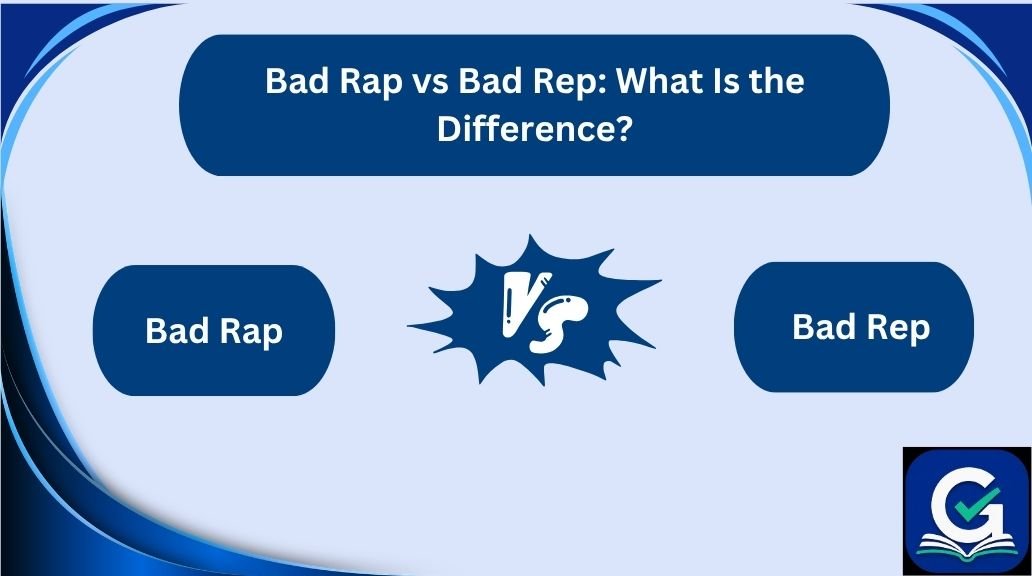
Have you ever heard someone say that a person, company, or movie has a “bad rap” and wondered whether they really meant “bad rep”? You are not alone. Bad rap vs bad rep is a common English usage question because both expressions sound natural in everyday American speech, and both are connected to the idea of having a negative reputation. However, they are not exactly interchangeable in every context.
The confusion becomes even stronger because rap and rep sound similar when spoken quickly. In addition, “rep” is a shortened form of “reputation,” while “rap” has a separate history and meaning in the expression “bad rap.” This makes the difference easier to understand once you look at what each phrase actually communicates.
In this guide, I will explain bad rap vs bad rep in simple US English. You will learn their meanings, differences, correct uses, common mistakes, examples, grammar rules, and practical writing tips. By the end, you will know exactly when to use each expression. 📚 One and the Same vs One in the Same | Calves vs Calfs | Abscess vs Abcess
Quick Answer: Bad Rap vs Bad Rep
Bad rap means an unfavorable reputation, especially one that is unfair, undeserved, or based on a negative judgment.
Bad rep is an informal shortened form of bad reputation. It simply means that someone or something has a negative reputation.
For example:
- “The restaurant gets a bad rap, but the food is actually excellent.”
- “The restaurant has a bad rep because of its slow service.”
The key distinction is that bad rap often suggests an unfair or undeserved negative reputation, while bad rep simply describes a poor reputation.
Understanding the Basics: Bad Rap vs Bad Rep
The easiest way to understand bad rap vs bad rep is to look at the words separately.
What Does “Bad Rap” Mean?
A bad rap is a negative reputation or unfavorable judgment, often one that a person or thing does not fully deserve.
For example:
“This neighborhood gets a bad rap.”
This means the neighborhood is often viewed negatively, possibly more negatively than it deserves.
The phrase can also suggest that someone or something has been criticized unfairly.
“He gets a bad rap for being quiet.”
The sentence does not necessarily mean that he is actually unpleasant. Instead, people may judge him negatively because he is quiet.
What Does “Bad Rep” Mean?
Bad rep is an informal abbreviation of bad reputation.
Here, rep stands for “reputation.”
For example:
“That company has a bad rep for poor customer service.”
The sentence simply says that the company is known for poor customer service.
Unlike bad rap, the phrase bad rep does not necessarily suggest that the reputation is unfair. It focuses on the negative reputation itself.
Comparison Table
| Form | Type | Meaning | Example | Correct/Incorrect |
|---|---|---|---|---|
| bad rap | Idiomatic phrase | An unfavorable reputation, often unfair or undeserved | “The product gets a bad rap.” | Correct |
| bad rep | Informal abbreviation | A bad or negative reputation | “The store has a bad rep.” | Correct |
| bad reputation | Standard phrase | A negative reputation | “The company has a bad reputation.” | Correct |
| bad wrap | Common misspelling | Usually intended to mean “bad rap” | “He gets a bad wrap.” | Incorrect in this meaning |
Both bad rap and bad rep can be correct, but they are not always identical in tone or meaning.
Correct Meanings & Uses
When to Use “Bad Rap”
Use bad rap when you are talking about a negative reputation or judgment, especially when that reputation may be unfair.
Consider this sentence:
“Camping gets a bad rap because some people think it is uncomfortable.”
Here, “gets a bad rap” means camping is viewed negatively.
The speaker may believe that this negative opinion is exaggerated or unfair.
Another example:
“My hometown gets a bad rap for being boring.”
The writer is suggesting that the hometown is unfairly considered boring.
Sentence Breakdown
Take the sentence:
“The movie gets a bad rap.”
- The movie = subject
- gets = verb
- a bad rap = noun phrase describing the negative reputation
The expression means that people tend to judge the movie negatively.
When to Use “Bad Rep”
Use bad rep when you simply want to say that someone or something has a poor reputation.
For example:
“The mechanic has a bad rep for arriving late.”
Here, the speaker is reporting a negative reputation.
There is no requirement that the reputation be unfair.
Another example:
“That website has a bad rep among customers.”
This means customers generally view the website negatively.
Sentence Breakdown
In:
“The company has a bad rep.”
- The company = subject
- has = verb
- a bad rep = noun phrase
- rep = shortened form of “reputation”
The phrase is informal but understandable in everyday American English.
Is “Bad Rap” More Correct Than “Bad Rep”?
Not necessarily.
This is one of the most important points in the bad rap vs bad rep debate.
They are different expressions rather than simply one correct form and one incorrect form.
Bad rap is an established idiomatic expression.
Bad rep is an informal shortening of “bad reputation.”
Therefore, both can be correct when used in appropriate contexts.
However, they have different levels of formality.
Compare:
- “The brand has a bad reputation.” — formal and standard
- “The brand has a bad rep.” — informal
- “The brand gets a bad rap.” — idiomatic and conversational
If you are writing a formal report, academic paper, business proposal, or professional document, bad reputation is usually the safest choice.
If you are writing casual content or dialogue, bad rep may sound perfectly natural.
Why Do People Confuse “Rap” and “Rep”?
The confusion is partly caused by pronunciation.
In rapid conversation, rap and rep can sound quite similar depending on the speaker and accent. People may also learn the expression by hearing it rather than seeing it in writing.
That creates a common spelling problem.
Someone may hear:
“He gets a bad rap.”
and write:
“He gets a bad wrap.”
The mistake happens because “wrap” is a familiar English word.
However, bad wrap is not the standard expression when you mean a negative reputation.
A Simple Memory Trick 🧠
Think of rap in bad rap as part of a fixed expression.
Think of rep as short for reputation.
So:
bad rap → idiom
bad rep → bad reputation
This simple distinction can prevent many spelling mistakes.
“Bad Rap” vs “Bad Reputation”
These expressions are closely related, but their tone can differ.
Bad Rap
“Bad rap” often carries the idea of criticism or judgment.
“The city gets a bad rap.”
This can imply:
“People judge the city too negatively.”
Bad Reputation
“Bad reputation” is more neutral.
“The city has a bad reputation.”
This simply reports that the city is viewed negatively.
The speaker does not necessarily say whether that reputation is deserved.
Compare the Meaning
She gets a bad rap for being strict.
This may suggest that people unfairly criticize her.
She has a bad reputation for being strict.
This simply says that she is known for being strict.
That subtle difference is useful when choosing between the expressions.
“Bad Rep” vs “Bad Reputation”
The difference between these two is mostly about formality.
Bad reputation is the complete expression.
Bad rep is the informal shortened version.
For example:
“The restaurant has a bad reputation.”
and:
“The restaurant has a bad rep.”
Both communicate essentially the same basic idea.
However, the first sentence sounds more formal.
Where “Bad Reputation” Works Best
Use bad reputation in:
- Academic writing
- Business reports
- Formal emails
- Professional documents
- News-style writing
- Official statements
Where “Bad Rep” Works Naturally
Use bad rep in:
- Conversations
- Text messages
- Casual blogs
- Social media
- Informal articles
- Dialogue
When in doubt, choose bad reputation in formal writing.
Case Study: A Workplace Example
Imagine that a manager is discussing a new employee with a coworker.
The coworker says:
“Jordan has a bad rep for missing deadlines.”
This means Jordan is known for missing deadlines.
Now imagine Jordan responds:
“I think I get a bad rap. I only missed two deadlines last year.”
The two expressions work naturally here, but they communicate slightly different ideas.
The coworker is describing Jordan’s reputation.
Jordan is arguing that the negative judgment is unfair or exaggerated.
This example demonstrates the practical difference between bad rep and bad rap.
Another Example: A Product
Imagine a phone has received negative reviews.
A customer might say:
“This phone has a bad rep for battery problems.”
The customer is describing its reputation.
A company representative might respond:
“Our phones get a bad rap because of a few older models.”
The company is suggesting that the negative reputation is unfair or no longer deserved.
Grammar Rules: Bad Rap vs Bad Rep
The expressions bad rap and bad rep function as noun phrases.
The adjective bad modifies the noun:
- bad + rap
- bad + rep
- bad + reputation
The article a is normally used because “rap” and “rep” are being treated as countable noun expressions in these constructions.
For example:
“He has a bad rap.”
“She has a bad rep.”
“The company has a bad reputation.”
Merriam-Webster is a standard American English dictionary resource, and dictionary usage guidance is useful when distinguishing established expressions from informal abbreviations. Its treatment of pronunciation and usage also reflects that acceptable English can contain variations without making every variant equally formal.
The important grammatical point is that rep is an informal shortened form connected to reputation, while bad rap is an established expression.
Why “Bad Wrap” Is Usually Incorrect
One of the most common mistakes is:
“He gets a bad wrap.”
If you mean that someone receives unfair criticism or has an unfavorable reputation, the standard expression is:
“He gets a bad rap.”
The word wrap has completely different meanings.
For example:
“Please wrap the gift.”
Here, “wrap” refers to covering something.
You can also use “wrap” in expressions such as:
“Let’s wrap up the meeting.”
Neither meaning is connected to reputation.
Therefore, when talking about reputation or unfair criticism, choose rap, not wrap.
Common Mistakes
People make bad rap vs bad rep mistakes for several reasons.
1. Fast Typing
When people type quickly, they often write the word that sounds right rather than the word they have seen in print.
For example:
“He gets a bad wrap.”
The writer may know the correct expression but type the wrong word automatically.
2. Autocorrect
Autocorrect can sometimes reinforce mistakes.
If a writer types something incorrectly, the keyboard may suggest another familiar word. Because “wrap” is a common word, it can easily appear in place of “rap.”
3. Lack of Knowledge
Some people learn expressions primarily through conversation.
If they have heard “bad rap” but never seen it written, they may reasonably guess that it is spelled “bad wrap.”
4. Confusing Abbreviations
“Rep” can be confusing because it has several meanings in English.
Depending on context, rep can refer to:
- reputation
- representative
- repetition
- repertory
In bad rep, however, it means reputation.
Similar Grammar Confusions
The bad rap vs bad rep issue belongs to a larger group of commonly confused English expressions.
| Confusion | Correct Forms | Main Difference |
|---|---|---|
| it’s vs its | Both can be correct | “It’s” = it is; “its” = possessive |
| your vs you’re | Both can be correct | “Your” = possession; “you’re” = you are |
| their vs there vs they’re | All can be correct | Possession, location, contraction |
| affect vs effect | Both can be correct | Usually verb vs noun |
| then vs than | Both can be correct | Time/order vs comparison |
| accept vs except | Both can be correct | Receive/agreement vs exclusion |
| loose vs lose | Both can be correct | Not tight vs fail to keep |
| bad rap vs bad rep | Both can be correct | Idiomatic expression vs informal abbreviation |
The lesson is simple: words that sound similar are not automatically interchangeable.
Usage in Different Contexts
Everyday Conversation
Both expressions can work naturally in casual conversation.
“That restaurant gets a bad rap.”
“That restaurant has a bad rep.”
The first can suggest that the criticism is unfair.
The second simply describes the restaurant’s reputation.
Professional Writing
In professional writing, bad reputation is usually the strongest choice.
Instead of:
“The company has a bad rep.”
write:
“The company has a bad reputation.”
This sounds clearer and more polished.
If you need to emphasize unfair criticism, you can write:
“The company has received unfair criticism in recent years.”
This is even more precise in formal contexts.
Creative Writing
Creative writing allows greater flexibility.
A character might naturally say:
“You know this place gets a bad rap.”
Another character might say:
“That guy has a bad rep around here.”
The choice can help establish personality, voice, and tone.
Social Media and Texting
Bad rep is particularly natural in informal digital communication.
For example:
“That app has a bad rep, but I actually like it.”
Shorter expressions often work well in texts and social posts.
Bad rap is also common:
“This hobby gets such a bad rap!”
The choice depends on what the writer wants to emphasize.
Why It Matters
Correct word choice matters because small differences can change how readers interpret a sentence.
Clarity in Communication
Using bad rap when you mean unfair criticism can communicate more nuance than simply saying bad reputation.
Professionalism
In formal writing, bad reputation is clearer and more polished than the informal bad rep.
Digital Communication
Online writing moves quickly. Readers may overlook small mistakes, but repeated errors can reduce trust.
Correct spelling helps readers understand your message without stopping to interpret what you meant.
A Simple Principle
“Choose the word that matches your meaning, not just the sound.”
That principle applies far beyond bad rap vs bad rep.
Special Exceptions and Edge Cases
There is no major grammatical exception that makes bad rap universally correct or bad rep universally incorrect.
The important edge case is context.
“Rap” Can Have Other Meanings
The word rap can refer to a quick knock or strike.
For example:
“He gave on the door a quick rap.”
“Rap” is also associated with a genre of music.
Neither meaning should be confused with the expression bad rap.
“Rep” Has Multiple Meanings
As mentioned earlier, rep can mean more than “reputation.”
For example:
“The sales rep called this morning.”
Here, “rep” means representative, not reputation.
Therefore, context determines the meaning.
Brand Names and Creative Names
A company, product, group, or creative work may intentionally use “Rap,” “Rep,” or “Wrap” as part of its name.
If it is a proper name, preserve the official spelling rather than changing it to fit a grammar rule.
How to Remember the Difference
Try this three-part memory trick:
1. Bad Rap = Negative Judgment
Think:
“People gave it a bad rap.”
This often suggests criticism that may be unfair.
2. Bad Rep = Bad Reputation
Think:
“Rep” is short for “reputation.”
Therefore:
“It has a bad rep.”
means:
“It has a bad reputation.”
3. Bad Wrap = Different Word
Think about wrapping a present.
“Wrap the gift.”
That has nothing to do with reputation.
Quick Recap Checklist
Use this checklist whenever you are unsure.
| Question | If Yes → Use |
|---|---|
| Am I talking about an unfavorable reputation or criticism that may be unfair? | Bad rap |
| Am I informally shortening “bad reputation”? | Bad rep |
| Am I writing something formal? | Bad reputation |
| Am I talking about covering or enclosing something? | Wrap |
| Am I describing a person who is known for something negative? | Bad rep or bad reputation |
| Am I saying someone is unfairly judged? | Bad rap |
Practice Example 1
“This sport gets a ___ because people think it is dangerous.”
Answer: bad rap
Why? The sentence suggests that the sport is being judged negatively, possibly unfairly.
Practice Example 2
“That business has a ___ for poor customer service.”
Answer: bad rep
Why? The sentence describes the business’s negative reputation.
Practice Example 3
“The company has a ___ among former employees.”
Answer: bad reputation
Why? This is the most formal and complete option.
Bad Rap vs Bad Rep: Quick Examples
Here are several examples to make the distinction easier.
Bad Rap
- “The neighborhood gets a bad rap.”
- “He gets a bad rap for being quiet.”
- “Reality TV gets a bad rap.”
- “The product has gotten a bad rap online.”
- “She thinks the profession gets a bad rap.”
In these examples, the expression often carries a sense of criticism or negative judgment.
Bad Rep
- “That restaurant has a bad rep.”
- “The company has a bad rep among customers.”
- “He has a bad rep at work.”
- “That brand has a bad rep for low-quality products.”
- “The app has a bad rep on social media.”
These examples focus more directly on reputation.
Bad Reputation
- “The company has a bad reputation.”
- “The neighborhood has a bad reputation.”
- “The product developed a bad reputation.”
- “The manager has a bad reputation for being difficult.”
- “The website has a bad reputation among users.”
This is the best general-purpose choice when you want formal, clear English.
Can “Bad Rap” and “Bad Rep” Be Used Interchangeably?
Sometimes, yes.
In casual conversation, both can communicate the general idea that someone or something is viewed negatively.
For example:
“The restaurant gets a bad rap.”
and:
“The restaurant has a bad rep.”
A listener will probably understand both.
However, the expressions are not perfectly identical.
Bad rap is especially useful when you want to emphasize criticism or an unfavorable judgment.
Bad rep is especially useful when you simply want to describe a negative reputation.
So, although they overlap, choosing the expression that best matches your intended meaning makes your writing more precise.
Is “Bad Rep” Formal English?
Bad rep is understandable and widely used informal English, but it is less formal than bad reputation.
That does not mean it is automatically wrong.
Language often uses shortened forms in everyday speech.
For example:
- advertisement → ad
- examination → exam
- laboratory → lab
- reputation → rep
The shortened form can be perfectly natural in casual communication.
For formal writing, however, the complete expression bad reputation is generally preferable.
Can You Say “Give Someone a Bad Rap”?
Yes.
The expression can appear in constructions involving criticism or judgment.
For example:
“The article gave the restaurant a bad rap.”
This means the article caused readers to develop a negative impression of the restaurant.
You can also say:
“Don’t give him a bad rap.”
This means:
“Don’t judge or criticize him unfairly.”
This use strongly demonstrates why bad rap often carries a sense of unfair treatment.
Can You Say “Have a Bad Rep”?
Yes.
This construction is natural in informal English.
For example:
“The store has a bad rep.”
The sentence means:
“The store has a bad reputation.”
The phrase is especially common in casual speech, online discussions, and informal writing.
However, if you are writing a formal business report, use:
“The store has a bad reputation.”
instead.
FAQs
1. Is it “bad rap” or “bad rep”?
Both can be correct, but they have slightly different meanings. Bad rap is an established expression for an unfavorable reputation or negative judgment, often one that is unfair. Bad rep is an informal shortened form of “bad reputation.”
2. Is “bad wrap” correct?
Usually, no. If you mean a negative reputation or unfair criticism, the standard expression is bad rap, not bad wrap. “Wrap” is a different word with meanings related to covering, enclosing, or finishing something.
3. Does “bad rap” mean bad reputation?
Yes. Bad rap can mean a bad or unfavorable reputation. It often adds the idea that someone or something has been judged negatively, possibly unfairly.
4. Is “bad rep” grammatically correct?
Yes, bad rep is an accepted informal expression when “rep” means “reputation.” It is less formal than bad reputation, so the complete form is usually better in professional or academic writing.
5. Which is better for formal writing: “bad rap” or “bad rep”?
For formal writing, bad reputation is usually the clearest choice. If you specifically want to express the idea of unfair criticism, bad rap can still be appropriate, but bad rep is more conversational.
6. How can I remember “bad rap” vs “bad rep”?
Remember that rep is short for reputation. Use bad rep when you mean a bad reputation informally. Use bad rap when you mean an unfavorable judgment or reputation, especially when it seems unfair. Never use bad wrap for this meaning.
Conclusion
Understanding bad rap vs bad rep is easier once you separate their meanings. Bad rap is an established expression that refers to an unfavorable reputation or negative judgment, often with the suggestion that the criticism is unfair or undeserved.
Bad rep, meanwhile, is an informal shortened form of bad reputation and simply describes a negative reputation.
Both expressions can be correct, but they serve slightly different purposes. In casual conversation, bad rap and bad rep are both natural choices.
In formal writing, bad reputation is usually the safest and clearest option. And if you are talking about reputation, remember that bad wrap is not the standard spelling.
The simplest rule is this: bad rap = negative or possibly unfair judgment, bad rep = bad reputation, and bad wrap = a different word entirely. Once you remember that distinction, you will never have to second-guess this common English confusion again. ✨

I’m Amelia Parker, an English language writer at Gramfino, focused on making difficult language topics easier to understand.
I write about grammar, vocabulary, word usage, and everyday English to help readers communicate clearly.