Have you ever written a sentence such as “They are one in the same” and wondered whether something about it looks wrong? You are not alone. The confusion between one and the same vs one in the same is common because the two phrases sound almost identical when spoken quickly. However, only one is the standard expression when you mean that two people or things are actually identical.
The correct phrase is one and the same. It means that two descriptions, names, people, or things refer to exactly the same person or thing. One in the same is generally considered an incorrect version of the expression when used with this meaning.
This small wording difference can matter, especially in professional writing, academic work, emails, and other situations where accuracy matters. Once you understand why the phrase uses and rather than in, the distinction becomes much easier to remember.
In this guide, we will explain one and the same vs one in the same, examine their meanings, look at common mistakes, and provide practical examples you can use in everyday and professional English. 📚 Calves vs Calfs | Abscess vs Abcess | Ability vs Abillity
Quick Answer: One and the Same vs One in the Same
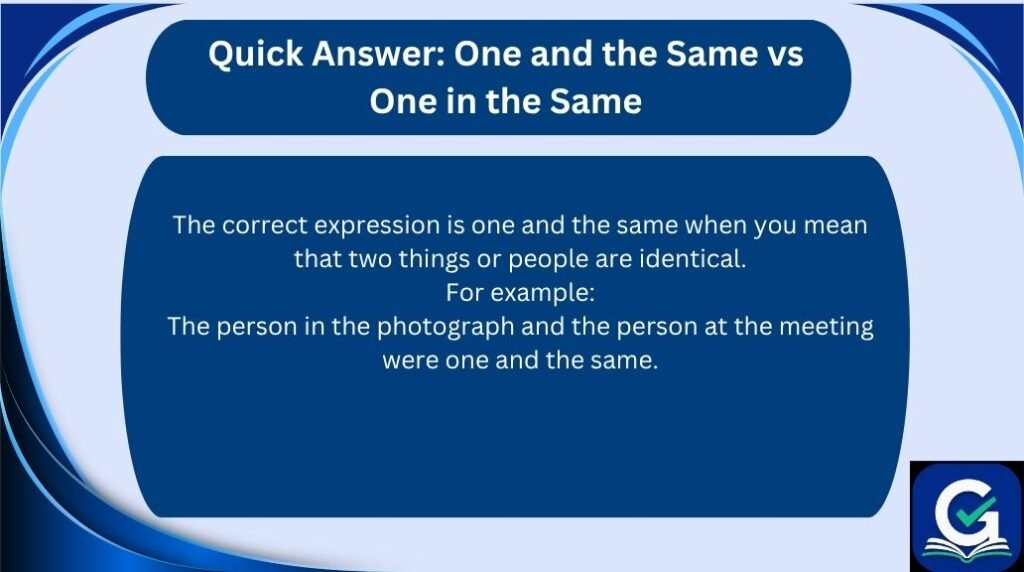
The correct expression is one and the same when you mean that two things or people are identical.
For example:
The person in the photograph and the person at the meeting were one and the same.
One in the same is usually a mistaken version of the phrase. If you are comparing two identities and saying they are actually identical, use one and the same.
Quick Rule
One and the same = correct
One in the same = incorrect for this idiomatic meaning
The word and connects the two ideas being identified as identical.
Understanding the Basics: One and the Same vs One in the Same
The easiest way to understand one and the same vs one in the same is to focus on meaning rather than pronunciation.
One and the same tells readers that two apparently different references point to one identical person, object, idea, or situation.
Consider this sentence:
The author of the article and the speaker at the conference were one and the same person.
The sentence says that the author and the speaker were not two different people. They were actually the same person.
By contrast, one in the same does not express the standard idiomatic meaning. It often appears because speakers hear and the as a continuous sound and later reproduce it as in the when writing.
Comparison Table
| Feature | One and the Same | One in the Same |
|---|---|---|
| Form | One and the same | One in the same |
| Type | Standard English expression | Common mistaken form |
| Meaning | Identical; exactly the same | Not the standard expression for this meaning |
| Example | They are one and the same. | They are one in the same. |
| Correct/Incorrect | Correct | Incorrect in this usage |
The key distinction is simple: use “and,” not “in,” when you mean identical.
Why the Confusion Happens
The confusion is largely caused by pronunciation.
When people say:
one and the same
the words can run together in natural speech. The unstressed and may sound weak, making the phrase difficult to distinguish clearly.
Someone who has heard the expression many times but has not seen it written may reasonably assume that it is one in the same.
That assumption is understandable, but it is not the standard spelling of the idiom.
What Does “One and the Same” Mean?
The expression one and the same means that two apparently separate things are actually identical.
It can refer to:
- People
- Objects
- Names
- Places
- Ideas
- Roles
- Situations
- Causes
- Descriptions
Example 1: Two Descriptions, One Person
The manager and the person who called me yesterday were one and the same.
Here, “the manager” and “the person who called me” are two descriptions of one person.
Example 2: Two Names, One Place
The old market and the new shopping district are one and the same location.
The writer is saying that the two descriptions refer to the same location.
Example 3: Two Roles, One Person
She is the company’s founder and its current CEO, so the two roles are held by one and the same person.
The expression emphasizes identity.
Example 4: Two Suspects, One Individual
The detective eventually discovered that the witness and the suspect were one and the same person.
Again, two descriptions identify one individual.
Why “And” Is Used in the Expression
Understanding the role of and makes the rule easier to remember.
The phrase is built around the idea that two references are being joined:
A and B are one and the same.
The word and connects the two descriptions.
For example:
The mystery writer and the anonymous blogger were one and the same.
“The mystery writer” is one reference.
“The anonymous blogger” is another reference.
The expression tells us that both references identify the same person.
The word in does not perform that connecting function in the standard idiom. That is why replacing and with in changes the expression into a nonstandard form.
Is “One in the Same” Ever Correct?
When you are using the phrase to mean “identical,” one in the same is not the standard form.
For example:
❌ The two witnesses were one in the same.
Better:
✅ The two witnesses were one and the same.
Similarly:
❌ The person who emailed me and the person who called me are one in the same.
Correct:
✅ The person who emailed me and the person who called me are one and the same.
There are legitimate English constructions containing the words one, in, and the same, but they are not interchangeable with the idiom one and the same.
That distinction is important. The issue is not that the words “one,” “in,” and “same” can never appear together in English. The issue is that one in the same is not the standard expression for saying that two things are identical.
Correct Meanings and Uses
The phrase one and the same can be useful in several situations.
1. Identifying the Same Person
This is one of the most common uses.
The teacher and the author of the book were one and the same.
The sentence tells us that the teacher wrote the book.
2. Identifying the Same Thing
The expression can also identify objects.
The missing document and the file on my desk were one and the same.
The two descriptions refer to one document.
3. Connecting Two Ideas
Sometimes the phrase connects related concepts.
For this project, quality and reliability are one and the same.
Here, the writer emphasizes that quality and reliability are effectively inseparable in the context being discussed.
4. Emphasizing Identity
The phrase can provide extra emphasis.
Compare:
The two names refer to the same person.
with:
The two names refer to one and the same person.
The second version places stronger emphasis on the fact that the identities are identical.
Sentence Breakdown
Consider:
The buyer and the person who submitted the offer were one and the same.
- The buyer = first reference
- the person who submitted the offer = second reference
- one and the same = both references identify one person
This structure is useful when the writer wants to remove doubt.
Test Tip: How to Remember the Correct Phrase
Here is a simple test.
Ask yourself:
Am I saying that two people or things are actually identical?
If the answer is yes, use:
one and the same
For example:
The winner and the person who received the trophy were one and the same.
If you can replace the phrase with “exactly the same” without changing the basic meaning, one and the same is likely the expression you need.
Memory Trick 🧠
Think of it this way:
A and B = one and the same.
The word and joins A and B.
So remember:
A + B → one AND the same
Not:
A + B → one IN the same
One and the Same vs One in the Same in Real Life
Imagine that you receive an email from your company’s hiring manager.
Later, you discover that the hiring manager is also the person who conducted your first interview.
You might say:
I realized that the hiring manager and the person who interviewed me were one and the same.
This is clear and professional.
Writing:
I realized that the hiring manager and the person who interviewed me were one in the same.
would use the commonly mistaken version of the phrase.
The distinction may seem small, but professional writing benefits from using established expressions correctly.
Case Study: A Workplace Example
Imagine a marketing team preparing a report.
During a meeting, someone says:
“The customer who submitted the complaint is the same person who completed our survey.”
Another employee wants to summarize the discovery in an email.
A polished version would be:
We confirmed that the customer who submitted the complaint and the person who completed the survey were one and the same.
This wording is concise and emphasizes that the two records belong to the same individual.
Why This Works
The sentence contains two descriptions:
- The customer who submitted the complaint
- The person who completed the survey
The phrase one and the same tells the reader that both descriptions identify one individual.
Incorrect Version
We confirmed that the customer who submitted the complaint and the person who completed the survey were one in the same.
The meaning may still be understandable, but the expression is not standard.
Professional Lesson
When writing an email, report, proposal, or business document, choose the established form:
one and the same
Accuracy in small expressions can make professional writing look more polished.
Grammar Rules: One and the Same vs One in the Same
The phrase one and the same functions as an established English expression meaning “identical” or “exactly the same.”
Dictionaries recognize one in several grammatical roles and idiomatic constructions. Dictionary references also document expressions such as one and all and at one, showing that “one” participates in many established idioms.
The important point here is that one and the same is the established form for expressing identity.
Why “One in the Same” Sounds Natural
The mistaken version often develops from speech.
When someone says:
one and the same
the word and can be pronounced quickly and with little stress.
As a result, a listener may hear something closer to:
one ’n the same
Over time, that sound can be interpreted as:
one in the same
This is an example of how spoken English can create spelling mistakes.
The Grammar Principle
The phrase identifies two references as one entity:
X and Y are one and the same.
The conjunction and connects X and Y.
Replacing and with in creates a different construction that does not represent the standard idiom.
Examples of “One and the Same”
Here are several examples showing natural usage.
Example 1
The person at the door and the caller were one and the same.
Meaning: The person at the door was the caller.
Example 2
The two brands have different names, but they are owned by one and the same company.
Meaning: Both brands belong to the same company.
Example 3
The author and the narrator are one and the same in the story.
Meaning: The author and narrator are being treated as the same person.
Example 4
For many readers, convenience and speed are one and the same.
Meaning: In that context, readers view convenience and speed as essentially identical.
Example 5
The original file and the backup copy turned out to be one and the same.
Meaning: The supposedly separate files were actually the same file.
Example 6
We discovered that the two accounts belonged to one and the same customer.
Meaning: Both accounts belonged to one customer.
Common Mistakes With This Phrase
Mistakes with one and the same vs one in the same happen for several reasons.
1. Fast Typing
People often type quickly and reproduce the phrase as they remember hearing it.
A writer may type:
one in the same
without consciously considering whether in or and is correct.
2. Pronunciation
As mentioned earlier, and is often reduced in natural speech.
This makes the phrase sound different from how it appears in writing.
3. Autocorrect
Autocorrect can sometimes reinforce a word choice rather than correct the underlying expression. If the writer repeatedly types a nonstandard phrase, a device may not identify the problem.
4. Lack of Knowledge
Some people simply have never encountered the phrase in written English.
If you have only heard an expression, it can be difficult to know its exact spelling.
5. Confusion With Other “In” Expressions
English contains many common expressions with in, such as:
- in the same way
- in the same place
- in the same situation
- in the same group
Because these are familiar, one in the same may feel grammatically plausible.
Similar Grammar Confusions
The confusion between one and the same vs one in the same belongs to a larger group of commonly mixed-up expressions.
| Common Confusion | Correct Form | Incorrect/Commonly Confused Form | Reason |
|---|---|---|---|
| one and the same | one and the same | one in the same | Sound-based confusion |
| it’s / its | it’s / its | mixed use | Contraction vs possessive |
| your / you’re | your / you’re | mixed use | Possessive vs contraction |
| their / they’re | their / they’re | mixed use | Possessive vs contraction |
| then / than | then / than | mixed use | Time/order vs comparison |
| affect / effect | affect / effect | mixed use | Different grammatical functions |
| they’re / there / their | all three | mixed use | Similar pronunciation |
| could have | could have | could of | Sound-based spelling |
These errors are common because English spelling does not always match pronunciation.
One and the Same vs One in the Same in Everyday Conversation
In casual conversation, people may use the incorrect form without causing confusion.
For example, someone might say:
“Those two guys are one in the same.”
The listener will probably understand the intended meaning.
However, being understandable is not the same as being grammatically standard.
In careful writing, use:
“Those two guys are one and the same.”
The correct expression is especially important when you are writing for an audience that expects standard English.
One and the Same in Professional Writing
Professional writing benefits from precision.
You might use the expression in:
- Business emails
- Reports
- Research papers
- Legal-style documents
- Presentations
- Workplace communication
- News writing
- Formal correspondence
Example
Our review showed that the account holder and the person who approved the transaction were one and the same.
This sentence sounds clear and professional.
Using the established form prevents a small wording error from distracting the reader.
One and the Same in Creative Writing
Creative writers can also use one and the same.
For example:
The stranger in the doorway and the man from her childhood memories were one and the same.
The phrase can create emphasis or reveal an important connection.
Another example:
Fear and excitement were, for him, one and the same.
Here, the expression is being used more figuratively. It suggests that the character experiences the two emotions as inseparable or effectively identical.
Creative writing gives authors flexibility, but the standard expression remains one and the same.
One and the Same in Social Media and Texting
Social media and texting are informal environments.
People frequently shorten words, ignore punctuation, and use phonetic spellings. You may therefore encounter:
one in the same
in casual online conversations.
That does not make it the standard form.
If you are writing a caption, post, professional message, or public comment and want polished English, choose:
one and the same
Informal vs Polished
Casual:
Those two accounts are one and the same lol.
Polished:
Those two accounts are one and the same.
The phrase itself does not need to be changed. The surrounding style can simply become more formal when necessary.
Why the Difference Matters
At first glance, one and the same vs one in the same may seem like a tiny issue. After all, most readers can understand the intended meaning.
But language accuracy matters for several reasons.
1. Clarity
Using the established expression makes your meaning immediately recognizable.
2. Professionalism
Correct expressions help business emails, reports, applications, and other documents appear polished.
3. Writing Accuracy
Small errors can distract readers, especially when they occur in formal writing.
4. Digital Communication
Online writing is often read quickly. Standard expressions make messages easier to process.
5. Confidence
Knowing the correct form helps you write without second-guessing yourself.
A Short Reminder
Clear writing makes your meaning easier to trust.
That is why even small grammar and usage distinctions are worth learning.
Is “One and the Same” Formal?
One and the same is somewhat emphatic and can sound more formal than simply saying the same.
Compare:
They are the same person.
with:
They are one and the same person.
The first sentence is straightforward.
The second emphasizes the identity more strongly.
You do not need to use one and the same in every sentence. If a simpler phrase works better, the same is often perfectly natural.
When to Choose “One and the Same”
Use it when you want to emphasize that two apparently separate references identify exactly the same thing.
For example:
The buyer and the person who signed the contract were one and the same.
The expression adds emphasis that may be useful in the context.
Can “One and the Same” Be Used With People?
Yes.
It is very common to use one and the same when referring to people.
Examples:
The caller and the customer were one and the same.
The author and the speaker were one and the same person.
The person who reported the problem and the person who fixed it were one and the same.
The expression helps connect two descriptions of a single individual.
Can “One and the Same” Be Used With Things?
Yes.
Examples include:
The two files were one and the same.
The two products turned out to be one and the same model.
The original plan and the revised plan were almost one and the same.
The exact wording can vary according to the sentence, but the core meaning remains identity.
Can “One and the Same” Be Used With Ideas?
Yes.
It can also describe concepts that are effectively identical within a particular context.
For example:
For this team, efficiency and productivity are almost one and the same.
This does not necessarily mean that the two abstract concepts are universally identical. Instead, the writer is emphasizing that they are treated as equivalent in the given context.
That distinction is useful when writing about abstract ideas.
Special Exception and Edge Cases
There is no standard grammatical exception that turns one in the same into the preferred form of the idiom meaning “identical.”
However, English can naturally contain the words one, in, and the same in other grammatical structures.
For example:
One person in the same department submitted both forms.
Here, in the same department is an ordinary prepositional phrase. It has nothing to do with the idiom one and the same.
Another example:
She was the one in the same room as the manager.
Again, in the same room describes location.
Therefore, the problem is not the sequence of individual words. The problem occurs when one in the same is used as a replacement for one and the same.
Important Distinction
One and the same = identical
in the same room = located together
in the same group = belonging to the same group
one in the same = not the standard idiom for “identical”
A Simple Editing Strategy
If you are proofreading an article, essay, email, or report, search for:
one in the same
Then ask whether you intended to say:
one and the same
If you meant “identical,” replace in with and.
Before
The two witnesses were one in the same.
After
The two witnesses were one and the same.
This quick search can prevent a very common mistake.
Quick Recap Checklist
Use this checklist whenever you are unsure about one and the same vs one in the same.
| Question | If Yes → Use |
|---|---|
| Am I saying two people are actually the same person? | one and the same |
| Am I saying two objects are identical? | one and the same |
| Am I saying two descriptions refer to one thing? | one and the same |
| Am I describing location, such as “in the same room”? | in the same |
| Am I using “one in the same” to mean identical? | Replace it with one and the same |
Practice Example 1
Choose the correct phrase:
The mysterious caller and the person at the office were ______.
Correct answer:
one and the same
Practice Example 2
Choose the correct phrase:
The two accounts belonged to ______ customer.
Correct answer:
one and the same
Practice Example 3
Choose the correct phrase:
They were sitting ______ room.
Correct answer:
the same
or:
in the same room
This third example shows why context matters. The word in is perfectly correct in other constructions. It simply does not replace and in the idiom one and the same.
Quick Comparison: One and the Same vs the Same
Sometimes writers wonder whether one and the same is necessary when the same would work.
Both can be correct, but they have slightly different emphasis.
| Phrase | General Effect | Example |
|---|---|---|
| the same | Direct and simple | They are the same person. |
| one and the same | More emphatic | They are one and the same person. |
If you want the shortest natural expression, use the same.
If you want to emphasize that two apparently different references identify exactly one person or thing, one and the same is useful.
FAQs
1. Is “one and the same” correct?
Yes. One and the same is the standard expression used to say that two people or things are identical or refer to the same person or thing.
Example:
The writer and the speaker were one and the same.
2. Is “one in the same” grammatically correct?
Not when it is being used as a replacement for one and the same. The standard expression for the meaning “identical” is one and the same.
3. Why do people say “one in the same”?
The mistake often comes from pronunciation. In natural speech, and can be pronounced quickly and weakly, making one and the same sound similar to one in the same.
4. What does “one and the same” mean?
It means that two apparently different people, things, descriptions, or identities are actually the same.
Example:
The anonymous writer and the newspaper columnist were one and the same.
5. Can I use “one and the same” in formal writing?
Yes. It is a standard expression and can be used in professional, academic, and other formal contexts when you want to emphasize identity.
6. Is “one and the same” the same as “the same”?
They can have similar meanings, but one and the same is often more emphatic. It highlights that two references point to one identical person or thing.
Conclusion
Understanding one and the same vs one in the same is much easier once you focus on the meaning of the expression. When you want to say that two people, things, names, descriptions, or ideas are actually identical, the correct standard phrase is one and the same.
The word and is important because it connects the two references being identified as one. The phrase one in the same commonly appears because of fast speech, pronunciation, typing habits, autocorrect, or simple unfamiliarity with the written expression. Although readers can usually understand the intended meaning, it is best to use the established form in polished writing.
Remember the easiest rule:
If two things are actually identical, they are one AND the same.
Once this simple distinction becomes familiar, you will be able to recognize and correct this common mistake quickly. In grammar, tiny words can make a big difference—and in this case, and is the word to remember. ✍️

I’m Clara Bennett, a vocabulary and language specialist at Gramfino, where I write about word meanings and proper usage.
I love helping readers choose the right words and build stronger English vocabulary with confidence.
[…] and practical writing tips. By the end, you will know exactly when to use each expression. 📚 One and the Same vs One in the Same | Calves vs Calfs | Abscess vs […]