Have you ever typed a word, looked at it twice, and suddenly wondered whether it is spelled correctly? This happens often with words that contain repeated letters, especially when we type quickly. One common example is acquit vs aquit. The two spellings look almost identical, but they do not have the same status in standard English.
If you are writing an essay, preparing a professional email, studying for an exam, or simply trying to improve your vocabulary, knowing which form is correct can save you from an unnecessary spelling mistake.
The correct spelling is acquit. It is a verb that commonly means to officially declare someone not guilty of a crime or charge. It can also describe how someone performs or conducts themselves in a particular situation. The spelling aquit, with only one “c,” is not the standard English spelling of this word.
In this guide, I will explain acquit vs aquit in simple terms, show you how to use acquit correctly, discuss common mistakes, and provide practical examples. By the end, the difference should be easy to remember. ✅ Committed vs Comited | Cozy vs. Cosy | Peak vs Peek
Quick Answer: Acquit vs Aquit
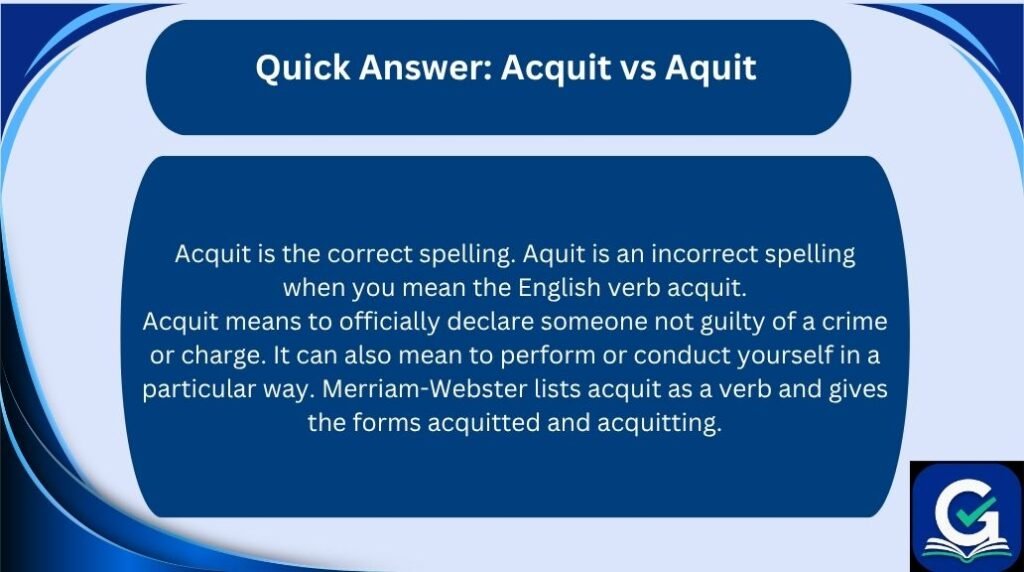
Acquit is the correct spelling. Aquit is an incorrect spelling when you mean the English verb acquit.
Acquit means to officially declare someone not guilty of a crime or charge. It can also mean to perform or conduct yourself in a particular way. Merriam-Webster lists acquit as a verb and gives the forms acquitted and acquitting.
Correct: The jury decided to acquit the defendant.
Incorrect: The jury decided to aquit the defendant.
The easiest rule is simple:
Use “acquit” with “cc.”
Understanding the Basics of Acquit vs Aquit
The main difference between these two forms is spelling. In standard English, acquit is the established word, while aquit is a misspelling.
The word acquit is pronounced approximately uh-KWIT. It functions primarily as a verb and is frequently used in legal contexts. For example, a court or jury may acquit a person when that person is found not guilty of a particular charge. Cambridge defines acquit as officially deciding in court that someone is not guilty of a particular crime.
However, acquit has another useful meaning. It can describe someone’s performance or behavior. For example:
She acquitted herself well during the interview.
Here, acquit does not mean “declare innocent.” Instead, it refers to performing or conducting oneself successfully.
Acquit vs Aquit Comparison Table
| Feature | Acquit | Aquit |
|---|---|---|
| Form | Acquit | Aquit |
| Type | Verb | Nonstandard/misspelled form |
| Meaning | To declare someone not guilty; to conduct oneself in a certain way | No standard English meaning in this context |
| Example | The jury chose to acquit him. | The jury chose to aquit him. |
| Correct/Incorrect | ✅ Correct | ❌ Incorrect |
The extra c is important. Removing it changes the spelling from the standard word to a misspelling.
Correct Meanings and Uses of Acquit
Understanding the meanings of acquit makes it easier to remember why the word is spelled the way it is.
1. Acquit Means to Declare Someone Not Guilty
The most familiar meaning of acquit is legal.
When a court or jury acquits someone, it officially finds that person not guilty of a particular charge.
Examples
- The jury acquitted the defendant.
- The judge decided to acquit him of the charge.
- She was acquitted of all charges.
- The defendant was acquitted because the evidence was insufficient.
Notice the common structure:
acquit + person + of + charge
For example:
The jury acquitted the defendant of the crime.
The word acquit does not simply mean that someone is personally believed to be innocent in everyday conversation. In its central legal sense, it refers to a formal decision concerning a specific charge. Merriam-Webster describes acquit as implying a formal decision in someone’s favor regarding a definite charge.
Sentence Breakdown
Consider:
The jury acquitted the defendant of the robbery charge.
- The jury = subject
- acquitted = verb
- the defendant = object
- of the robbery charge = explains the charge
This sentence clearly communicates that the jury formally cleared the defendant of that charge.
2. Acquit Can Describe Performance
There is another meaning that learners sometimes overlook.
Acquit oneself can mean to perform or conduct oneself in a particular way, especially in a difficult situation.
For example:
She acquitted herself well during the presentation.
This means she performed well or handled herself effectively.
Cambridge specifically recognizes this use, explaining that acquit yourself can mean to perform or behave in a particular way.
More Examples
- He acquitted himself well during the interview.
- The players acquitted themselves admirably in the final.
- She acquitted herself professionally during the meeting.
- The young speaker acquitted herself confidently on stage.
This usage is somewhat formal, so you may see it more often in professional, academic, literary, or formal writing than in casual conversation.
3. Acquit Has Historical Uses
Merriam-Webster also records older meanings connected with paying or discharging an obligation. These meanings are marked as archaic or obsolete.
For modern American English, however, the most useful meanings are:
- To formally declare someone not guilty.
- To conduct or perform oneself in a certain way.
You generally do not need the older meanings for ordinary writing.
Test Tip: How to Check Your Spelling
When you are unsure about acquit vs aquit, try this quick test:
Ask yourself:
Am I trying to write the verb meaning “declare not guilty” or “perform/behave”?
If yes, write:
acquit
Never:
aquit
A second memory trick is to remember the related forms:
- acquit
- acquitted
- acquitting
- acquittal
Seeing the repeated cc across the word family can help reinforce the correct spelling.
Why Is Acquit Spelled With “cc”?
The spelling can feel unusual because English pronunciation does not always make every written letter obvious.
The word is pronounced /əˈkwɪt/, so the sound may make it tempting to spell the word phonetically as aquit. However, standard spelling preserves the established form acquit. Merriam-Webster lists the pronunciation and explicitly gives acquitted and acquitting as its inflected forms.
This is a useful reminder that English spelling cannot always be predicted from pronunciation alone.
Compare:
- quit
- acquit
- acquitted
- acquitting
The pronunciation alone does not tell you that the spelling should contain cc.
Acquit vs Aquit in Real-Life Writing
Let’s imagine a workplace situation.
Suppose a manager is discussing a legal case with a colleague.
Incorrect Email
The court decided to aquit the employee after reviewing the evidence.
The sentence has a spelling error.
Correct Email
The court decided to acquit the employee after reviewing the evidence.
The second version uses the standard spelling.
Now consider the other meaning.
Correct Professional Sentence
Maria acquitted herself well during the client presentation.
Here, acquitted herself well means Maria performed well.
This example shows why learning the meaning of a word is just as important as memorizing its spelling.
Case Study: A Workplace Example
Imagine that a company employee is involved in a legal dispute outside the workplace. After several months, the case goes to court. The employee is eventually found not guilty.
A manager might write:
“The court acquitted James of the charges, so the company will review the matter separately.”
Here, acquitted is the past tense of acquit.
Now imagine a different situation. James is asked to give a presentation to senior executives.
His manager might later say:
“James acquitted himself very well during the presentation.”
The same root word appears in both sentences, but the meaning changes.
Example 1: Legal Meaning
The court acquitted James of the charges.
Meaning: The court officially found James not guilty.
Example 2: Performance Meaning
James acquitted himself well during the presentation.
Meaning: James performed or conducted himself well.
This is one reason learning vocabulary in context is so useful.
Grammar Rules for Acquit
Is Acquit a Verb?
Yes. Acquit is a verb.
Merriam-Webster identifies acquit as a verb and gives its standard forms as acquitted and acquitting.
Examples include:
- The jury will acquit him.
- The jury acquitted him.
- The lawyers are asking the court to acquit their client.
- She acquitted herself well.
What Is the Past Tense of Acquit?
The past tense and past participle are:
acquitted
Not:
❌ aquitted
Notice that the double consonant remains, and another t is added before the -ed ending.
Correct Forms
| Form | Example |
|---|---|
| Base form | acquit |
| Third-person singular | acquits |
| Present participle | acquitting |
| Past tense | acquitted |
| Past participle | acquitted |
| Noun | acquittal |
Examples
Present:
The jury may acquit the defendant.
Past:
The jury acquitted the defendant.
Continuous:
The court is considering whether to acquit him.
Perfect:
The defendant has been acquitted.
These forms are all built from the correct spelling acquit.
Why “Aquit” Is Incorrect
The problem with aquit is not that it represents a different common grammatical form. It is simply missing the second c from the standard spelling.
When you want to use the English verb meaning “declare not guilty,” standard dictionaries give the spelling:
acquit
Merriam-Webster’s dictionary entry is explicitly headed acquit, not aquit.
Cambridge also lists acquit as the standard English verb.
Therefore:
❌ The judge will aquit him.
should be:
✅ The judge will acquit him.
Common Mistakes With Acquit
Why do people make the aquit spelling mistake?
There are several common reasons.
1. Fast Typing
When people type quickly, they often leave out repeated letters.
For example:
acquit → aquit
The second c can easily disappear during fast typing.
This is especially common when you know how the word sounds but have not memorized its spelling.
2. Pronunciation
Because acquit is pronounced approximately “uh-KWIT,” some writers may spell it according to sound.
English contains many words whose spelling cannot be predicted perfectly from pronunciation.
Therefore, hearing the word is not enough. You also need to recognize its written form.
3. Autocorrect
Autocorrect can sometimes create confusion when a misspelled word is not immediately corrected.
If you type aquit, your device may or may not suggest acquit, depending on the software and context.
Always proofread important documents instead of relying completely on autocorrect.
4. Lack of Familiarity
Someone who rarely encounters legal vocabulary may simply never have seen the word written correctly.
Reading the word in books, articles, legal documents, and reliable dictionaries helps build visual familiarity.
Similar Grammar and Spelling Confusions
The acquit vs aquit problem is part of a larger group of common English mistakes.
| Confusion | Correct Form | Meaning |
|---|---|---|
| its / it’s | its / it’s | Possession / it is |
| your / you’re | your / you’re | Possession / you are |
| their / they’re | their / they’re | Possession / they are |
| affect / effect | affect / effect | Influence / result |
| accept / except | accept / except | Receive / excluding |
| definitely / definately | definitely | Certainly |
| separate / seperate | separate | Apart or distinct |
| acquit / aquit | acquit | Declare not guilty |
These errors have different causes, but they share one lesson:
Do not rely only on how a word sounds.
Spelling, meaning, and context all matter.
Usage in Different Contexts
Everyday Conversation
You may not hear acquit frequently in casual conversation, but it can appear when people discuss court cases.
Example:
The jury decided to acquit him.
Another example:
She really acquitted herself well in that situation.
The first is legal. The second refers to performance.
Professional Writing
Correct spelling becomes especially important in professional communication.
For example:
The court acquitted the company executive of the charges.
This is appropriate for a formal report.
You might also write:
The new employee acquitted herself exceptionally well during the training session.
This use is more formal and polished.
Academic Writing
Students may encounter acquit in history, law, literature, politics, and social science materials.
Example:
The jury voted to acquit the accused after reviewing the evidence.
In academic writing, spelling mistakes can distract readers and weaken the credibility of otherwise strong work.
Creative Writing
Writers can use acquit when creating courtroom scenes or formal dialogue.
For example:
“The evidence is insufficient. We must acquit.”
A novelist might also write:
She had acquitted herself with remarkable courage.
Creative writing gives you more freedom, but standard spelling still matters unless a deliberate stylistic choice is being made.
Social Media and Texting
Informal communication often contains spelling mistakes, but acquit should still be spelled correctly when you use it.
For example:
Finally, the jury chose to acquit him. ⚖️
A short post can still be grammatically and mechanically accurate.
Why Acquit vs Aquit Matters
It may seem like one missing letter is not a big deal. In casual texting, readers may understand what you mean. However, accuracy matters more in professional and educational contexts.
1. Clarity
Correct spelling makes your meaning immediately recognizable.
The jury acquitted him.
is clear and standard.
2. Professionalism
A spelling mistake in a legal report, school paper, business document, or formal email can make the writer appear careless.
Using acquit correctly shows attention to detail.
3. Digital Communication
Online writing is often read quickly. Correct spelling helps readers process information without stopping to interpret unusual forms.
This is particularly important in:
- Emails
- Websites
- Blog posts
- Reports
- Online courses
- Social media
- Business documents
4. Credibility
Accurate word choice supports the credibility of your writing.
A simple rule worth remembering is:
One correct letter can protect an entire sentence from looking careless.
Special Exception: Is “Aquit” Ever Correct?
For ordinary modern US English, aquit should not be used as the spelling of the verb acquit.
If you encounter aquit somewhere, it may be:
- A typographical error
- A misspelling
- A proper name
- A specialized name or identifier
A name or brand can theoretically use unusual spelling, but that does not make aquit an alternative spelling of the standard English verb.
For normal English writing, use:
acquit
Do not treat aquit as a standard alternative.
Acquit vs Aquit: Quick Recap Checklist
Use this checklist whenever you are unsure.
| Question | If Yes → Use |
|---|---|
| Do you mean “declare someone not guilty”? | acquit |
| Are you discussing a court decision? | acquit |
| Do you mean “perform or conduct oneself”? | acquit |
| Are you writing the past tense? | acquitted |
| Are you writing the -ing form? | acquitting |
| Are you referring to the noun for the legal decision? | acquittal |
| Are you tempted to write “aquit”? | ❌ Use acquit instead |
Practice Example 1
The jury voted to ______ the defendant.
Answer: acquit
Practice Example 2
She ______ herself well during the difficult interview.
Answer: acquitted
Practice Example 3
The defendant was ______ of all charges.
Answer: acquitted
If you remember the double c, you will avoid the most common spelling error.
Acquit vs Aquit: Easy Memory Trick
Here is a simple way to remember the spelling:
Think: AC + QUIT = ACQUIT
Break the word into:
AC + QUIT
That gives you:
ACQUIT
You can also remember the word family:
acquit → acquitted → acquitting → acquittal
All these forms begin with acqu-.
So if you write aquit, stop and ask:
“Where did my second C go?”
That quick question can help you catch the mistake before submitting your writing.
Examples of Correct Acquit Usage
Here are additional examples to reinforce the rule:
- The jury decided to acquit the defendant.
- The judge refused to acquit him at that stage.
- She was acquitted of the charges.
- The evidence led the jury to acquit the accused.
- The court eventually acquitted him.
- He acquitted himself well during the debate.
- The candidate acquitted herself admirably during the interview.
- The defendant has been acquitted.
- The lawyers requested that the court acquit their client.
- The athlete acquitted himself well under pressure.
Notice how every example uses acquit, acquitted, or a related form.
Incorrect Examples and Corrections
Understanding errors can be just as helpful as studying correct examples.
Incorrect:
The jury decided to aquit the defendant.
Correct:
The jury decided to acquit the defendant.
Incorrect:
He was aquitted of the charges.
Correct:
He was acquitted of the charges.
Incorrect:
She aquitted herself well during the competition.
Correct:
She acquitted herself well during the competition.
Incorrect:
The judge may aquit the accused.
Correct:
The judge may acquit the accused.
The repeated c is the key spelling feature.
FAQs
1. Is “acquit” or “aquit” correct?
Acquit is correct. Aquit is a misspelling when you mean the standard English verb meaning “to declare someone not guilty” or “to conduct oneself in a particular way.” Merriam-Webster and Cambridge both list acquit as the standard word.
2. What does acquit mean?
Acquit commonly means to officially declare someone not guilty of a particular crime or charge. It can also mean to perform or conduct oneself in a particular way.
3. What is the past tense of acquit?
The past tense is acquitted.
Example:
The jury acquitted the defendant.
Merriam-Webster lists acquitted as the past form of acquit.
4. How do you use acquit in a sentence?
You can use it in a legal sentence such as:
The jury decided to acquit the defendant.
You can also use it to describe performance:
She acquitted herself well during the interview.
Both uses are recognized in standard dictionaries.
5. Why do people spell acquit as aquit?
The error may happen because acquit is pronounced approximately “uh-KWIT,” making the spelling less obvious from sound alone. Fast typing, autocorrect, and unfamiliarity with the word can also contribute to the mistake.
6. Is acquit only used in legal situations?
No. Although the legal meaning is very common, acquit oneself can also mean to perform or behave in a particular way. For example, “She acquitted herself well” means that she handled the situation or performed successfully.
Conclusion
The difference between acquit vs aquit is straightforward once you know the correct spelling. Acquit is the standard English word, while aquit is an incorrect spelling when you mean the verb acquit.
The word acquit commonly means to officially declare someone not guilty of a particular charge, but it can also describe how someone performs or conducts themselves.
Remember the spelling pattern: AC + QUIT = ACQUIT. The double c is essential. Its related forms include acquitted, acquitting, and acquittal.
Whether you are writing a school assignment, professional email, legal discussion, blog post, or social media update, choosing the correct spelling makes your writing clearer and more credible. If you ever hesitate between acquit and aquit, choose acquit.
When in doubt, remember: the correct word has two Cs—acquit, not aquit.

I’m Mason Reed, a grammar researcher at Gramfino, where I explore grammar rules and common English mistakes.
I turn my research into clear explanations and practical examples that readers can easily follow.
[…] social media post, or professional document, this guide will help you use annually with confidence. Acquit vs Aquit | Committed vs Comited | Cozy vs. […]