Have you ever written a sentence and suddenly wondered whether committed vs comited is the correct spelling? This is a small but surprisingly common English spelling confusion.
The two forms look almost identical, so it is easy to leave out one letter when typing quickly. However, only one spelling is correct in standard English: committed.
The spelling comited is incorrect. Whether you are writing a school assignment, professional email, social media post, resume, or everyday message, knowing this difference can make your writing more accurate and polished.
In this guide, I will explain the difference between committed vs comited in simple US English. You will learn the correct spelling, understand why the final consonant is doubled, see practical examples, review common mistakes, and discover easy memory tricks.
By the end, you should have no trouble choosing the correct form. ✍️ Cozy vs. Cosy | Peak vs Peek | Color vs Colour
Quick Answer: Committed vs Comited
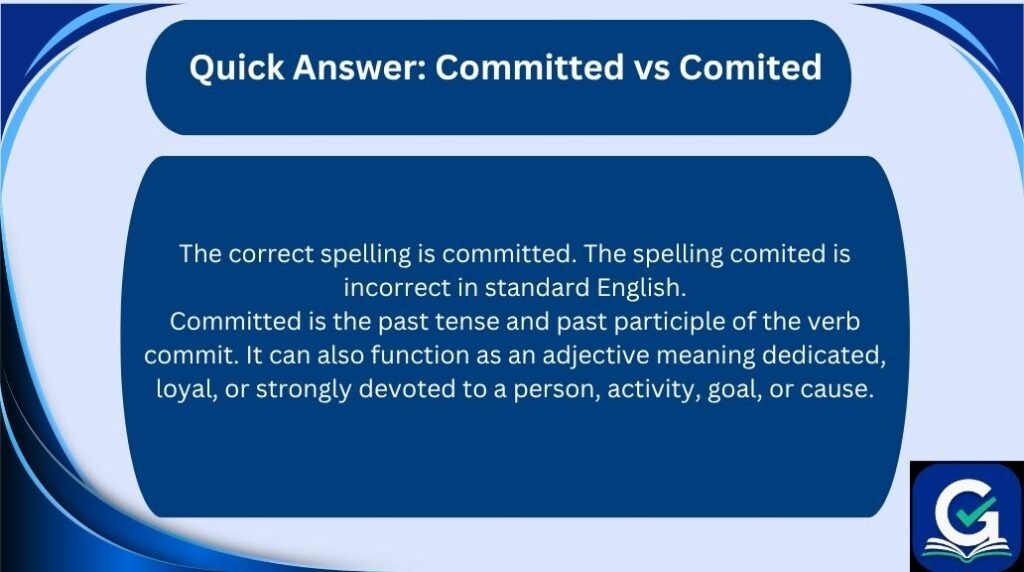
The correct spelling is committed. The spelling comited is incorrect in standard English.
Committed is the past tense and past participle of the verb commit. It can also function as an adjective meaning dedicated, loyal, or strongly devoted to a person, activity, goal, or cause.
Correct: She is committed to her career.
Incorrect: She is comited to her career.
The easiest way to remember the spelling is:
commit → committed
Notice the two t’s in committed.
Understanding the Basics of Committed vs Comited
The main difference between committed vs comited is that committed follows the standard English spelling rule, while comited leaves out a required t.
The base verb is commit. When you form its past tense or past participle, the final consonant is doubled before adding -ed:
commit + ed → committed
You should not remove one of the final t’s.
Comparison Table
| Form | Type | Meaning | Example | Correct/Incorrect |
|---|---|---|---|---|
| commit | Base verb | To dedicate, promise, or carry out an action | I commit to the plan. | ✅ Correct |
| commits | Third-person singular | Present form of commit | She commits to her goals. | ✅ Correct |
| committed | Past tense | Dedicated, promised, or carried out | He committed to the project. | ✅ Correct |
| committed | Past participle | Used with helping verbs | They have committed to the plan. | ✅ Correct |
| committed | Adjective | Dedicated or devoted | She is committed to her work. | ✅ Correct |
| comited | Misspelling | Not a standard English word | He is comited to the job. | ❌ Incorrect |
| committing | Present participle | The -ing form of commit | They are committing more resources. | ✅ Correct |
The table makes the difference simple: committed is the standard form, while comited is simply a spelling mistake.
Correct Meaning and Uses
Understanding what committed means can help you recognize when to use it.
The word can describe dedication, a promise, an action, or something that has been carried out. Its exact meaning depends on the sentence.
Committed Means Dedicated
One of the most common meanings of committed is dedicated or devoted.
For example:
She is committed to improving her English.
In this sentence, committed means that she is serious about improving her English and is willing to make an effort.
Other examples include:
- He is committed to his education.
- They are committed to helping their community.
- We are committed to providing excellent service.
- The team is committed to achieving its goals.
Sentence Breakdown
Consider this sentence:
The company is committed to customer satisfaction.
The company = subject
is = linking verb
committed = adjective
to customer satisfaction = phrase explaining the area of dedication
This structure is very common in business English.
Committed Means Promised or Dedicated
The verb commit can mean to promise or dedicate yourself to something.
For example:
I committed to finishing the project by Friday.
Here, committed means that I made a firm decision or promise to finish the project.
You can also say:
She committed herself to helping the organization.
The phrase committed herself emphasizes a strong personal dedication.
Committed Can Refer to Resources
The word can also describe money, time, staff, or other resources that have been allocated to something.
For example:
The company committed additional funds to the project.
Here, committed means that the company allocated or dedicated additional funds.
Another example:
We committed more time to training.
The meaning is that more time was devoted to training.
Committed Can Refer to an Offense
Another important use appears in legal and formal contexts.
For example:
The suspect committed a serious offense.
Here, committed means performed or carried out the offense.
You may see similar expressions such as:
- committed a crime
- committed an offense
- committed an error
- committed an act
The meaning changes according to the noun that follows it.
Committed in Romantic Relationships
In everyday English, committed is frequently used when talking about relationships.
For example:
They are in a committed relationship.
This means that the relationship is serious and that the people involved are dedicated to it.
You might also say:
She is committed to her partner.
Here, committed expresses loyalty, seriousness, and dedication.
Why “Comited” Is Incorrect
When comparing committed vs comited, the incorrect form is easy to identify once you understand the spelling pattern.
The word commit ends with t. When the suffix -ed is added, the final consonant is doubled:
commit → committed
The incorrect version is:
comited ❌
It removes one of the required t’s.
This is similar to other English words that double a final consonant:
- admit → admitted
- permit → permitted
- submit → submitted
- omit → omitted
- refer → referred
- prefer → preferred
Therefore, if you know how to spell commit, you can use that base word to remember the correct past form.
The Grammar Rule Behind Committed
English has several spelling rules for adding endings such as -ed and -ing.
In certain short verbs, the final consonant is doubled before the suffix. Commit is one of these verbs.
The result is:
commit + ed = committed
and:
commit + ing = committing
This means that the correct verb forms include:
- commit
- commits
- committed
- committed
- committing
Examples
I commit to my goals.
She commits to the schedule.
He committed to the agreement.
They have committed to the new plan.
We are committing additional resources.
The spelling does not become comited at any point in these standard forms.
Committed as a Verb
As a verb, committed is the past tense and past participle of commit.
Simple Past
She committed to the project yesterday.
The action happened in the past.
Present Perfect
She has committed to the project.
The present perfect uses has + committed.
Past Perfect
She had committed to the project before the meeting.
The past perfect uses had + committed.
Passive Construction
The funds were committed to the project.
Here, committed appears in a passive structure.
The spelling stays exactly the same in each case.
Committed as an Adjective
Committed can also be an adjective.
When it is an adjective, it usually describes someone who is dedicated or serious about something.
Examples:
He is a committed teacher.
She is a committed athlete.
They are committed volunteers.
We need committed employees.
In each sentence, committed describes a person.
This is an important distinction because the word does not always function as a verb. However, the spelling remains committed regardless of its grammatical role.
Common Phrase: Committed to
One of the most common structures is:
committed to + noun
Examples:
She is committed to her career.
He is committed to his family.
They are committed to quality.
The phrase can also be followed by an -ing form:
committed to + verb-ing
Examples:
She is committed to learning English.
He is committed to improving his writing.
We are committed to reducing waste.
This can sometimes confuse learners because they expect the word to to be followed by the base form of a verb. In the expression committed to, however, to functions as part of a prepositional phrase, so a gerund can follow it.
Committed vs Commitment
Another useful comparison is committed vs commitment.
Although these words are related, they have different grammatical functions.
Committed can be a verb form or adjective.
Commitment is a noun.
Compare:
She is committed to her work.
and:
She has a strong commitment to her work.
In the first sentence, committed describes her dedication.
In the second sentence, commitment names the dedication itself.
More Examples
- He is committed to the team.
- His commitment to the team is impressive.
- They are committed to the project.
- Their commitment to the project is clear.
Learning related words can help you understand vocabulary as well as grammar.
Case Study: A Professional Email
Imagine that an employee is writing an email to a manager.
Incorrect Version
Dear Mr. Smith,
I am fully comited to completing this project on time.
The meaning is clear, but comited is misspelled.
Correct Version
Dear Mr. Smith,
I am fully committed to completing this project on time.
The corrected version looks more professional and polished.
Why This Matters
A spelling error may seem minor, but professional writing often creates an impression of your attention to detail.
The correct spelling is especially important in:
- resumes
- cover letters
- business emails
- reports
- presentations
- proposals
- academic assignments
- professional websites
A single extra t can make the difference between a standard English word and a spelling error.
Common Mistakes With Committed
The committed vs comited confusion usually happens because the writer knows the word but does not remember its spelling pattern.
Fast Typing
Typing quickly can cause repeated letters to disappear.
For example:
committed → comited
The writer may not notice the missing t because the brain automatically understands the intended word.
Autocorrect
Autocorrect can fix some spelling errors, but you should not rely on it completely.
Different devices and applications have different dictionaries and settings. Some errors may remain unnoticed.
Lack of Knowledge
English learners may understand the meaning of commit but not know that the final consonant doubles before -ed.
Learning the word as a family can solve this problem:
commit → committed → committing → commitment
Reading Too Quickly
When proofreading, your brain may see what you intended to write instead of what is actually on the screen.
This is why reading your work slowly can help identify errors.
Similar English Spelling Confusions
The committed vs comited issue is similar to many other common English spelling mistakes.
| Confusion | Correct | Incorrect | Main Issue |
|---|---|---|---|
| committed/comited | committed | comited | Missing t |
| admitted/admited | admitted | admited | Missing t |
| occurred/occured | occurred | occured | Missing r |
| referred/refered | referred | refered | Missing r |
| planned/planed | planned | planed | Missing n |
| beginning/begining | beginning | begining | Missing n |
| its/it’s | its / it’s | — | Possession vs contraction |
| your/you’re | your / you’re | — | Possession vs contraction |
| their/they’re | their / they’re | — | Possession vs contraction |
These examples show why proofreading is valuable. English contains many words in which a single letter changes the correctness of a sentence.
Usage in Everyday Conversation
In everyday speech, people commonly use committed when talking about goals, relationships, work, and personal decisions.
Examples:
I’m committed to getting better.
She is committed to her studies.
He is committed to his family.
We are committed to making this work.
Because spelling is not visible in spoken conversation, you may not notice the difference when hearing the word. The distinction becomes important when you write it.
Usage in Professional Writing
Professional writing frequently uses committed because businesses and organizations often want to communicate dedication.
Examples include:
We are committed to providing high-quality products.
Our organization is committed to supporting employees.
The company remains committed to customer satisfaction.
The team is committed to meeting the deadline.
These sentences are common in business communication, company statements, reports, and marketing materials.
Using comited instead would create an unnecessary spelling error.
Usage in Creative Writing
Creative writers can use committed to describe a character’s determination or emotional attachment.
For example:
Despite every setback, Daniel remained committed to his dream.
Or:
She was deeply committed to protecting the people she loved.
The word can communicate persistence, loyalty, and emotional strength.
Usage in Social Media and Texting
Informal communication often contains spelling mistakes because people type quickly.
You might see someone write:
Staying committed! 💪
or:
I’m committed to becoming a better version of myself. ✨
Although texting is informal, using the correct spelling is still useful when writing public posts, captions, professional profiles, or business content.
Why Correct Spelling Matters
Knowing the difference between committed vs comited may seem like a small detail, but accurate spelling improves communication.
Clarity
Correct spelling makes your message easier to read.
Readers do not have to stop and wonder whether a strange-looking word is intentional.
Professionalism
Correct spelling creates a stronger impression in formal communication.
A correctly written email looks more polished than one containing avoidable spelling mistakes.
Credibility
Readers may judge the reliability of written information partly by its presentation. Frequent spelling mistakes can distract from otherwise useful content.
Confidence
Knowing the correct spelling helps you write more confidently.
Instead of stopping to wonder whether the word is correct, you can use it naturally.
Good writing is often built from small details.
Easy Ways to Remember “Committed”
If you frequently forget the spelling, try these memory tricks.
Remember the Double T
The simplest trick is:
commit → committed
Think of the word as:
coMMiTTed
It contains both double m and double t.
Remember the Word Family
Learn these forms together:
- commit
- committed
- committing
- commitment
This is easier than memorizing each form separately.
Write It Three Times
If a spelling repeatedly causes trouble, write the correct word several times:
committed
committed
committed
Then use it in a sentence:
I am committed to improving my English.
Repetition can reinforce visual memory.
Committed vs Comiting: Another Related Error
Some people also write comiting instead of committing.
The correct spelling is:
committing ✅
The incorrect form is:
comiting ❌
The same consonant-doubling pattern applies before -ing:
commit → committing
Compare:
- commit → committed
- commit → committing
Both forms retain the double t.
Test Tip: Use the Base Word
When you are uncertain, return to the base word.
Ask yourself:
What is the base verb?
The answer is:
commit
Now add the ending:
commit + ed
The result is:
committed
This method is more reliable than trying to guess whether one or two letters look right.
Quick Test
Which sentence is correct?
A. She is comited to her goals.
B. She is committed to her goals.
The answer is B.
Quick Recap Checklist
Use this checklist whenever you are unsure about the spelling.
| Question | If Yes → Use |
|---|---|
| Am I talking about the past form of commit? | committed |
| Am I using the past participle? | committed |
| Am I describing someone as dedicated? | committed |
| Am I talking about a serious relationship? | committed |
| Did I write “comited”? | Change it to committed |
| Am I forming the -ing version? | committing |
Practice 1
❌ The team is comited to winning.
✅ The team is committed to winning.
Practice 2
❌ She comited herself to the cause.
✅ She committed herself to the cause.
Practice 3
❌ We are comited to providing better service.
✅ We are committed to providing better service.
FAQs
1. Is “committed” or “comited” correct?
Committed is correct. Comited is an incorrect spelling. The correct word contains two t’s: committed.
2. Why does committed have two t’s?
The verb commit follows a consonant-doubling spelling pattern when the endings -ed and -ing are added. Therefore, the correct forms are committed and committing.
3. What does committed mean?
Committed can mean dedicated, devoted, or strongly determined. It can also be the past tense or past participle of commit, depending on the sentence.
For example:
She is committed to her career.
Here, it means dedicated.
4. Is comited a word?
No. Comited is not the standard English spelling of committed. If you mean the past form of commit, use committed.
5. How do you spell committed?
The correct spelling is:
C-O-M-M-I-T-T-E-D
A helpful visual memory trick is coMMiTTed.
6. What is the difference between commit and committed?
Commit is the base form of the verb, while committed is its past tense and past participle. Committed can also be an adjective meaning dedicated or devoted.
Examples:
I commit to the plan.
I committed to the plan yesterday.
I am committed to the plan.
Conclusion
When it comes to committed vs comited, the answer is straightforward: committed is the correct spelling, while comited is a misspelling. The word committed can work as the past tense or past participle of commit, and it can also be an adjective describing someone who is dedicated, loyal, or serious about something.
The most important spelling point is the double t: commit → committed. Remembering this simple pattern can help you avoid one of the easiest mistakes to make when writing quickly.
Whether you are preparing a professional email, school assignment, resume, website, or social media post, taking a moment to check the spelling can make your writing look much more polished. So whenever you hesitate between the two forms, choose the one with two t’s. Committed is correct—comited is not. ✅

I’m Ethan Carter, a grammar writer at Gramfino, where I explain English grammar in a simple and practical way.
I enjoy helping readers understand sentence structure, grammar rules, and common writing mistakes.
[…] and provide practical examples. By the end, the difference should be easy to remember. ✅ Committed vs Comited | Cozy vs. Cosy | Peak vs […]