Have you ever wondered whether cozy vs cosy is the correct spelling? You are not alone. This small spelling difference often confuses English learners, bloggers, students, and even experienced writers because both words have the same basic meaning: comfortable, warm, pleasant, and inviting.
The main difference is not meaning but regional spelling. Cozy is the standard form used in American English, while cosy is commonly used in British English. If you are writing for a US audience, cozy is usually the right choice. If you are following British English, cosy is the preferred spelling.
In this guide, I’ll explain the difference between cozy vs cosy, show you how to use both forms correctly, and give you simple examples so you never have to second-guess this spelling again. 🇺🇸🇬🇧 Peak vs Peek | Color vs Colour | Cringy vs Cringey
Quick Answer: Cozy vs. Cosy
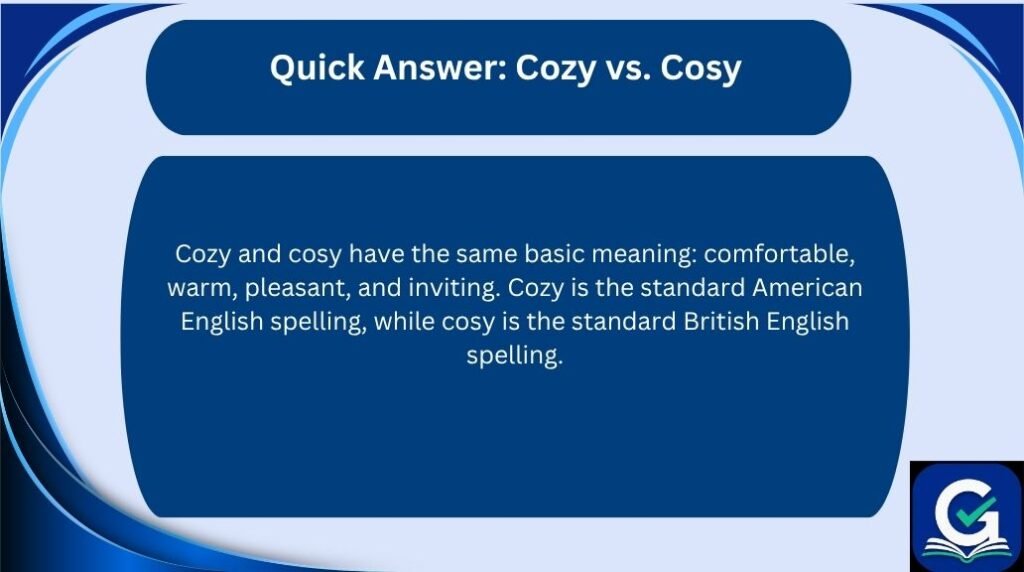
Cozy and cosy have the same basic meaning: comfortable, warm, pleasant, and inviting. Cozy is the standard American English spelling, while cosy is the standard British English spelling.
- 🇺🇸 US English: cozy
- 🇬🇧 UK English: cosy
- 🇨🇦 Canadian English: cozy is generally common, although usage can vary by context.
- 🇦🇺 Australian English: cosy is generally used.
- Meaning: comfortable, warm, pleasant, or inviting
Example:
The cabin is warm and cozy.
In British English, the same sentence would normally be:
The cabin is warm and cosy.
Neither spelling is inherently wrong. The important thing is consistency with the English variety you are using.
Understanding the Basics of Cozy vs. Cosy
The easiest way to understand cozy vs. cosy is to remember that they are spelling variants of the same word.
The pronunciation and core meaning are essentially the same. The main distinction is geographical rather than grammatical.
| Form | Type | Meaning | Example | Correct/Incorrect |
|---|---|---|---|---|
| cozy | Adjective | Comfortable, warm, pleasant, or inviting | The room feels cozy. | Correct in US English |
| cosy | Adjective | Comfortable, warm, pleasant, or inviting | The room feels cosy. | Correct in UK English |
| cozy | Noun | A warm cover or certain mystery-fiction genre | She bought a tea cozy. | Correct in US English |
| cosy | Noun | A warm cover or certain mystery-fiction genre | She bought a tea cosy. | Correct in UK English |
| cozy | Verb | To become comfortable or snug | We cozied up by the fire. | Correct in US English |
| cosy | Verb | To become comfortable or snug | We cosied up by the fire. | Correct in UK English |
Cambridge Dictionary lists cozy as the American spelling and cosy as the British spelling, while also recognizing adjective, noun, and verb uses.
The simplest rule
Think of it this way:
American English → cozy
British English → cosy
That one rule will solve most cozy vs. cosy questions.
What Does “Cozy” Mean?
In American English, cozy usually means comfortable, warm, pleasant, and inviting.
It is especially common when describing:
- homes
- bedrooms
- blankets
- cafés
- cabins
- fireplaces
- clothing
- atmospheres
- relationships
- relaxing environments
For example:
I love this cozy little café.
Here, cozy tells the reader that the café feels comfortable and inviting.
Another example:
We spent a cozy evening watching movies.
The word suggests a pleasant, relaxed experience.
Breaking down the sentence
Consider:
The apartment has a cozy atmosphere.
- The apartment = subject
- has = verb
- a cozy atmosphere = object phrase
- cozy = adjective describing “atmosphere”
The word does not describe something merely as physically small. It often suggests a feeling of warmth, comfort, intimacy, or pleasantness.
What Does “Cosy” Mean?
Cosy means the same thing as cozy, but it is the spelling traditionally associated with British English.
For example:
The cottage has a cosy fireplace.
This is perfectly correct in British English.
An American writer would normally write:
The cottage has a cozy fireplace.
The meaning has not changed. Only the spelling has.
Another example
British English:
We found a cosy little restaurant near the station.
American English:
We found a cozy little restaurant near the station.
Both sentences communicate essentially the same idea.
Cambridge specifically describes cosy as the UK spelling of cozy and defines it as comfortable and pleasant, especially when describing a small, warm building or room.
Is “Cozy” Correct in American English?
Yes. Cozy is the standard American English spelling.
If you are writing:
- a US blog post
- an American school assignment
- a business email for a US company
- an American novel
- website content for US readers
- social media content aimed at Americans
then cozy is usually the better choice.
Examples
- This blanket is so cozy.
- We stayed in a cozy cabin.
- The restaurant has a cozy atmosphere.
- I made my bedroom more cozy.
- Let’s get cozy by the fireplace.
For a US English audience, using cosy is not necessarily incomprehensible or grammatically wrong, but it may look distinctly British.
Is “Cosy” Correct in British English?
Yes. Cosy is the standard British English spelling.
You will commonly see it in writing from:
- the United Kingdom
- British publications
- British websites
- UK businesses
- British literature
- British educational materials
Examples
- This room is wonderfully cosy.
- We spent a cosy evening at home.
- She bought a cosy blanket.
- The pub has a cosy atmosphere.
- It was a cold but cosy winter evening.
Cambridge lists cosy as the UK form and cozy as its US equivalent.
Is “Cozy” or “Cosy” More Correct?
Neither is universally more correct.
The correct spelling depends on the variety of English.
If you are following American English, use cozy.
If you are following British English, use cosy.
This is similar to other spelling differences between American and British English:
- color / colour
- favorite / favourite
- organize / organise
- center / centre
- traveler / traveller
These differences do not necessarily indicate different meanings. They often reflect different spelling conventions.
Test Tip 📝
Ask yourself:
Who is going to read this?
If the answer is primarily American readers, choose cozy.
If the answer is primarily British readers, choose cosy.
This simple audience test works in most situations.
Cozy vs. Cosy in Everyday Conversation
In casual conversation, both forms are perfectly understandable.
An American might say:
My room is really cozy.
A British speaker might say:
My room is really cosy.
If you are speaking rather than writing, you usually will not notice the difference because the words are pronounced essentially the same.
The spelling becomes important when you write the word.
Common conversational examples
American English:
“This sweater is so cozy.”
British English:
“This jumper is so cosy.”
Notice that the spelling changes, but the idea remains the same.
Cozy vs. Cosy in Professional Writing
Professional writing requires consistency.
Suppose you are writing a US marketing campaign for a furniture company:
Create a cozy living room with soft lighting and comfortable furniture.
That spelling fits an American audience.
For a British furniture company, you might write:
Create a cosy living room with soft lighting and comfortable furniture.
Why consistency matters
Imagine a website repeatedly using:
cozy
colour
favourite
centre
The combination may look inconsistent because it mixes American and British spelling conventions.
A single mixed spelling is not always a serious error, but professional content generally looks more polished when it follows one consistent style.
Cozy vs. Cosy in Creative Writing
Creative writers have more flexibility.
If you are writing dialogue for a British character, cosy may be appropriate because it reflects British spelling.
If your story is written in American English, cozy is the natural choice.
Example
American-style narration:
She curled up in the cozy chair beside the fireplace.
British-style narration:
She curled up in the cosy chair beside the fireplace.
Both versions work.
The choice depends on the language style of the surrounding text.
Cozy vs. Cosy on Social Media and Texting
Social media is much more relaxed.
You may see:
Cozy night in 🕯️☕️
or:
Cosy night in 🕯️☕️
Both are easily understood.
However, if you are managing a professional brand, it is still wise to follow the spelling convention of your target market.
For a US brand:
Make your home cozy this fall. 🍂
For a UK brand:
Make your home cosy this autumn. 🍂
The spelling can help reinforce the brand’s regional identity.
Other Meanings and Uses of “Cozy” and “Cosy”
The words are not limited to describing rooms.
They can describe many different situations.
Comfortable clothing
These socks are incredibly cozy.
British:
These socks are incredibly cosy.
A pleasant atmosphere
The café has a cozy atmosphere.
British:
The café has a cosy atmosphere.
A relaxed experience
We had a cozy evening at home.
British:
We had a cosy evening at home.
A small, comfortable space
They rented a cozy cottage.
British:
They rented a cosy cottage.
A close or intimate situation
The word can sometimes describe an arrangement that is overly close or suspicious.
For example:
The two organizations have a cozy relationship.
This meaning can suggest that the relationship is excessively comfortable or close, sometimes in a way that raises concerns about fairness or independence.
Cambridge also records this disapproving sense of cozy/cosy, particularly for arrangements that are convenient for the people involved but may be questionable.
A Real-Life Case Study: Choosing the Right Spelling
Imagine you work for an American home-decor company.
Your marketing team creates this headline:
Create a Cosy Home This Winter
The sentence is understandable, but if your brand targets American customers, cosy may look inconsistent with the rest of your US English content.
A US-focused version would be:
Create a Cozy Home This Winter
Now imagine the same company is based in the UK and targets British customers.
In that situation:
Create a Cosy Home This Winter
is the natural choice.
Workplace lesson
The important question is not:
“Which spelling is the one true spelling?”
Instead, ask:
“Which English variety am I using?”
That is the practical solution to the cozy vs. cosy confusion.
Grammar Rules Behind Cozy vs. Cosy
The most important grammatical point is that cozy and cosy are not different grammatical forms.
They are spelling variants.
Both can function as adjectives.
As an adjective
The room is cozy.
The room is cosy.
Both describe the room.
As a noun
The word can also refer to certain objects or literary genres.
For example:
She bought a tea cozy.
In British English:
She bought a tea cosy.
Cambridge lists a “tea cosy” or “tea cozy” as a cover used to keep a teapot warm.
The word can also refer to a type of mystery fiction, often called a cozy mystery in American English and a cosy mystery in British English.
As a verb
The word can also be used as a verb in expressions such as cozy up or cosy up.
For example:
We cozied up by the fire.
British English:
We cosied up by the fire.
The exact inflection can vary according to the spelling convention being followed, but the underlying word is the same.
What Do Major Dictionaries Say?
Dictionary evidence supports the regional-spelling explanation.
Cambridge Dictionary identifies cozy as the US spelling of cosy and identifies cosy as the UK spelling of cozy.
Cambridge also defines the adjective as meaning comfortable and pleasant, particularly in relation to a small, warm space.
This means you should not treat one spelling as a simple spelling mistake.
Instead:
Cozy = American English
Cosy = British English
That is the key grammar and spelling rule to remember.
Why Do People Confuse These Spellings?
The confusion usually comes from exposure to different forms of English.
Someone in the United States may grow up seeing:
cozy
Then they encounter:
cosy
in a British book, website, or television program.
Naturally, they may wonder whether they have been spelling the word incorrectly.
The reverse can also happen.
A British writer may see cozy frequently on American websites and wonder whether the spelling has changed.
Neither writer necessarily made a mistake.
They are simply seeing different regional conventions.
Common Mistakes With Cozy vs. Cosy
Mistake 1: Assuming one spelling is always wrong
This is the biggest misunderstanding.
Cosy is not simply a misspelling of cozy.
Likewise, cozy is not simply a misspelling of cosy.
Both are established English spellings.
Mistake 2: Mixing regional styles
A writer may use American spelling in one paragraph and British spelling in another.
For example:
The room has a cozy atmosphere and a cosy fireplace.
This is understandable, but if the article is intended to follow one variety of English, the inconsistency is unnecessary.
Mistake 3: Trusting autocorrect blindly
Autocorrect may be configured for a particular regional dictionary.
Your device might automatically prefer cozy even if you are writing British English, or suggest cosy if your language settings use British English.
Mistake 4: Fast typing
When people type quickly, they often choose the spelling they see most often.
This is especially common when switching between American and British websites.
Mistake 5: Lack of knowledge about regional spelling
Many learners are taught “English” without being told that English has multiple standardized varieties.
Once you understand regional spelling, cozy vs. cosy becomes much easier.
Similar Spelling Confusions in English
The same kind of regional or grammatical confusion appears elsewhere.
| Confusion | Correct Use |
|---|---|
| color / colour | US / UK spelling |
| favorite / favourite | US / UK spelling |
| center / centre | US / UK spelling |
| organize / organise | US / UK spelling, depending on style |
| theater / theatre | US / UK spelling |
| its / it’s | Possession / contraction |
| your / you’re | Possession / contraction |
| there / their / they’re | Place / possession / contraction |
| cozy / cosy | US / UK spelling |
Notice that cozy vs. cosy is different from its vs. it’s.
With its/it’s, the two forms have different grammatical functions and meanings.
With cozy/cosy, the core meaning remains the same.
Cozy vs. Cosy in American English
Because this article uses US English, the preferred spelling throughout is cozy.
Examples include:
- cozy home
- cozy room
- cozy sweater
- cozy blanket
- cozy restaurant
- cozy café
- cozy atmosphere
- cozy evening
- cozy corner
- cozy cabin
- cozy mystery
For American readers, cozy will generally look more natural.
Cozy vs. Cosy in British English
British English normally uses cosy.
Examples include:
- cosy home
- cosy room
- cosy jumper
- cosy blanket
- cosy restaurant
- cosy atmosphere
- cosy evening
- cosy corner
- cosy cottage
- cosy mystery
The difference is primarily orthographic.
The pronunciation and basic meaning remain closely aligned.
Special Exception: “Cozy Mystery” and “Cosy Mystery” 📚
One interesting edge case is the mystery-fiction genre.
In American publishing and discussion, you will often see:
cozy mystery
In British English, you may see:
cosy mystery
Cambridge recognizes this specialized literary meaning: a type of crime or mystery story that is generally less graphic or frightening and often takes place in pleasant settings.
So if you are writing about this genre for a US audience, cozy mystery is the natural spelling.
If you are discussing British publishing conventions, cosy mystery may be preferable.
Another special use: tea cozy
The noun can refer to a cover placed over a teapot to keep the tea warm.
American English:
tea cozy
British English:
tea cosy
Again, the regional spelling changes, but the basic object does not.
Why Consistency Matters in Writing
At first glance, one letter may seem unimportant.
But consistency matters because readers quickly notice patterns.
Imagine reading a professional US website that uses:
cozy
in one section,
colour
in another,
favourite
somewhere else,
and
centre
later.
The reader may begin to wonder whether the content was written or edited by different people.
Consistency creates a sense of control and professionalism.
For content creators
If you write for a specific audience, establish your style before publishing.
For a US audience, choose:
cozy
For a UK audience, choose:
cosy
Then keep that choice consistent.
Why It Matters: Clarity, Professionalism, and Accuracy
You might think cozy vs. cosy is too small a detail to matter.
In casual texting, it probably is.
But in professional communication, spelling choices contribute to the overall quality of your writing.
1. Clarity
Using the expected regional spelling helps readers recognize your intended English variety.
2. Professionalism
Consistent spelling makes websites, reports, emails, and marketing materials look carefully edited.
3. Writing accuracy
Understanding regional spelling prevents you from “correcting” a word that is actually valid.
4. Digital communication
Online content reaches international readers. Knowing both forms helps you recognize that different spelling does not always mean different meaning.
“Good writing is not only about being correct; it is also about being consistent.”
That principle is especially useful when choosing between American and British spelling.
How to Remember the Difference
Here is an easy memory trick:
Think “US = Z”
American English uses:
cozy
with a z.
British English uses:
cosy
with an s.
You can connect this with another familiar example:
organize → American English
organise → British English
This is not a perfect rule for every English spelling difference, but it can help you remember this particular pair.
Quick memory sentence
US writers get cozy with Z. 🇺🇸
UK writers get cosy with S. 🇬🇧
Simple, memorable, and effective.
Quick Recap Checklist
Use this checklist whenever you are unsure.
| Question | If Yes → Use |
|---|---|
| Am I writing for a US audience? | cozy |
| Am I following American English? | cozy |
| Am I writing for a UK audience? | cosy |
| Am I following British English? | cosy |
| Am I writing about a US “cozy mystery”? | cozy |
| Am I writing in British publishing style? | cosy |
| Do I want consistent US spelling? | cozy |
| Do I want consistent UK spelling? | cosy |
Practice Example 1
Choose the correct form for US English:
The hotel room was warm and ___.
Answer: cozy
Practice Example 2
Choose the correct form for British English:
We spent a ___ evening beside the fireplace.
Answer: cosy
Practice Example 3
Choose the correct form for a US home-decor website:
Create a ___ reading corner.
Answer: cozy
Frequently Asked Questions About Cozy vs. Cosy
1. Is “cozy” or “cosy” correct?
Both are correct. Cozy is the standard American English spelling, while cosy is the standard British English spelling. The meaning is essentially the same.
2. Is “cosy” British or American?
Cosy is primarily British English. American English generally uses cozy instead. Cambridge identifies cosy as the UK spelling of cozy.
3. Is “cozy” American English?
Yes. Cozy is the standard American English spelling. It means comfortable, warm, pleasant, or inviting.
4. Do cozy and cosy have different meanings?
Usually, no. They have the same core meaning. The primary difference is spelling based on the variety of English being used. Both can also be used in certain noun and verb constructions.
5. Should I use cozy or cosy for a US website?
Use cozy if your website follows US English. This is especially appropriate for American marketing, blogs, business websites, and educational content.
6. Is “cozy mystery” spelled with an S or Z?
For American English, the usual spelling is cozy mystery. British English commonly uses cosy mystery. The phrase refers to a relatively gentle type of mystery or crime fiction.
Conclusion
The difference between cozy vs. cosy is simple once you know the rule. Both words describe something comfortable, warm, pleasant, or inviting, and both are legitimate English spellings.
The main difference is regional: cozy is the standard spelling in American English, while cosy is the standard spelling in British English.
If you are writing for readers in the United States, choose cozy. If you are following British English, choose cosy. The most important thing is to remain consistent throughout your writing.
So the next time you wonder whether a room is cozy or cosy, remember the simplest rule: US English gets the Z; British English gets the S. 🇺🇸🇬🇧
Different spelling, same comfort. Choose the form that matches your audience.

I’m Mason Reed, a grammar researcher at Gramfino, where I explore grammar rules and common English mistakes.
I turn my research into clear explanations and practical examples that readers can easily follow.

[…] the end, you should have no trouble choosing the correct form. ✍️ Cozy vs. Cosy | Peak vs Peek | Color vs […]