Have you ever written a word and suddenly wondered whether it should end in -ize or -ise? If so, you are not alone. The difference between standardized vs standardised can be confusing because both spellings appear in reputable English writing.
You may see “standardized” in American articles, textbooks, business documents, and websites, while “standardised” often appears in British English.
At first glance, the two words look like competing spellings, but the real issue is usually which variety of English you are using.
The good news is that there is a simple rule. Standardized is the standard spelling in American English, while standardised is commonly used in British English. Both forms come from the verb “standardize/standardise,” meaning to make something conform to a standard or make things consistent.
In this guide, I will explain the difference between standardized vs standardised, show you when to use each form, examine common mistakes, and give you practical examples for school, work, publishing, and everyday writing. ✍️ Memento vs Momento | Heard vs Herd | Flaky vs Flakey
Quick Answer: Standardized vs Standardised
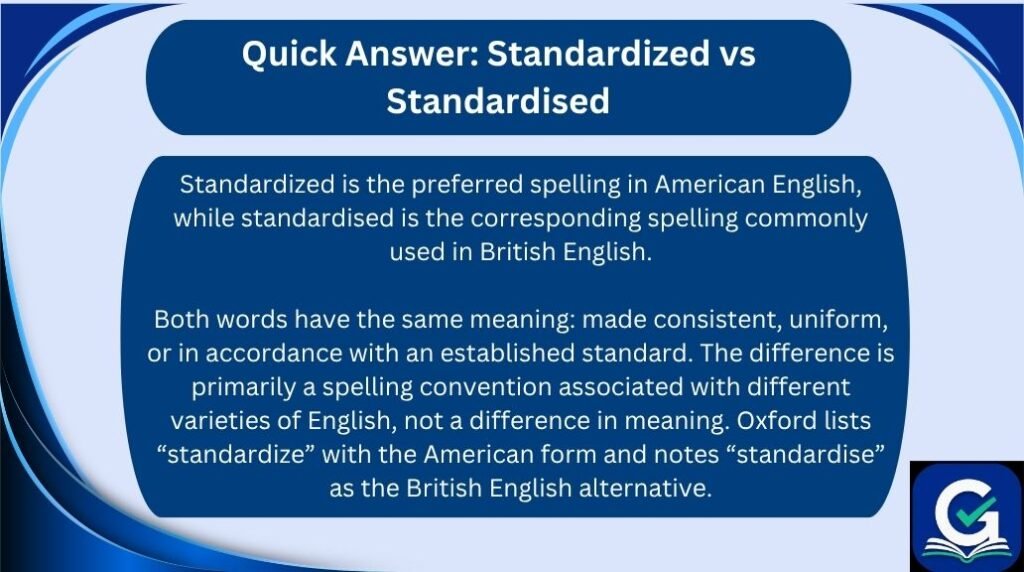
Standardized is the preferred spelling in American English, while standardised is the corresponding spelling commonly used in British English.
Both words have the same meaning: made consistent, uniform, or in accordance with an established standard. The difference is primarily a spelling convention associated with different varieties of English, not a difference in meaning. Oxford lists “standardize” with the American form and notes “standardise” as the British English alternative.
Examples:
- American English: “The company standardized its procedures.”
- British English: “The company standardised its procedures.”
So, if you are writing specifically for a US audience, use “standardized.”
Understanding the Basics
The easiest way to understand standardized vs standardised is to recognize the spelling pattern behind them.
The two forms use different endings:
- American English: -ize → standardized
- British English: -ise → standardised
The meaning remains the same.
Comparison Table
| Form | Type | Meaning | Example | Correct/Incorrect |
|---|---|---|---|---|
| standardized | Past tense/past participle | Made uniform or brought into conformity with a standard | “The test was standardized nationwide.” | Correct in American English |
| standardised | Past tense/past participle | Made uniform or brought into conformity with a standard | “The test was standardised nationwide.” | Correct in British English |
| standardize | Base verb | To make something conform to a standard | “We need to standardize the process.” | Correct in American English |
| standardise | Base verb | To make something conform to a standard | “We need to standardise the process.” | Correct in British English |
| standardizing | Present participle | Making something uniform | “The team is standardizing procedures.” | Correct in American English |
| standardising | Present participle | Making something uniform | “The team is standardising procedures.” | Correct in British English |
The Main Point
Neither spelling is automatically wrong.
The better choice depends on your English variety and audience.
If you are writing for readers in the United States, standardized is the natural choice. If you are following British English conventions, standardised is appropriate.
Oxford’s American dictionary entry gives standardize and standardized as the American forms, while its broader learner dictionary identifies standardise as the British alternative.
What Does “Standardized” Mean?
Standardized is the past-tense and past-participle form of standardize.
To standardize something means to make it follow a particular standard, method, format, or level of quality.
For example:
“The company standardized its customer service procedures.”
Here, standardized means that the company made its procedures more uniform. Instead of different employees following completely different methods, they now follow an established process.
Another example is:
“The researchers used standardized measurements.”
This means the measurements followed a consistent method.
Common Uses of “Standardized”
You will frequently see standardized in:
- Education
- Business
- Science
- Technology
- Healthcare
- Manufacturing
- Government
- Academic writing
- Professional communication
Consider these examples:
Education:
“The school introduced standardized testing.”
Business:
“The company standardized its hiring process.”
Science:
“The researchers used standardized procedures.”
Technology:
“The developers standardized the data format.”
Manufacturing:
“The factory standardized the production process.”
In all these examples, the central idea is consistency.
What Does “Standardised” Mean?
Standardised has the same meaning as standardized. The difference is spelling.
It is commonly associated with British English.
For example:
“The company standardised its internal procedures.”
This means exactly the same thing as:
“The company standardized its internal procedures.”
The spelling changes, but the meaning does not.
British English commonly uses -ise spellings in words such as:
- standardise
- standardised
- organise
- organised
- recognise
- recognised
- realise
- realised
American English generally uses:
- standardize
- standardized
- organize
- organized
- recognize
- recognized
- realize
- realized
This is part of a larger pattern of spelling differences between American and British English.
Why Do “-ize” and “-ise” Both Exist?
English has developed through centuries of interaction among different languages and regional writing traditions. As English evolved, spelling conventions became associated with different countries and publishing traditions.
The -ize/-ise distinction is one example.
American English generally favors -ize, particularly in words such as:
- standardize
- organize
- recognize
- modernize
- specialize
- finalize
British English uses -ise frequently:
- standardise
- organise
- recognise
- modernize
- specialise
- finalise
However, British spelling is more complicated than simply saying that every British word must use -ise. Some British dictionaries and publishers also use -ize in certain words. That is why it is better to think in terms of style conventions rather than a simplistic “right versus wrong” rule.
The important point for a US English writer is straightforward:
Use “standardized” when following American English conventions.
Standardized vs Standardised in American English
If your audience is primarily American, standardized is the safest and most natural choice.
For example:
“The organization standardized its training materials.”
This sentence fits conventional US English.
You might also encounter:
“The organization standardised its training materials.”
A US reader will probably understand it immediately, but the spelling may look distinctly British.
Why Consistency Matters
Suppose your article contains:
“The company standardized its policies.”
Later, you write:
“The company standardised its training materials.”
The reader can understand both sentences, but the inconsistent spelling may make your writing look poorly edited.
If your document follows American English, maintain the American spelling throughout.
Use:
- standardized
- standardize
- standardizing
- standardization
rather than switching unnecessarily between regional variants.
Standardized vs Standardised in British English
If you are writing according to British English conventions, standardised may be the preferred spelling.
For example:
“The new system standardised the reporting process.”
This is natural in British English.
Oxford identifies standardise as the British English form alongside the American standardize.
Therefore, British writers may naturally use:
- standardise
- standardised
- standardising
- standardisation
The key is to follow the spelling system appropriate to your audience, institution, publication, or style guide.
Is “Standardised” Wrong in American English?
Not necessarily.
It is better to call standardised a British spelling rather than simply calling it “incorrect.”
American English generally prefers standardized, but British spelling can appear in American writing when a writer is quoting a source, preserving an organization’s original wording, discussing British English, or intentionally following British style.
For example:
“The British report described how the system was standardised.”
Here, the British spelling may be completely intentional.
Better Rule
Instead of asking:
“Is standardised wrong?”
Ask:
“Which English variety am I supposed to use?”
That question gives you the more accurate answer.
Is “Standardized” Correct in British English?
Yes, standardized can appear in British English, particularly in publications or organizations that prefer the -ize convention.
However, many British contexts commonly use standardised.
This means you should not assume that one spelling is universally British and the other universally American in every context.
For a US-focused article, however, the practical recommendation remains simple:
Choose “standardized.”
Sentence Examples With “Standardized”
Here are several examples showing how the American spelling works in real sentences.
Example 1: Education
“The state introduced a standardized assessment for high school students.”
Breakdown:
- standardized = made according to a consistent standard
- assessment = a test or evaluation
- The phrase describes a test designed according to an established system.
Example 2: Business
“The company standardized its onboarding process.”
Breakdown:
- company = subject
- standardized = past-tense verb
- its onboarding process = object
The sentence says the company made its onboarding process consistent.
Example 3: Research
“The scientists used standardized equipment during the experiment.”
Here, standardized describes the equipment.
Example 4: Technology
“The software uses standardized data formats.”
Here, standardized is an adjective describing “data formats.”
Example 5: Workplace
“We standardized the reporting procedure last year.”
Here, standardized functions as the main verb.
Sentence Examples With “Standardised”
Now compare the British spelling.
Example 1
“The university standardised its examination procedures.”
Example 2
“The laboratory used standardised testing methods.”
Example 3
“The organization standardised its internal processes.”
The meanings are identical to their American counterparts.
The spelling changes because the writing convention changes.
A Useful Test Tip
Test Tip: Check Your Audience
When you are unsure whether to write standardized or standardised, ask:
Am I writing in American English or British English?
If the answer is American English, choose:
standardized
If the answer is British English, standardised is commonly appropriate.
You can also check nearby spelling choices.
For example, if your document already uses:
- organize
- recognize
- analyze
- specialize
then standardized will usually fit your spelling system.
If your document uses:
- organise
- recognise
- analyse
- specialise
then standardised may fit better.
The most important thing is consistency.
Case Study: A Workplace Email
Imagine that Maria works for a US-based technology company. She is preparing an email about a new company-wide process.
Her first draft says:
“We have standardised our reporting system to make monthly reviews easier.”
The sentence is understandable, but Maria’s company uses American English.
A more consistent version would be:
“We have standardized our reporting system to make monthly reviews easier.”
Now the spelling matches the company’s US English style.
Why This Matters
Maria is not changing the meaning of the sentence. She is simply aligning the spelling with the company’s preferred English variety.
Now imagine that Maria is preparing a report for a British client whose style guide uses -ise spellings.
In that situation, she may write:
“We have standardised our reporting system to make monthly reviews easier.”
Again, the meaning stays the same.
This example shows why context matters more than memorizing one form as universally correct.
Grammar Rules Behind the Difference
The words standardized and standardised are both forms of the same verb.
American Pattern
standardize → standardized
The verb ends in -ize, so the past tense is formed by adding -d:
standardize → standardized
British Pattern
standardise → standardised
The verb ends in -ise, so the past tense becomes:
standardise → standardised
The grammatical function is identical.
Both can function as:
- A past-tense verb
- A past participle
- An adjective, depending on sentence structure
Example as a Verb
“The company standardized the procedure.”
Here, standardized is a past-tense verb.
Example as an Adjective
“The company uses a standardized procedure.”
Here, standardized describes the procedure.
The same distinction applies to standardised.
What Dictionaries Tell Us
Dictionaries are useful because they document how words are spelled and used across varieties of English.
Oxford lists standardize as the American form and identifies standardise as the British English alternative. Its American dictionary entry gives standardize and standardized as the relevant American forms.
This supports an important principle:
English does not have only one worldwide spelling system.
American English and British English have several established spelling differences.
Merriam-Webster also emphasizes that English pronunciation and usage can contain legitimate regional variation rather than one universal form of every word.
So, when deciding between standardized vs standardised, the best approach is to consider your intended variety of English.
Common Mistakes With These Spellings
Why do people confuse these two forms?
Several everyday factors contribute to spelling mistakes.
1. Fast Typing
When people type quickly, they may use the spelling they see most often online.
A US writer may accidentally type “standardised” after reading many British websites.
2. Autocorrect
Autocorrect and grammar software can sometimes be configured for a particular regional dictionary.
For example, a device using British English may prefer standardised, while a US English setting may prefer standardized.
3. Lack of Knowledge
Some writers do not realize that American and British English use different spelling conventions.
They may assume that one spelling must be a typo.
4. Mixed Sources
Modern readers consume content from around the world.
You might read an American news site in the morning, a British academic article later, and an Australian website in the evening.
Naturally, different spelling patterns can become mixed in your writing.
5. Inconsistent Style Settings
A document can also become inconsistent when different writers collaborate.
One person may use American spelling while another uses British spelling.
Similar Grammar and Spelling Confusions
The standardized vs standardised issue belongs to a larger group of English problems.
| Confusion | Correct Forms | Main Difference |
|---|---|---|
| it’s vs its | it’s / its | Contraction vs possessive |
| your vs you’re | your / you’re | Possessive vs “you are” |
| they’re vs their vs there | they’re / their / there | Different grammatical functions |
| affect vs effect | affect / effect | Usually verb vs noun |
| then vs than | then / than | Time/order vs comparison |
| principal vs principle | principal / principle | Person/primary vs rule or belief |
| practice vs practise | practice / practise | US English usually uses “practice” for both; British English distinguishes noun and verb |
| color vs colour | color / colour | American vs British spelling |
| organize vs organise | organize / organise | American vs British spelling |
| standardized vs standardised | standardized / standardised | American vs British spelling |
These examples show that English variation is often systematic rather than random.
Usage in Different Contexts
The best spelling can depend on the situation.
Everyday Conversation
In casual conversation, you may not notice the difference because the two words are pronounced similarly.
For example:
“The process was standardized.”
Someone speaking British English may say:
“The process was standardised.”
The spelling difference is mostly visible in writing.
Professional Writing
Professional writing requires consistency.
If you are preparing:
- Business reports
- Resumes
- Cover letters
- Proposals
- Internal documents
- Presentations
use the spelling system expected by your organization or audience.
For a US company, standardized is generally the better choice.
Academic Writing
Academic writing should follow the required style guide.
If your professor, university, journal, or publisher specifies American English, use standardized.
If the publication follows British English, use the spelling required by that style.
Never switch between regional forms without a reason.
Creative Writing
Creative writers have more flexibility.
An author may intentionally use British spelling for a British character, setting, or publication.
For example:
“The council standardised the procedure.”
That spelling could help maintain a consistent British voice.
Social Media and Texting
Social media is generally more flexible.
People often write quickly, use informal language, or mix regional spelling conventions.
Still, if you are representing a business or professional brand, consistent spelling is preferable.
Why It Matters
At first, the difference between standardized vs standardised may seem tiny. After all, readers usually understand both.
But spelling choices can communicate important information about your intended audience and writing style.
1. Clarity
Consistent spelling makes your writing easier to process.
2. Professionalism
A document that consistently follows one style looks more carefully edited.
3. Accuracy
Using the appropriate regional spelling demonstrates awareness of English conventions.
4. Digital Communication
Websites, emails, reports, and online publications reach international audiences. A consistent spelling system helps establish a clear editorial identity.
5. Reader Expectations
American readers generally expect American spellings, while British readers may expect British conventions.
As a useful rule:
Good writing is not only about choosing correct words; it is also about choosing a consistent style for the people who will read them.
Special Exceptions and Edge Cases
There is no major brand-name exception that changes the basic meaning of standardized vs standardised, but there are important style variations.
Some British publishers and institutions prefer -ise, while others accept or prefer -ize in certain words.
Therefore, you should not assume that every British publication must use standardised.
Style Guides Can Override General Preferences
A company might have a house style that says:
“Use American English throughout all customer-facing content.”
In that case, use standardized, even if some international team members normally use British spelling.
Likewise, a British publisher may require standardised.
Proper Names
If an organization’s official name or quotation contains a particular spelling, preserve it.
For example, when reproducing a title, quotation, or official wording, do not silently change the spelling simply to match your preferred variety.
Standardized vs Standardised: What About “Standardization”?
The same regional spelling difference appears in the noun.
American English generally uses:
standardization
British English commonly uses:
standardisation
Compare:
“The standardization of procedures improved efficiency.”
with:
“The standardisation of procedures improved efficiency.”
Again, the meaning is the same.
Oxford lists standardization and notes standardisation as the British English spelling.
This is useful because it reveals the larger spelling pattern:
| American English | British English |
|---|---|
| standardize | standardise |
| standardized | standardised |
| standardizing | standardising |
| standardization | standardisation |
If you remember this pattern, choosing the correct form becomes much easier.
Standardized vs Standardised in SEO Content
For SEO writers, consistency becomes especially important.
Search engines can understand regional spelling differences, and both forms are legitimate in their respective varieties. However, your content should match its target audience.
If you are creating content specifically for readers in the United States, use:
standardized
If you are creating content specifically for a British audience, use the appropriate British convention.
SEO Best Practice
Do not force both spellings repeatedly into an article simply to target searches.
Instead:
- Choose the spelling that matches your audience.
- Mention the alternative naturally when explaining the difference.
- Use related semantic terms.
- Maintain consistent regional spelling.
- Answer the reader’s question directly.
For example, an article targeting US readers can naturally say:
“Standardized is the American spelling, while standardised is commonly used in British English.”
That answers the search intent without unnecessary repetition.
How to Remember the Difference
Here is a simple memory trick:
Think “Z” for American English
standardized
The Z helps you remember the American spelling.
Think “S” for British English
standardised
The S can remind you of the British spelling.
You can also connect it with other common pairs:
- organize → organise
- recognize → recognise
- realize → realise
- standardize → standardise
If your document consistently uses -ize, continue using that pattern.
If it consistently uses -ise, continue with that pattern.
Quick Recap Checklist
Use this checklist whenever you are unsure.
| Question | If Yes → Use |
|---|---|
| Are you writing for a US audience? | standardized |
| Are you following American English? | standardized |
| Are you writing for a British audience? | standardised is commonly appropriate |
| Does your organization’s style guide require -ize? | standardized |
| Does your publisher’s style guide require -ise? | standardised |
| Are you quoting a source? | Preserve the source’s original spelling |
| Are you mixing both forms in one document without a reason? | Choose one style and make it consistent |
Practice Example 1
Choose the American English spelling:
“The school introduced a ______ testing system.”
Answer: standardized
Practice Example 2
Choose the British English spelling:
“The company ______ its procedures last year.”
Answer: standardised
Practice Example 3
For a US business report, choose:
“The team has ______ the workflow.”
Answer: standardized
Frequently Asked Questions
1. Is “standardized” or “standardised” correct?
Both are established spellings. Standardized is the preferred form in American English, while standardised is commonly used in British English. The meaning is the same.
2. Which spelling should I use in American English?
Use standardized. It is the conventional American English spelling of the past tense and past participle of “standardize.” Oxford’s American dictionary lists “standardize” and “standardized” as the American forms.
3. Is “standardised” wrong?
No. Standardised is a legitimate spelling commonly associated with British English. It should not automatically be treated as a spelling error.
4. What is the difference between standardized and standardised?
There is no difference in basic meaning. Both mean made consistent, uniform, or in accordance with a standard. The main difference is regional spelling: American English generally uses standardized, while British English commonly uses standardised.
5. Should I use “standardized” in an American essay?
Yes. If your essay follows American English conventions, standardized is the natural choice. Also check your school’s or instructor’s required style guide.
6. How can I remember which spelling to use?
Remember Z for American English: standardized. For British English, standardised uses s. You can reinforce the pattern with pairs such as organize/organise and recognize/recognise.
Conclusion
The difference between standardized vs standardised is much easier once you stop thinking of it as a simple right-versus-wrong spelling problem. Both forms are valid within established varieties of English.
Standardized is the preferred spelling for American English, while standardised is commonly used in British English. Both describe something that has been made consistent, uniform, or compliant with an established standard.
If you are writing for a US audience, remember the simple rule: choose “standardized.” If you are following British English conventions, “standardised” may be the appropriate choice. Most importantly, stay consistent throughout your document.
Language has regional varieties, and good writers know how to work with those differences rather than treating every variation as an error. ✨
Remember: same meaning, different regional spelling—American English uses “standardized,” while British English commonly uses “standardised.”

I’m Ethan Carter, a grammar writer at Gramfino, where I explain English grammar in a simple and practical way.
I enjoy helping readers understand sentence structure, grammar rules, and common writing mistakes.


[…] you can use in real life. By the end, choosing the right word should feel much easier. 😊 Standardized vs Standardised | Memento vs Momento | Heard vs […]